Every interaction shapes what people believe about your brand. Whether it's through your website, in a sales conversation or across a campaign. And increasingly, in the answer an AI tool gives when someone asks which company to trust.
Brand strategy gives those moments a shared direction. It brings your purpose, positioning, personality, messaging, and visual identity together into a system that helps people understand who you are, why you matter, and what they can expect from you.
That consistency has a measurable impact. Nearly 9 in 10 consumers say trust matters as much as price or quality when making a purchase decision. Yet without a clear strategy, brands often send mixed signals, lose time to internal misalignment, and struggle to stand apart, even when the product or solution they offer is exceptional.
This guide explores the essential elements of brand strategy, the differences between B2B and B2C approaches, and a practical five-step process for creating a strategy your team can use to make stronger decisions and build lasting trust.
Key Takeaways
- Brand Strategy Is One Connected System Brand strategy connects purpose, positioning, personality, story, and visual identity into one consistent system, not a series of disconnected decisions.
- Trust Now Rivals Price and Quality as a Purchase Driver: Nearly 9 in 10 consumers say trusting a brand matters as much as price or quality, making brand strategy a growth driver rather than a design exercise.
- Strong Brand Strategy Starts with Clear Ownership:More mature brands typically give one senior leader ownership while gathering input from the broader team.
- The Elements Stay the Same, but B2B and B2C Weight Them Differently: The core elements of brand strategy don't change between B2B and B2C, but proof points, sales cycle length, and personality risk tolerance do.
- Strategy Only Pays Off Once It's Activated: A documented strategy only creates value once it's active in your website, content, and search/AI visibility. Execution is where most brand strategies succeed or quietly fail.
What Is Brand Strategy?
Brand strategy defines how your brand is positioned, perceived, and experienced over time. It shapes your identity and differentiates you from competitors by spelling out who you are, who you serve, and why you exist.
A strong brand strategy connects purpose, positioning, messaging, and experience into a unified system. It ensures that what you say, what you display, and what you deliver all reinforce the same, consistent story.
Effective brand strategy typically includes:
Brand strategy is not a one-time exercise. It is a living system, informed by clear brand guides and governance frameworks, that evolves as markets shift, customers change, and organizations grow.
Why Brand Strategy Is So Important
Brand strategy provides clear direction when navigating complex decisions. Instead of making isolated marketing decisions, you’re operating from a shared framework that guides what to say, how to say it, and where to focus.
- Internally - Brand strategy aligns teams around a common vision. When everyone understands the bigger picture, campaigns move faster, messaging stays cohesive, and resources are invested with intention rather than guesswork.
- Externally - A strong brand strategy is what separates you from competitors. It clarifies your unique value in a crowded market and ensures your audience hears a consistent, compelling message across every touchpoint.
That consistency becomes a competitive advantage. It strengthens recognition, builds confidence, and helps your brand stand out when customers are deciding who to trust, engage, or buy from. In a McKinsey survey of 500 senior marketing decision-makers, branding ranked as their number-one priority for 2026, ahead of topics including budget management, data-driven marketing, and generative AI. The finding reflects a renewed focus on brand as a foundation for differentiation and long-term growth.
Not Sure Where Your Brand Strategy Is Falling Short? Book a Free Consultation
The Role of Leadership in Brand Strategy
Brand strategy often starts at the top.
We’ve found that a strong brand strategy is closely tied to strong leadership and vision. While many organizations involve teams in the process, strategy is most often developed by senior leadership with team input. This model was cited by 42 percent of respondents in Fratzke’s 2026 Brand Playbook, while only 27 percent described a fully co-created approach.
More mature organizations tend to lean toward leadership-led strategy, with leaders setting direction and teams executing with clarity. Less mature organizations are more likely to co-create out of necessity, often because a clear vision has not yet been established.
The takeaway is not that collaboration is bad. It is that leadership matters. When brand strategy lacks a clear owner or vision, execution suffers and satisfaction drops.
The brands that get this right treat brand strategy as an essential business function, and not just a design exercise. Someone has to own the vision, or every team will fill the gap with their own interpretation." - Ryan Fratzke, Partner & Executive Strategist
Core Elements of a Strong Brand Strategy
A strong brand strategy isn’t built on guesswork. There are foundational elements every brand needs, and how you define and express them should be shaped by your audience. The brand elements outlined below should reflect what your customers care about, how they think, and what motivates them to choose you.
Brand Purpose
Brand purpose answers a fundamental question: why does your brand exist? It is the underlying reason your organization shows up in the world. A clear purpose anchors decision-making, guides communication, and provides long-term direction. It ensures your brand is not only selling a product or service, but standing for something meaningful to the people you serve.
Core Values
Core values shape how your brand behaves and connects with others who share the same values. With an internal culture, external messaging, and consistency, you can shape how customers experience your organization. Values are most powerful when customers see you living your values rather than just saying you have them.
Brand Personality
Brand personality defines how your brand feels. At Fratzke, we use the brand archetype model to help organizations identify and clarify this personality. Rooted in Carl Jung’s psychology, archetypes reflect universal character types such as the Hero, Caregiver, Explorer, or Sage. These archetypes are recognizable and emotionally resonant because they mirror patterns people intuitively understand.
Great brands do not just communicate features. They feel human. Archetypes give brands a clear and consistent personality that shapes voice, design, and storytelling.
Brand Voice and Tone
Personality shows up in language through voice and tone. Voice is your brand's consistent personality on the page: the words you choose, the rhythm of your sentences, the level of formality. Tone is how that voice flexes by context, more measured in a research report, warmer in a customer email, sharper in a social caption.
A brand strategy should define both clearly enough that any writer on your team, or any partner agency, can sound like you without guessing.
Brand Story
Your brand story connects purpose, values, and personality into a narrative people can understand. It explains who you are, what you believe, and how you create value. An honest brand story provides context for your positioning and gives customers a reason to care, rather than exaggerating what the brand can deliver.
Brand Positioning
Brand positioning defines where you stand in the market and why that position matters. It includes your unique value proposition and the proof points that support it. Who is your brand for, and what problem does it solve? Do all of your communications point to solving that problem?
Without clear positioning, brands drift toward generic messaging. With it, teams have a reference point for pricing, messaging, partnerships, and product development.
Brand Visual Identity
Visual identity translates strategy into something tangible. This includes logo systems, color palettes, typography, photography style, and design principles. A cohesive visual identity reinforces recognition and signals professionalism.
Strong visual systems make it easier for teams to scale content while maintaining consistency.
See How Fratzke Helped Xperi Strengthen Their Brand Strategy. Read the Case Study.
Brand Strategy for B2B vs. B2C: What's the Difference?
The core elements of brand strategy, purpose, positioning, personality, story, and visual identity, don't change based on who's buying. How those elements get built and where they carry the most weight does.
Who's actually making the decision. A B2C purchase is often one person, deciding quickly, sometimes on impulse, often driven by emotion as much as logic. A B2B purchase usually runs through a buying committee: a champion, a budget holder, an end user, sometimes procurement or legal. B2B brand strategy has to hold up across all of those perspectives, not just the one most excited about the idea.
What counts as proof. Consumer brands can lean on reviews, social proof, and cultural relevance to build trust quickly. B2B buyers want to see the same enthusiasm backed by something sturdier: case studies, credentials, references, and evidence that the provider has solved this exact problem before. Fratzke's own checklist for building authority (proprietary research, client results, third-party validation) matters in both worlds, but B2B buyers lean on it harder before they'll take a meeting.
How much room there is for personality. Consumer brands can go all-in on an archetype. Nike fully commits to the Hero. Chanel fully commits to the Lover. B2B brands still need a distinct personality (a category full of interchangeable, jargon-heavy voices is exactly how brands become forgettable) but that personality has to coexist with credibility.
How long the strategy has to hold. A B2C purchase might happen in a single session after one well-timed ad. A B2B sale can take months, touching a website, a sales deck, a proposal, a follow-up email, and a handful of meetings along the way. Brand strategy in B2B isn't judged by one great campaign. It's judged by whether the story stays consistent across every one of those touchpoints, because a buying committee that's already nervous about risk will notice the first crack.
Fratzke works with hundreds of brands across both worlds, from consumer brands like Razer and REI to B2B organizations like TopBuild, DTS, and TiVo, and the biggest mistake we see is treating one playbook as universal. A B2C-style campaign voice can undercut credibility with a wary procurement team. A B2B-style case-study-heavy approach can feel cold and transactional to a consumer making an emotional purchase. The starting point is always the same question: how does this specific audience actually decide?
If your organization sells primarily to other businesses, we go much deeper on this in B2B Branding: How to Build a Brand that Drives Growth, including how to build a brand that stays memorable, earns trust before the first sales call, and moves a whole committee toward "yes."
How to Build a Brand Strategy That Works
Building an effective brand strategy requires discipline, data-backed research, and implementation. It also requires a willingness to challenge assumptions.
1. Understand Your Audience
Brand strategy starts with understanding the people you are trying to reach. This includes customer needs, motivations, behaviors, and decision drivers. Research methods like surveys, interviews, and focus groups help uncover patterns that inform positioning and messaging.
Without this foundation, brand strategy is often built on a set of assumptions that have not been tested. Fratzke is passionate about using customer insights to develop a strategy. We conduct market research and build customer personas to give you a detailed view of what your customers seek.
2. Define a Clear Market Position
A clear position explains how your brand is different and why that difference matters. Many brands struggle here. In Fratzke’s 2026 Brand Playbook, teams that reported lower satisfaction with their brand strategy often cited unclear positioning and inconsistent execution as challenges.
The cost of getting this wrong shows up directly in buyer behavior: a Gartner survey found that when technology buyers can't tell providers apart, they default to a more established competitor, delay the purchase, or walk away with no decision at all. Strong positioning is specific, defensible, and rooted in customer value.
3. Align Messaging and Experience
Messaging should reflect your position and purpose across every touchpoint. Your tone should reflect your brand’s personality and history, strengthening the relationship with your audience through every piece of written communication.
This includes marketing, sales, product, and customer experience. When messaging and experience are misaligned, trust erodes quickly. Brand strategy creates the framework that keeps these elements working together.
4. Design for Consistency and Flexibility
Brand systems should be consistent enough to build recognition and flexible enough to evolve. Research shows that organizations that maintain strong brand consistency see a 10-20% lift in top-line revenue.
Clear guidelines help teams execute confidently while leaving room for adaptation as channels and audiences change.
5. Measure, Learn, and Refine
Brand strategy is not static. Regularly reviewing performance, customer feedback, and competitive context helps teams refine strategy over time. This ongoing process is often where organizations see the biggest gains.
Turning Brand Strategy Into Action: Where Digital Fits
A brand strategy only creates value once it's active in the places your customers actually look. That means your strategy has to hold up on your website, in search results, in paid and organic content, and increasingly, in how AI tools describe your brand when someone asks.
A few places brand strategy shows up in digital execution:
- Website experience - your positioning and voice should be legible in the first five seconds someone lands on your homepage, not buried three clicks deep. A website built around your strategy does more of the convincing before a sales conversation ever starts.
- Search and AI visibility - traditional SEO still matters, but so does how large language models summarize your brand when a prospect asks an AI assistant for a recommendation. Strategy informs the language you want repeated back, whether by a search engine or a chatbot. Fratzke's AI Search services help brands ensure they are showing up consistently and accurately across generative search answers.
- Content and channel consistency. Every blog post, ad, and social caption is a small proof point for your positioning. Digital marketing execution is where brand strategy either gets reinforced daily or slowly diluted.
Your brand strategy sets the direction. Digital execution across touch points brings your brand story to life for your customers. Skipping the second step is one of the most common reasons a strong strategy underperforms. The best way to understand if your brand strategy is being executed well is to perform a brand audit. You can learn more about Brand Audit best practices in our article: Brand Audit: A Complete Guide to Evaluating and Strengthening Your Brand.
Need Help Activating Your Brand Strategy? Explore Fratzke's Digital Marketing Services
Why Organizations Partner with Outside Experts
Many teams turn to external partners to strengthen brand strategy, not because they lack internal talent, but because they need perspective.
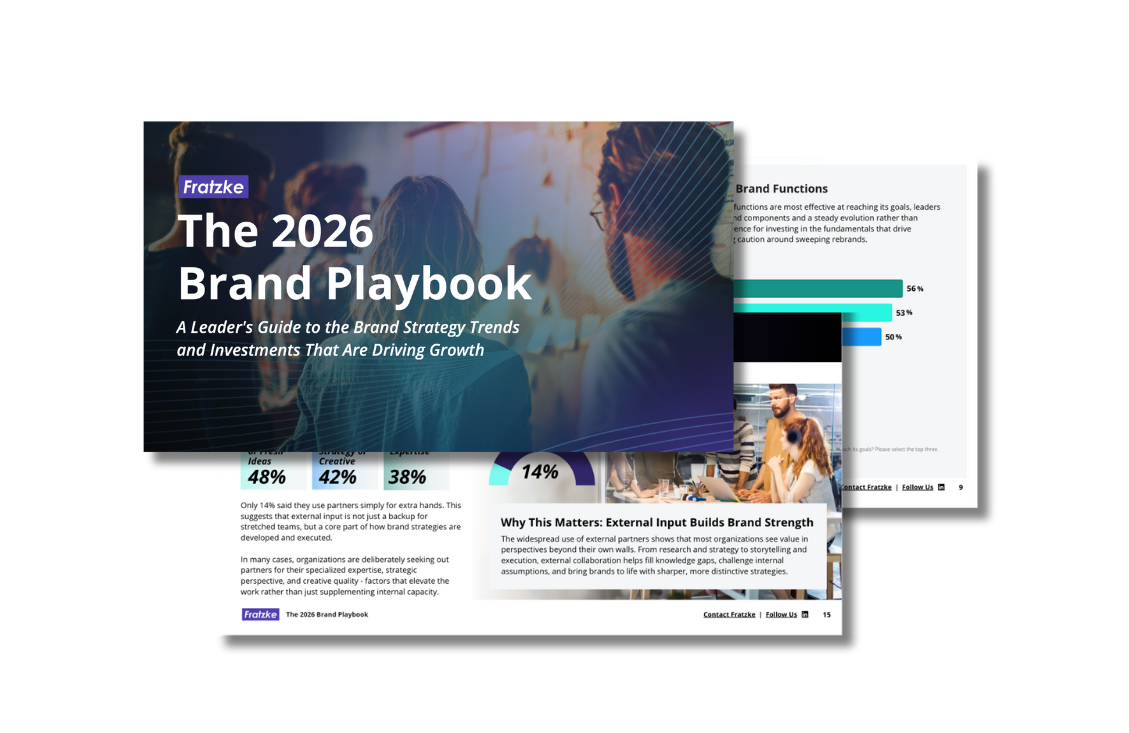
We found that only 14 percent of organizations use partners simply for extra capacity. Nearly half, 48 percent, said they needed an outside perspective, while 42 percent sought a higher quality strategy.
This highlights an important shift. External partners are valued for their ability to challenge assumptions, bring clarity, and elevate strategic thinking.
Fratzke’s Approach to Brand Strategy
Fratzke works collaboratively with clients to develop brand strategies rooted in purpose, insight, and storytelling that connects. Our work spans:
- Research-driven brand strategy development
- Brand purpose and positioning
- Voice and messaging frameworks
- Visual identity and logo systems
- Brand portfolio planning
We bring a human-centered approach to every engagement, working closely with teams to understand assumptions, gaps, and opportunities. The goal is not just a strategy document, but a strategy that teams can actually use.
Turn Brand Strategy into Consistent Growth
Building a strong brand strategy is not about getting everything right the first time. It is about listening closely, asking better questions, and making informed choices that reflect how customers think, feel, and decide. Discovering what your customers actually want is the first step. With market research and detailed customer personas, you can build a brand strategy that helps you meet your ROI goals.
Brand strategy is most effective when grounded in real customer insights and reinforced by clear leadership and execution. Our data-backed, human-centered approach helps organizations define who they are, how they are different, and why that difference matters to the people they want to reach.
If you are ready to move beyond assumptions and build a brand strategy that drives growth, we are here to help. Get Your Free Consultation
Frequently Asked Questions
What's the difference between brand strategy and brand identity?
Brand strategy is the thinking: your purpose, positioning, values, and voice. Brand identity is the expression of that thinking, your logo, colors, typography, and visual system. Identity without strategy is decoration. Strategy without identity never becomes tangible to customers.
How long does it take to build a brand strategy?
Timelines vary by organization size and how much research is required, but most engagements run 6 to 12 weeks from discovery through a documented strategy and roadmap. Complex, multi-brand organizations can take longer.
Who should own brand strategy inside an organization?
Fratzke's research found that strategy works best with a clear leadership owner, typically a CMO, VP of Brand, or CEO at smaller companies, who sets direction with input from the broader team. Fully co-created strategy without a clear owner tends to correlate with lower satisfaction and slower execution.
How often should a brand strategy be revisited?
Most organizations should formally revisit brand strategy every 2 to 3 years, or sooner if there's a major market shift, a merger, a new competitive threat, or consistent gaps between how the brand intends to show up and how customers actually perceive it.
Should brand strategy be developed internally or with an outside partner?
Both can work. Fratzke's research shows the top reasons organizations bring in outside help are a fresh, unbiased perspective (48%) and a higher standard of strategic quality (42%), not simply a lack of internal bandwidth. The right choice depends on how close your internal team can get to an objective view of the brand.