

B2B website design is the practice of building business-to-business websites that offer guidance and brand appeal to multiple stakeholders evaluating which company to choose in a research-heavy buying cycle.
B2B website design is not a coat of paint to make a brand look pretty. It is the architecture that determines whether a six-person buying committee can find what they need, build internal confidence, and choose to take the next step with your team.
Unlike B2C, where the site's job is to convert a single buyer, B2B web design exists to assist committees, provide clarity amidst months of evaluation, and earn a conversation rather than close a transaction.

We've worked on B2B redesigns where the win wasn't a prettier homepage but a clearer path for a buying committee that couldn't find pricing, couldn't locate proof, and couldn't figure out who the product was for. Learn about the best practices, a reusable evaluation process, and a step-by-step guide to getting B2B web design right in 2026.
What Makes B2B Website Design Different from B2C
B2B web design is its own discipline, not a more serious version of B2C design. The fundamental difference is who is buying, how they decide, and what the website needs to accomplish to move them forward.
In B2C, one person visits a site, evaluates a product, and either buys or leaves. In B2B, a typical purchase involves a buying group of six to ten people who research independently, build consensus, and then engage with a vendor. The same Gartner data finds that a majority of B2B buyers describe their most recent purchase as complex or difficult.
That complexity is the driver of creating a B2B web design brief that makes it simple to choose your brand.
- Decision Makers: B2B involves a buying committee of several stakeholders. B2C is usually a single buyer.
- Sales Cycle: B2B is long, research-heavy, and non-linear. B2C is short and often completed in the same session.
- Primary Job of the Site: B2B sites exist to educate, build trust, and earn a conversation. B2C sites exist to drive an immediate purchase.
- Content that Matters Most: In B2B, that means case studies, specs, proof, and documentation. In B2C, it's product imagery, reviews, and fast checkout.
Higher price points mean buyers do more due diligence before engaging. They want to understand pricing, available options, and compliance requirements before speaking with a sales representative.
And because the buying journey is non-linear, any page can be an entry point. Every page needs to stand on its own and move that persona toward the next step.

Why B2B Website Design Matters More Than Ever in 2026
The buying journey has moved online faster than most B2B companies have updated their sites. Gartner reports that buyers spend only 17% of their total purchase journey meeting with potential suppliers. When multiple vendors are under consideration, each gets less than 6% of the research time.
Deals increasingly stall not because of price or product, but because one committee member couldn't find the answer they needed and stopped championing the deal internally. The site's inability to support consensus is a pipeline problem, not a design problem.
Interaction to Next Paint (INP) is now a Core Web Vital, and Google's own research links Core Web Vitals improvements directly to conversion rate gains. A well-designed B2B website in 2026 shortens sales cycles, reduces rep burden, and helps buying committees build internal confidence before a first call.
B2B Website Design Best Practices
The following practices reflect how high-performing B2B sites are actually built, not a generic web design checklist. Each one addresses a specific failure mode we see in real redesign audits.
- Clear value proposition and positioning
- Buyer-led navigation, not org-chart-led
- Trust layer embedded in the conversion path
- Guided content for every buying stage
- One clear CTA per page
- Fast, stable, mobile-first performance
- WCAG accessibility conformance
- AI-mediated discovery optimization (nice-to-have, increasingly required)
Lead with a Clear Value Proposition and Positioning
Vague messaging is the most common conversion killer on B2B websites. Your hero headline and subhead should do three things. Name the outcome you deliver, specify the customer you serve, and differentiate from the obvious alternative.
"We help enterprise logistics teams reduce dwell time by 30% without replacing their TMS" converts better than "Modern solutions for modern supply chains."
Stripe's homepage is a clean benchmark. You know what they do, who it's for, and why it matters before any marketing abstraction enters the picture. Clarity wins qualified conversions, and clever wins design awards.
Design Navigation Around Buyers, Not Your Org Chart
Navigation organized around internal product names or team structures is one of the most reliable red flags in a B2B audit. A VP of Operations doesn't search for "Platform Module 4." They search for "inventory management for distribution."
Information architecture built around buyer evaluation paths, by use case, industry, or persona, routes stakeholders to relevant content without requiring them to decode internal naming. Salesforce's industry pages and Asana's role-based navigation are both worth studying for how this scales.
Build Trust Into the Page with Proof
Proof is a conversion element in B2B, not a secondary page. Quantified outcomes, named customer logos, short testimonials with a specific claim, and visible security certifications need to live where buying decisions form, such as the homepage, solution pages, and pricing pages.
Treat proof as part of your conversion architecture from the start of a redesign, not something you populate at the end. Our recent website redesign with TopBuild Home Services focused on establishing industry authority through elevated navigation, polished content, and industry-specific language.
Provide Guided Content for Every Stage of the Journey
B2B buyers do not move linearly from awareness to purchase. They circle back, bring in new stakeholders, and compare vendors on review sites.
Awareness-stage buyers need thought leadership and explainer content that frames the problem. Evaluation-stage buyers need case studies, comparison pages, and integration documentation. Decision-stage buyers need pricing transparency and a clear path to talk to someone.
The goal is to keep evaluation on-site rather than pushing buyers to G2, TrustRadius, or a competitor's comparison page.
Treat Conversion as UX
Every page should have one clear primary action and secondary actions matched to buyer intent. A reader on a thought leadership article is not ready for "Request a Demo." A visitor on a pricing page probably is.
Mismatched CTAs create confusion that kills conversions. Keep forms short, apply progressive profiling to collect data across multiple visits rather than all at once, and set expectations after submission. Who will contact them, in what timeframe, and what the conversation will cover.
Make It Fast, Stable, and Mobile-First
Page speed is a B2B conversion lever. Google's research shows that bounce probability increases 32% as load time grows from one to three seconds. The three Core Web Vitals benchmarks are LCP under 2.5 seconds, INP under 200ms, and CLS under 0.1.
B2B research on mobile happens more often than most teams assume, during commutes, between meetings, and after hours. A site that passes desktop QA but fails INP on mobile is losing buyers.

Make It Accessible
WCAG 2.1 AA conformance is a legal risk mitigation and a signal of organizational professionalism. Accessibility lawsuits targeting commercial websites have increased steadily, and enterprise procurement teams increasingly require vendors to meet accessibility standards.
Accessible sites also tend to be cleaner and more parseable by search crawlers, so the investment compounds across SEO and UX. Proper heading hierarchy, sufficient color contrast, keyboard navigability, and descriptive alt text are the baseline, not optional.
Design for AI-Mediated Discovery
AI search tools, including ChatGPT, Google's AI Overviews, and Perplexity, are now a meaningful source of B2B buyer research. Structuring your site to be discoverable and citable by these systems is a 2026 competitive advantage.
Check the boxes on a crawlable HTML, answer-first copy that leads each section with the most important fact, structured schema markup (FAQPage, Product, Organization), and key facts in text rather than images.
For a deeper look at how to optimize for AI search, see Fratzke's insights on digital marketing strategy.
A Framework for Evaluating (and Designing) a B2B Website
Our B2B Website Effectiveness Scorecard gives teams a structured way to audit an existing site or evaluate a redesign. Run it before a redesign to identify what's broken, and after to confirm what was fixed.

- Messaging Clarity. A first-time visitor can describe what you sell and who it's for within seconds.
Check message clarity: show the homepage to someone unfamiliar with the company for five seconds and ask them to describe the business.
- Buyer-Led Navigation. IA mirrors how buyers evaluate by role, use case, or industry, not your org chart.
Check ease of navigation: map the nav against your ICP's evaluation questions and see if answers are findable without decoding internal naming.
- Trust layer. Logos, quantified outcomes, and compliance proof are visible early.
Check established authority: audit the homepage and top solution pages for proof placement within the first scroll.
- Conversion paths. One clear primary action per page, matched to buyer intent, with short forms.
Check that CTAs make sense: review every key template for CTA alignment and form field count.
- Performance and technical UX. Fast and stable on mobile; meets Core Web Vitals including INP.
Check website performance: run PageSpeed Insights and Google Search Console's Core Web Vitals report.
- Content and discoverability depth. Comparison, integration, docs, and FAQ content keep evaluation on-site.
Check content for concise answers: verify that buyers can answer "How does this compare to X?" and "Does it integrate with Y?" without leaving the site.
- AI and search visibility. Crawlable, answer-first, schema-marked content that AI search can cite.
Check schema and AI visibility metrics: run a Screaming Frog crawl and review key pages for answer-first structure and schema implementation.
B2B Website Design Examples Worth Studying
The following sites were chosen for specific things they do well, each evaluated against scorecard criteria, with one tactic you can apply directly.
- HubSpot (SaaS)
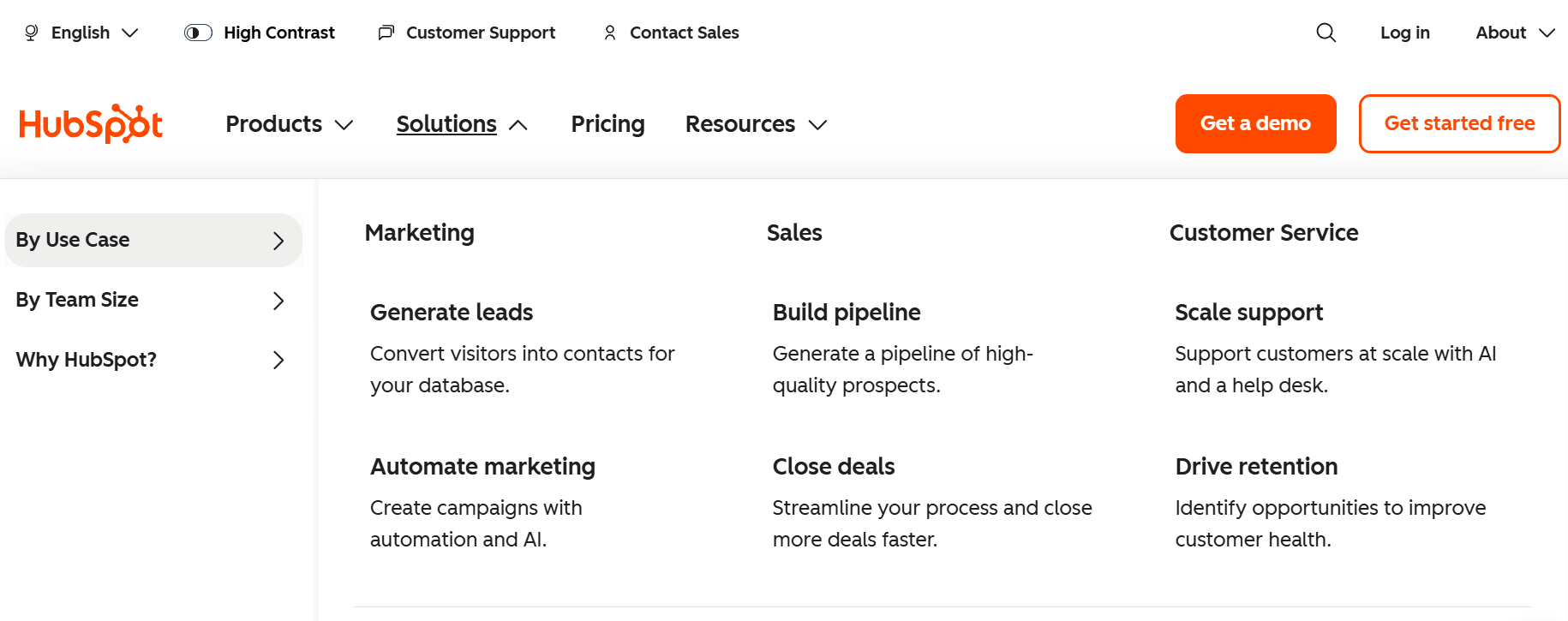
HubSpot handles buyer-led navigation better than almost any SaaS company at scale. Navigation is organized by use case and persona, not product module, so a marketing director finds role-relevant content without decoding internal taxonomy.
Take this B2B web design tip: Map every top nav item to a specific buyer persona or evaluation question.
- Grainger (Industrial/Distribution)
Grainger serves both small contractors placing one-off orders and large facilities teams managing procurement catalogs, without forcing either to adapt to the other's workflow.
Take this B2B web design tip: If your site serves buyers with very different purchasing behaviors, invest in role-based routing from the homepage.

How to Design a B2B Website, Step by Step
Most generic web design processes do not map onto the complexity of a real B2B redesign. The following process reflects how a competent team like Fratzke actually runs one.
Step 1: Define Your ICP, Buying Committee, and Goals
Every downstream decision traces back to three questions: who is the ideal customer, who is in their buying committee, and what must the site accomplish? Map the buying committee by persona, including economic buyer, technical evaluator, end user, champion, and blockers.
Set one or two measurable goals: qualified demo requests, sales-qualified leads per month, or time to first meeting.
Step 2: Audit the Current Site and the Competition
Run the B2B Website Effectiveness Scorecard against your current site before any design work begins. Identify what's working in Google Search Console, what's broken in conversion funnels, and where buyers stall using heatmaps and session recordings.
Run the same scorecard against two or three competitors to find the gaps where better content, clearer positioning, or stronger proof can win the buyer's attention. See Fratzke's guide to brand audits for how to structure this.
Step 3: Set Messaging, Positioning, and Information Architecture
Lock the value proposition before any visual design begins. Most B2B sites that fail to convert have a messaging problem, not a design problem.
From the positioning work, build the sitemap around buyer evaluation paths, not your org chart. A sitemap built around buyer questions produces a site that feels effortless to navigate because it mirrors how buyers already think.
Step 4: Wireframe Key Templates and Conversion Paths
Wireframe the homepage, solution pages, and high-intent templates before applying visual design. For each template, define the primary action, the secondary action, and the content hierarchy that the buyer needs to feel confident taking either one.
Finalize form strategy at this stage: field count, required fields, and the post-submission experience.
Step 5: Design, Build, and Optimize for Performance
Apply visual design with a performance budget set upfront. Page weight, image optimization, and third-party script load targets should be locked before the visual system is finalized.
Choose a CMS your team can maintain: Webflow for sites needing fast iteration, WordPress for content-heavy sites, and headless for complex data or multi-channel needs. Build with crawlable, accessible markup and integrate your CRM from day one.
Step 6: Launch, Measure, and Test Continuously
Launch with a checklist: 301 redirects, updated XML sitemap, analytics and Search Console configured, schema markup live, and Core Web Vitals baseline recorded. After launch, treat the site as a living product.
Run structured A/B tests on high-traffic, high-intent pages and revisit the scorecard every six months.
When to Hire Help for a B2B Website Redesign
In-house works when your site serves one primary audience with a straightforward evaluation path, you have design and development capacity on the team, and your positioning is clear and stable.
Outside help for B2B web design from a digital marketing partner can be valuable when your site serves multiple audiences with different navigation needs, you're going through a repositioning, or you're facing technical performance or migration challenges. It can also make a significant difference when your site looks fine on the surface but isn't converting, and you don't have a clear understanding of why.

That last scenario is the one we see most often. The site doesn't look broken, analytics don't show an obvious problem, but qualified buyers are not converting at the rate the pipeline needs. A professional audit using the scorecard above will usually surface two or three structural issues that explain the gap.
If you fit the second profile, Fratzke evaluates and executes B2B redesigns starting with an audit and working through strategy, design, and build.
Creating a Well-Optimized B2B Website
A great B2B website isn't the most visually impressive one in your category. It's the one that makes buying easier for a committee.
A B2B website should be clear enough that a first-time visitor understands what you do in seconds, trustworthy enough that a CFO can make the case internally, fast enough that a technical evaluator doesn't abandon it on mobile, and deep enough that a six-month evaluation never has to leave the site to find an answer.
Fratzke helps mid-sized and enterprise marketing and brand teams close the gap between intention and execution. We help teams accelerate brand growth by delivering actionable insights, clear strategies, and consistent results.
Connect with our team to request a website audit using the B2B Website Effectiveness Scorecard.
Frequently Asked Questions About B2B Website Design
What is B2B website design?
B2B website design is the practice of building websites that support business-to-business sales by helping multiple stakeholders in a buying committee evaluate, trust, and take the next step with a vendor. It differs from B2C in that it prioritizes education, proof, and consensus-building over single-session conversion. A well-designed B2B site answers buyer questions, reduces reliance on sales for basic information, and earns a qualified conversation.
How is B2B website design different from B2C?
B2B website design is built for a buying group, not a single buyer, across a sales cycle that can last weeks or months. The site's job is to educate, build trust, and generate a qualified conversation rather than close a transaction immediately. B2C prioritizes speed and emotional appeal for one buyer making a faster decision, which means the content, navigation, and conversion logic are structurally different.
What are the key elements of a good B2B website?
A good B2B website includes a clear value proposition visible within seconds, buyer-led navigation organized by use case or persona rather than org chart, visible proof in the form of quantified outcomes and customer logos, guided content for every stage of the buying journey, and fast mobile-first performance. Every page should have one clear primary call to action matched to buyer intent.
How much does a B2B website design or redesign cost?
B2B website redesigns range from roughly $15,000 to $25,000 for a focused mid-sized site to $75,000 or more for complex enterprise sites with multiple audience paths, custom integrations, and content strategy included. The primary cost drivers are the scope of messaging work, the number of page templates required, and integration complexity. An audit-first approach helps scope the project to what actually needs to change.
How long does a B2B website redesign take?
A focused B2B website redesign typically takes 10 to 16 weeks from strategy kickoff to launch. Projects that include significant positioning work, custom development, or complex integrations run 16 to 24 weeks. The most common source of delays is content: copy approvals, customer sign-offs on case studies, and stakeholder alignment on messaging. Teams that complete positioning work before visual design begins consistently ship faster.
What are the best B2B website design best practices for 2026?
The highest-impact practices are messaging clarity in the hero, buyer-led navigation organized around evaluation paths, trust embedded in the conversion path rather than siloed in a case study library, one clear CTA per page matched to buyer intent, and performance meeting Core Web Vitals benchmarks, including INP. AI-mediated discovery optimization, structuring content to be found and cited by AI search, is increasingly a competitive differentiator.
How do I measure whether my B2B website is working?
The primary metrics are qualified form submissions or demo requests, conversion rate on high-intent pages like pricing and demo pages, and time-on-site as a proxy for buyer engagement. Secondary metrics include Core Web Vitals scores and the percentage of inbound leads that sales classifies as sales-qualified. A site generating volume but low sales-qualification rates has a targeting or messaging problem, not a traffic problem.
What CMS is best for a B2B website?
Webflow is a strong default for B2B marketing sites that need fast iteration and a design-friendly editing experience. WordPress suits content-heavy sites where editorial flexibility is a priority. Headless CMS architectures like Contentful or Sanity are appropriate for sites with complex data requirements or multiple front-end channels. The right CMS is the one your team can maintain, and your developers can build performant, accessible sites on.