


In 2026, the cost of a professional website redesign or build depends on what your business actually needs the site to do.
A simple refresh, a custom marketing website, an e-commerce experience, and an enterprise website rebuild all require different levels of strategy, design, content, development, and technical planning. The right investment comes down to scope: how many pages you need, how custom the experience should be, what functionality matters, and who is responsible for bringing it all to life.
Those details matter because a website is rarely just a design project. It is often a business tool, a sales enablement asset, a brand expression, and a customer experience all working together.
In this guide, we’ll unpack the factors behind website redesign costs with practical ranges and real considerations, so you can evaluate your options with clarity and make a smarter decision for your business.
Quick-Answer Price Ranges by Project Type
Here’s what it typically costs to build or redesign a website, based on the three project types we see most often.
- Custom Website: $30,000 to $100,000+
Best for small to midsize businesses that need more than a template. This range usually includes custom design, core pages, content strategy, development, and a site built to support your business goals. - Enterprise Build: $100,000 to $250,000+
Best for larger organizations with multiple stakeholders, integrations, regional or multi-brand sites, accessibility and compliance requirements, or a more complex digital ecosystem. - Custom E-Commerce: $150,000 to $300,000+
Best for brands selling online with more complex needs, such as product catalogs, inventory sync, payment flows, subscriptions, shipping logic, or platform integrations. The difference between a Shopify and BigCommerce integration with an Oracle ERP can significantly impact the scope.
What Drives the Cost of a Website Redesign
The cost of a website redesign comes down to a few key variables. When you understand those factors before requesting a quote, it becomes much easier to set a realistic budget and avoid surprises once the project is underway.
From our perspective, these conversations should happen during a thorough discovery process, which is the first step in our website design and development process. That is where page count, content needs, design complexity, functionality, integrations, and launch requirements can be looked at individually, rather than rolled into one lump-sum estimate that becomes hard to explain later.
Done well, discovery helps your team understand where the budget is going, what matters most, and which investments are most likely to move the business forward.
Scope and Number of Pages
The number of pages on your site has a direct impact on the scope of a redesign. More pages often mean more content to plan, more design decisions to make, and more development work to complete.
But page count is only part of the story. A blog with one repeatable layout for dozens of posts is very different from a site with multiple service pages, location pages, case studies, team profiles, and landing pages that each need a more tailored approach. The goal is not simply to cut pages to reduce cost. It is to understand which pages are doing meaningful work for your business. If certain pages are ranking in search, supporting conversions, or helping customers make decisions, they may be worth improving rather than removing.
Custom Design vs. Template
This is one of the biggest factors shaping the overall investment. A template or theme can help you move faster, but it also comes with limits. Your site has to work within an existing structure, which can make it harder to create a distinct brand experience or support more specific business needs.
Custom website design gives you more room to build around your brand, audience, content, and growth goals. It allows the site to feel more intentional, scale more easily, and stand apart in a category where many competitors may be relying on similar layouts or patterns. For companies where the website is a primary sales, marketing, or customer experience tool, custom design is often the stronger long-term investment. For an early-stage business still validating its offer, a template may be a practical place to start.
Content, Copywriting, and Media
Content is one of the most underestimated parts of a website redesign, and one of the most common reasons projects get delayed.
A strong site needs more than polished design. It needs clear messaging, thoughtful page structure, conversion-focused copy, and the right supporting media, whether that includes photography, video, graphics, or case study assets. When those pieces are not planned early, they can slow down design, development, reviews, and launch.
Writing your own copy may seem like a way to keep the project lean, but it only works if your team has the time and expertise to do it well. If your internal team does not realistically have the bandwidth to write, review, and approve new content on the project timeline, it is usually smarter to plan for professional support from the start.
Website Functionality and Integrations
Custom functionality can quickly expand the scope of a website redesign. Booking systems, cost calculators, gated portals, e-commerce checkout, CRM or ERP integrations, and AI chatbots all require additional development, testing, and long-term support.
That does not mean you should avoid them. It means each feature should connect to a clear business outcome. A form connected to HubSpot, a gated resource library, a client portal, or a self-service quoting tool may sound like simple additions, but each one introduces decisions around user experience, data flow, security, maintenance, and performance. The goal is to prioritize functionality that helps your audience take action and helps your team work smarter, then plan for the support it will need after launch.
Content Migration and Re-platforming
Migrating content means moving every page, image, and metadata field from your old site into the new one without losing what's already ranking. Replatforming, or moving from one CMS to another, adds another layer of complexity. URL structures may change, content fields may need to be remapped, and every old URL should have a redirect plan so search engines and visitors can find the right new page.
This step is easy to underestimate, but it matters. Done poorly, migration can hurt years of search visibility. Done well, it protects your existing momentum while setting the new site up for stronger performance.
SEO and AI Visibility Readiness
Building for search should start on day one of a website redesign. That means a clean site structure, strong Core Web Vitals, proper schema markup, and content that search engines can easily understand. In 2026, it also means planning for AI search. Answer-first content, FAQ schema, and clean, crawlable HTML help AI platforms read, interpret, and cite your website accurately.
Visitors arriving from AI search convert at a 5x the rate of standard organic traffic, which makes this a revenue factor, not just a technical checkbox.
Building SEO and AEO readiness into a redesign from the start is table stakes. For a deeper look at how these two disciplines work together, see our AEO vs. SEO guide.
Accessibility and Compliance
Website accessibility means your site can be used by more people, including those who rely on screen readers, keyboard navigation, or strong color contrast to move through digital experiences.
It is also becoming a business and legal priority. Accessibility-related website lawsuits continued to rise in 2025, and small and mid-sized businesses are increasingly being named, not just large corporations. That is why accessibility should be planned into a redesign from the start. Building toward WCAG 2.1 AA standards during design, development, and testing is much easier than trying to fix accessibility issues after launch.
Who Builds It
Boutique website agencies, large development companies, and in-house teams each come with different costs, strengths, and tradeoffs. The right fit depends on how strategic, technical, and ongoing your website needs are. The next section breaks down what each option typically costs and who it fits best.
Website Design Agency Cost vs In-House
Website cost is not just about who can build the site. It is about who can help you make the right strategic decisions before, during, and after launch.
- Boutique website agency: $25,000 to $150,000+ per project
Best for brands that need a strategic website partner who can help align stakeholders, clarify messaging, design a stronger customer experience, manage development, and support growth after launch. - Large development company: $75,000 to $300,000+ per project
Best for highly complex builds with extensive technical requirements, enterprise systems, custom platforms, or large-scale integrations that require deep development resources. - In-house team: $70,000 to $120,000+ per year per hir
e
Best for organizations that need constant website work across design, development, content, optimization, and ongoing maintenance.
Be honest about what your website needs to accomplish before choosing a path. If you simply need ongoing updates, an in-house team may be the right investment. If your build is heavily technical, a large development company may make sense.
If your website needs to clarify your brand, support sales, improve the customer journey, and create a stronger foundation for growth, a boutique website agency is often the strongest fit. You get the strategic depth and executional support of an experienced team, with the focus, senior access, and collaboration of a true partner.
If you're evaluating whether to bring a redesign in-house or hire out, our guide to B2B website design walks through how to structure that decision.
Ongoing Website Costs After Launch
A website is not done at launch. Budgeting for the build alone and forgetting the recurring costs is one of the most common ways redesign budgets fall short in year two.
- Hosting: $20 to $500+ per month, depending on traffic volume and whether you're on shared, managed, or enterprise-grade infrastructure.
- Domain: $10 to $50 per year.
- SSL certificate: Often included with hosting, or $50 to $200 per year if purchased separately.
- Maintenance and support: $500 to $2,500+ per month, covering plugin updates, bug fixes, and CMS patches.
- Security monitoring: $20 to $200 per month for malware scanning and firewall protection.
- Content updates: Varies widely, from a few hours of internal staff time to a $500 to $2,000 monthly retainer with an agency.
- Ongoing SEO and AI-search support: $2,500 to $10,000+ per month for mid-market and enterprise programs.
A workable rule of thumb is to budget 10 to 20% of your build cost per year for website maintenance and improvements. If your redesign or build costs $40,000, plan on $4,000 to $8,000 annually to keep it secure, fast, and current.
Skipping this line item does not make the cost go away. It simply pushes the expense into the future, often at the worst possible time. Think: a plugin conflict that takes your site down during a product launch, or a missed security patch that turns into a much bigger problem. Treat ongoing maintenance as protection for the investment you already made. A website is not a one-time purchase like a piece of office furniture. It is closer to a vehicle: the initial cost gets you on the road, but maintenance keeps it performing over time.
Businesses that build this into their first-year budget rarely feel surprised by it. The ones that do not are often the ones scrambling for support when something breaks two months after launch.
The Cost of Not Redesigning
Every conversation about redesign cost eventually turns into a conversation about the cost of doing nothing, and that comparison usually favors the redesign.
An outdated site quietly erodes trust before a visitor reads a single word of copy. It also costs measurable revenue.
Portent's analysis of over 100 million page views found that e-commerce sites loading in one second convert at more than 1.8 times the rate of sites loading in two seconds, a gap that compounds fast across thousands of monthly visitors. Aging, unpatched platforms carry security risks that grow every month they go unaddressed, and a site built on outdated SEO practices loses visibility in both traditional search and the AI-powered answers now shaping early-stage research.
A brand that no longer matches the business behind it sends the wrong signal to exactly the buyers you're trying to win. None of this means panic. It means the honest comparison is never "redesign versus free." It's "redesign versus the compounding cost of an aging asset."
How to Budget for a Redesign and Calculate ROI
Turning a cost estimate into a smart decision means thinking about your website as a growth asset, not a line item to minimize.
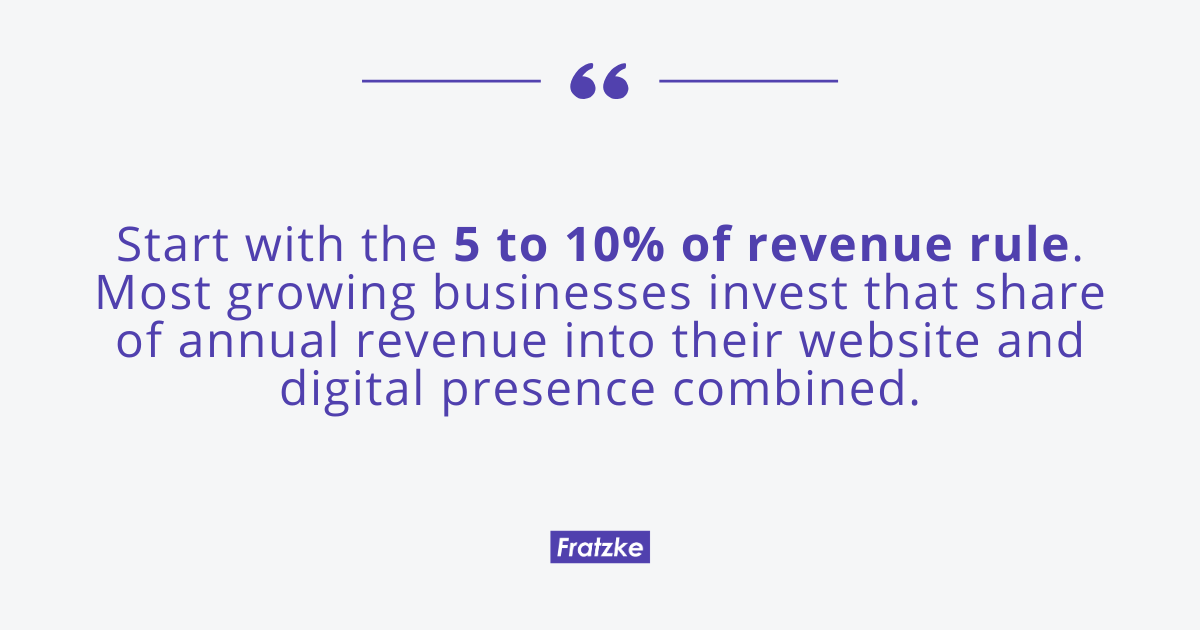
Start with the 5 to 10% of revenue rule. Most growing businesses invest that share of annual revenue into their website and digital presence combined.
Start by identifying the metric your website is meant to move. That might be lead generation, e-commerce revenue, sales enablement, recruitment, investor confidence, or brand credibility with enterprise buyers. Then measure where that metric stands today, define a reasonable improvement target, and estimate the business value of closing that gap.
This is the kind of thinking that helps teams make better budget decisions. A CFO evaluating a major redesign does not just need to see polished design concepts. They need to understand the business case behind the investment.
Once the goal is clear, prioritize the pages and features most likely to support that outcome. Everything else can be phased into a later release. Trying to force every idea into the first launch often creates more complexity, more cost, and more risk than the project needs.
This is also why a clear website strategy should come before design. A focused strategy phase helps define the audience, messaging, site structure, functionality, content needs, and success metrics before production begins. That upfront work can prevent the expensive mid-project pivots that stretch both budget and timeline.
What You're Really Paying For
A website’s true cost is shaped by scope, complexity, and the outcome it needs to support. You are not simply buying a set of pages. You are investing in a tool that can help create leads, sales, credibility, customer trust, and visibility across both traditional and AI-powered search.
Budget for the outcome your business needs, not the lowest number in a proposal. Start by defining your goals and must-have functionality, then get two to three scoped quotes so you can compare the approach, deliverables, and level of strategic support behind each number.
Fratzke works with mid-sized and enterprise marketing teams to scope website redesigns before a single design decision gets made. If you are not yet sure what your redesign needs to include, our website audit services can help reveal the clearest path forward.
Frequently Asked Questions About Website Costs
How much does a website cost in 2026?
In 2026, a professional website build or redesign typically costs between $30,000 and $250,000+, depending on scope.
How much does an e-commerce website cost?
A custom e-commerce website typically costs between $70,000 and $100,000+ in 2026. The final investment depends on the complexity of the experience, including product catalog size, inventory sync, payment flows, subscriptions, shipping logic, checkout requirements, and platform integrations. Larger or more custom e-commerce builds can exceed this range when they require deeper technical planning or integration with systems like ERP, CRM, or fulfillment platforms.
Is it cheaper to build a website in-house or use or an agency?
Building in-house can be less expensive if you already have the right strategy, design, development, content, and QA talent on your team. But if you need to hire for those roles, the investment can add up quickly. A website agency typically costs more upfront, but gives you access to a full team across strategy, design, development, project management, and QA without having to build that team internally. For growth-critical websites, that structure can reduce risk, strengthen execution, and help the project move forward with greater confidence.
How much does it cost to maintain a website per month?
Website maintenance typically costs $100 to $2,500 or more per month, covering hosting, security monitoring, plugin updates, and content changes. A reasonable annual rule of thumb is 10 to 20% of your original build cost.
Why do custom websites cost more than templates?
Custom websites cost more because every layout, interaction, and integration is built specifically for your brand rather than reused from a pre-built theme. That investment pays off in scalability, differentiation, and a user experience tailored to your actual audience rather than a generic one.
How long does a website redesign take?
A website redesign typically takes 8 to 12 weeks for a small-to-midsize business site and 3 to 9 months for an enterprise website rebuild. Timelines extend most often due to slow content delivery and scope changes requested mid-project.
Should I redesign or rebuild my website?
Redesign when your current platform still meets your technical needs but the design, UX, or content is outdated. Rebuild when your CMS is unsupported, can't scale, or can't integrate with the systems your business now runs on.
Does a website need to be optimized for AI search now?
Yes. AI-powered search platforms are increasingly shaping how buyers research vendors before they ever visit a website directly, and sites built with answer-first content and structured data earn those citations more consistently than sites that retrofit it later.


.avif)


