A data-backed, vendor-neutral guide to getting cited in Google AI Overviews: how sources are selected, why ranking and structure both matter, and the exact steps to earn citations.
To get cited in Google AI Overviews, your page needs to rank well for the query, present a clear, front-loaded answer the AI can extract, and back it with strong authority and trust signals. Google's own guidance is direct. There's no special AI Overview markup or submission process; eligibility is earned through the same Search Essentials that govern traditional ranking.
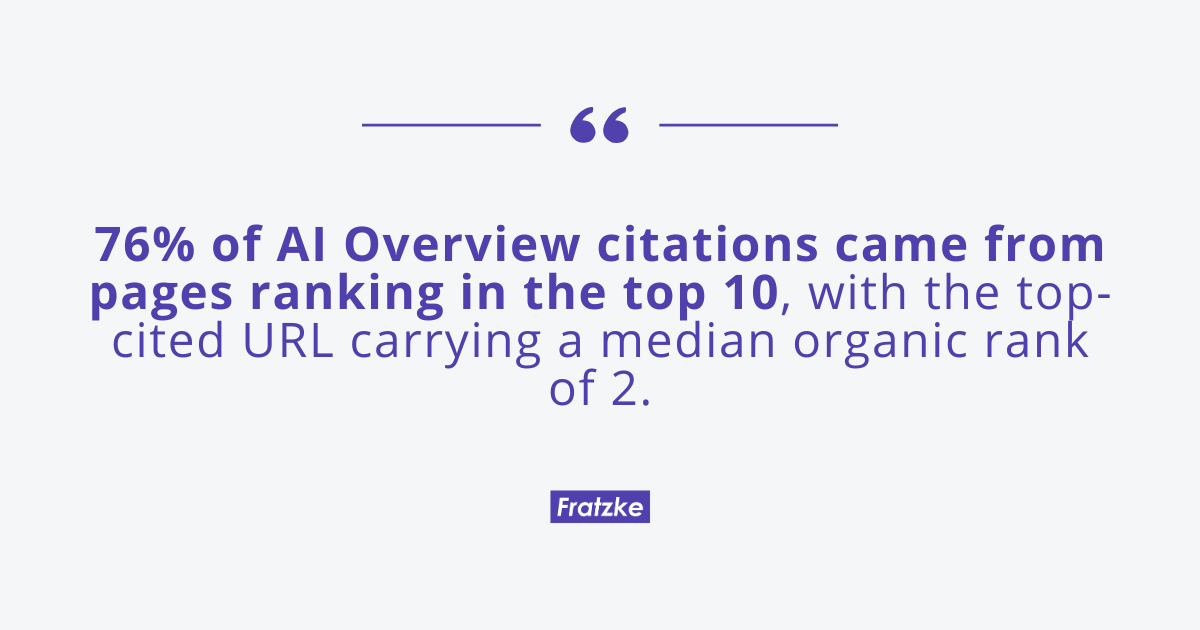
Ranking strength alone isn't the whole story either. Recent Ahrefs data shows that pages ranking in the top 10 accounted for 76% of AI Overview citations in mid-2025, but that overlap had dropped to just 38% by early 2026, meaning citation and ranking are separating faster than most SEO teams have adjusted for.
Below is a data-backed, step-by-step method for earning those citations, grounded in what Google has actually published rather than industry speculation. Fratzke has helped companies show up in Google AI Overviews, with strong results to show for it.
What Are Google AI Overviews (and Why Citations Matter)?
Google AI Overviews are AI-generated summaries that appear at the top of search results, synthesizing information from multiple sources and citing the pages that the summary draws from. They differ from a classic featured snippet in one key way: a snippet pulls a single passage from a single page, while an AI Overview blends several sources into one synthesized answer with multiple citations attached.
Being cited matters for a few concrete reasons.
It puts your brand at the very top of the page, above every organic result.
It functions as a trust signal, since Google is effectively vouching for your content
It drives qualified referral traffic from users who arrive with real intent
It builds brand awareness even without a click, since your framing shapes how they understand the topic
AI Overviews now appear on roughly 48% of Google searches, up sharply from about 6.5% a year earlier, so this is no longer a niche feature affecting a handful of queries.
How Google AI Overviews Choose Which Sources to Cite
Start with Google's own position because it's the foundation on which everything else is built. There's no special AI Overview markup, no submission process, and no separate index.
Your page needs to be indexed and eligible for a standard search snippet; then it's evaluated using the same Search Essentials and helpful-content standards that govern traditional ranking. Google has published this explicitly, stating that from Google Search's perspective, optimizing for generative AI search is still SEO, not a separate discipline.
That said, the data shows real patterns worth understanding. Ranking strength is the closest thing to a hard prerequisite, though the correlation is weakening fast.
A follow-up study covering 863,000 keywords and 4 million citations in early 2026 found that overlap had fallen to 38%, with citations now split fairly evenly between pages ranking 11 to 100 and pages beyond the top 100.
Ranking well still helps significantly, but it's no longer close to sufficient on its own, and even ranking first is described by Ahrefs as roughly a coin flip for earning a citation.
On-page position matters just as much as ranking.
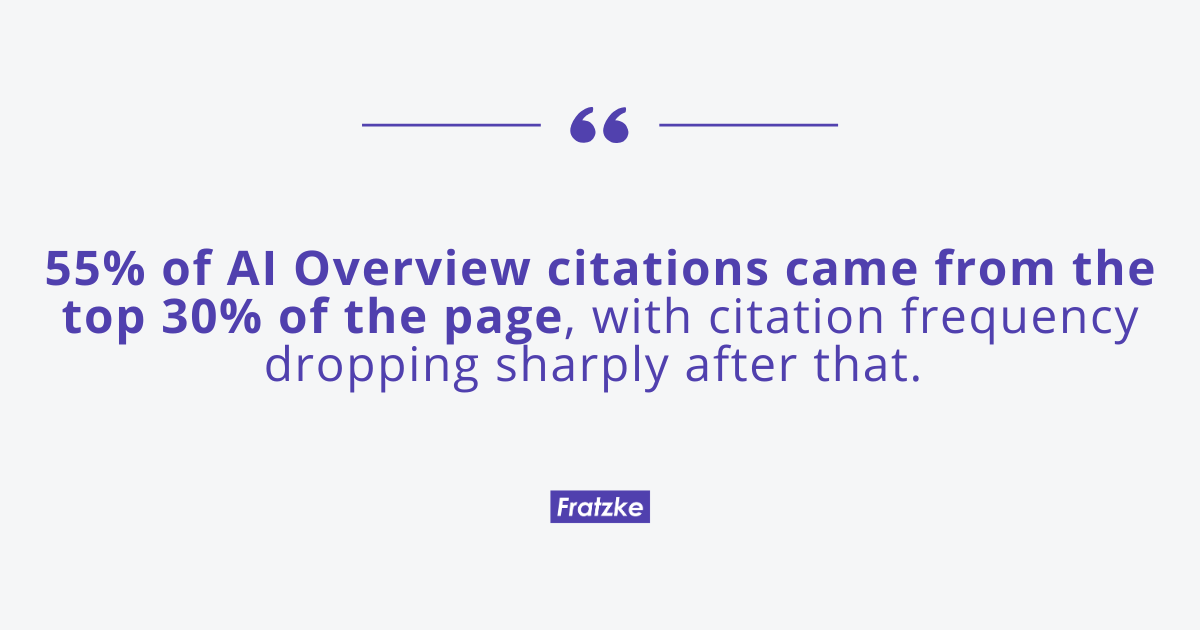
A CXL study of 100 AI Overview citations found that 55% of AI Overview citations came from the top 30% of the page, with citation frequency dropping sharply after that.
Kevin Indig's separate analysis of 1.2 million search results and over 18,000 ChatGPT citations found the same pattern on a different platform: 44.2% of citations came from the first 30% of a document, and burying a key definition below introductory context cut retrieval odds by roughly 2.5 times. He calls this the "ski ramp" effect: a steep cliff after the first third of a page, then a long, slow tail.
Trust signals matter heavily too.
Research from AI-visibility platforms puts the share of citations coming from sources with strong E-E-A-T (Experience, Expertise, Authoritativeness, Trustworthiness) signals at around 96%.
And AI Overviews frequently rely on what Google calls query fan-out, running hidden sub-queries across related subtopics before assembling a response, so a page covering a topic in real depth has more chances to match one of those sub-queries than a page that only touches the surface.
Be clear-eyed about the limits here. Google hasn't published a full citation formula, and it's unlikely to do so. Correlation between ranking and citation isn't causation, and every study here describes a probability, not a guarantee.
Treat the data below as directional evidence about what improves your odds, not a checklist that guarantees a result.
How to Get Cited in Google AI Overviews, Step by Step
The logic here has two parts. Step 1 is the ranking foundation, which is necessary but not sufficient on its own. Steps 2 through 6 are how you win the citation among the other page-one competitors once you've cleared that bar.
Step 1: Rank on Page One First (the Foundation)
Get your page ranking well for the target query before anything else, since even in today's weaker correlation environment, top-10 rankings remain your strongest citation prerequisite. The SEO fundamentals still apply in full: content that genuinely matches search intent, technical health and clean indexability, and real topical authority built through backlinks and expertise.
Structuring for extraction on a page nobody finds won't produce citations. Fratzke's SEO audit services are a practical starting point if you're not sure where your target pages currently stand.
Step 2: Front-Load the Answer (Structure for Extraction)
Put a direct, 40- to 60-word answer in the first 150 words of the page, and repeat that pattern at the top of every major section, since 55% of AI Overview citations come from the top 30% of a page.
Don't build up to your point with a long introduction. State the answer, then expand with evidence afterward. Use short, atomic paragraphs of two to four sentences.
Write descriptive, question-format H2s and H3s that mirror how someone would phrase the query, since a heading like "How do I reduce customer churn" retrieves more reliably than "Churn Reduction Strategies." Use bulleted lists and short tables for parseable data, since structured formats extract more cleanly than prose.
Step 3: Build FAQ Sections as Citation Surfaces
Add an FAQ section to your key pages, since FAQ blocks are one of the highest-leverage citation surfaces available, especially deep in a page where a front-loaded answer alone won't reach. Each question-and-answer pair should function as a self-contained unit with a clear question as the heading, followed immediately by a crisp, standalone answer in the first sentence.
Add FAQPage schema so Google can identify the structure explicitly. This article's own FAQ section below models exactly this technique.
Step 4: Strengthen E-E-A-T and Authority Signals
Build the trust signals that around 96% of cited sources share. Add visible author credentials and bylines so that readers and retrieval systems can see who's responsible for the claims on the page.
Where possible, include original research or proprietary data, since a data point nobody else has published is far more citable than a repeated statistic. Cite your own sources transparently and write from demonstrated first-hand experience rather than generic, assembled advice.
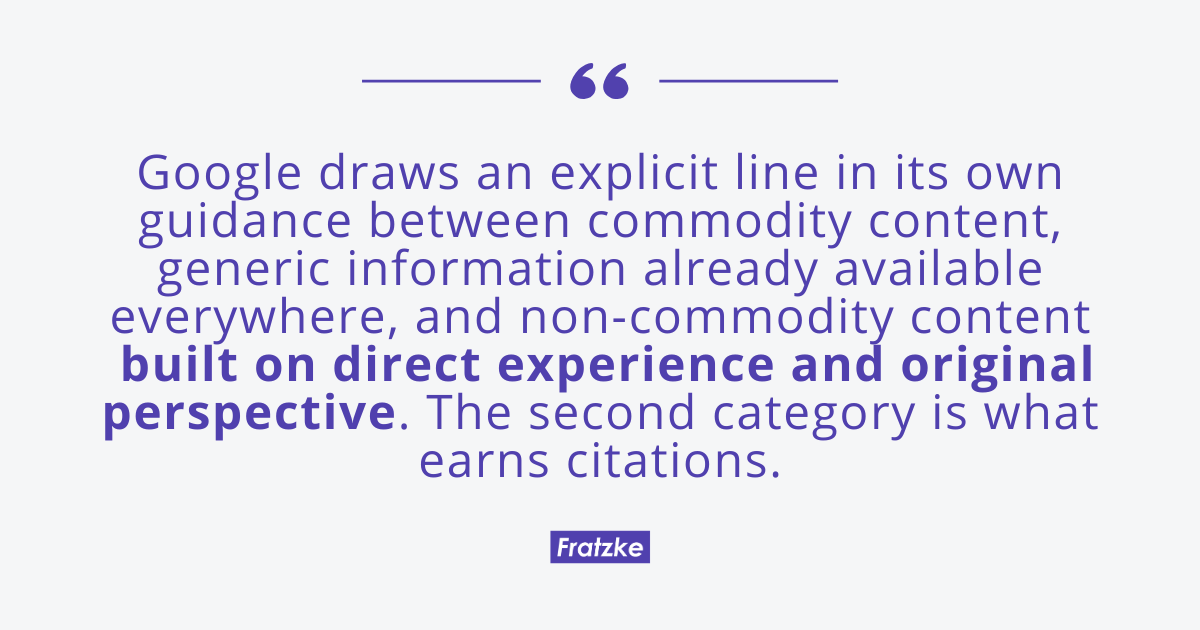
Google draws an explicit line in its own guidance between commodity content, generic information already available everywhere, and non-commodity content built on direct experience and original perspective. The second category is what earns citations.
Step 5: Earn Off-Site Mentions and Topical Coverage
Build consensus beyond your own domain, since AI systems assess whether what your brand says aligns with what other credible sources say about you. That means genuine participation in the places these engines look for corroboration: industry publications, relevant Reddit threads, YouTube content, and review sites.
Pair that off-site work with topical depth on your own site: content clusters that cover a subject's subtopics thoroughly, connected with clear internal linking, expand your citation surface across the fan-out sub-queries that an AI Overview runs behind the scenes.
Step 6: Nail the Technical Basics (Crawlability and Static HTML)
Make sure Google can cleanly crawl and parse the page, since none of the above matters if the content is inaccessible. Confirm that crawling is allowed in robots.txt and by any CDN or hosting layer in front of your site.
Keep Core Web Vitals and page speed healthy, since slow, unstable pages create friction for both users and retrieval systems. Serve key content as static, indexable HTML rather than something that only renders after heavy client-side JavaScript execution, since content locked behind rendering delays is harder for any retrieval system to extract reliably.
Citation-Friendly vs. Citation-Hostile Content
The playbook above boils down to a simple contrast between content that gets extracted and content that gets skipped.
Citation-friendly: Answer stated in the first one to two sentences
Citation-hostile: Answer buried after a long narrative introduction
Every item on the friendly side comes down to the same theme: extractability. If a retrieval system can isolate your answer cleanly and confirm it's trustworthy, you're in the running.
How to Track Your AI Overview Citations
Measurement here should stay practical and platform-agnostic.
Start by manually searching your target queries and checking which sources the AI Overview actually cites for each one.
Watch your site analytics for referral spikes tied to specific queries, since Google Search Console now reports AI Overview impressions and clicks within the standard Performance report under the "Web" search type.
Beyond manual checks, several dedicated AI-visibility platforms exist for tracking this at scale, including tools from Ahrefs, Semrush, AirOps, and Otterly.ai, among others. Each takes a slightly different approach, and none is a clear universal best choice, so evaluate based on which reporting depth matters most for your team.
One distinction worth understanding clearly: a citation and a mention are not the same thing. A citation means the AI engine linked directly to your page as a source. A mention means your brand was named in the response without a link back.
Both carry value, but they should be tracked and reported separately rather than conflated into one number. Fratzke's SEO audit services include AI search readiness as a standard part of the evaluation if you want a full walkthrough built for your own pages.
Mistakes That Kill Your Citation Chances
A handful of avoidable errors show up constantly in pages that rank well but never get cited.
Burying the answer below a long, scene-setting introduction. Fix: front-load a direct answer within the first 150 words.
Thin or generic content that repeats what every other page already says. Fix: add original data, real examples, or first-hand experience.
Stale content that hasn't been reviewed in a long time. Fix: refresh statistics and examples on a regular cadence, since freshness affects citation eligibility.
Keyword stuffing instead of answering questions. Fix: write to directly resolve the query, not to hit a density target.
JavaScript-dependent rendering that hides key content from crawlers. Fix: serve critical content as static, indexable HTML.
Ignoring off-site presence entirely. Fix: build genuine visibility on the platforms AI engines already treat as trust signals.
No measurement at all. Fix: track citations and mentions separately so you know what's actually working.
Earn the Citation, Don't Chase the Algorithm
There's no secret markup, no submission form, and no shortcut that bypasses the fundamentals here. Google has said so directly. You earn a citation in an AI Overview the same way you earn any other kind of trust: by ranking for the query, then being the clearest, most credible, most extractable answer among the pages that do.
The first concrete step is a quick audit of your top page. Ask, do they currently rank for the queries that matter, and if so, does the actual answer appear in the first 30% of the page? Most pages fail one of those two tests, and fixing whichever one applies is usually the highest-leverage change available.
Many teams have strong plans, solid budgets, and expanding tech stacks, but they're stretched thin. Fratzke helps teams accelerate brand growth by delivering actionable insights, clear strategies, and consistent results.
Frequently Asked Questions
How do you get cited in Google AI Overviews?
You get cited by ranking well for the target query, then presenting a clear, front-loaded answer that Google's retrieval system can extract cleanly, backed by strong authority and trust signals. There's no special markup or submission process. Eligibility is earned through the same Search Essentials that govern traditional ranking.
Do you have to rank on page one to be cited in an AI Overview?
Not strictly, but it helps significantly. Ahrefs data shows the share of citations coming from top-10 pages fell from 76% to 38% between mid-2025 and early 2026, meaning a growing share of citations now comes from pages ranking well outside the top 10 or even the top 100.
How does Google choose sources for AI Overviews?
Google draws from the same index used for traditional search, evaluating pages against Search Essentials, helpful-content standards, and E-E-A-T signals. It also runs hidden fan-out sub-queries across related subtopics to build a fuller answer. Google hasn't published a complete formula, and citation is a probability, not a guarantee.
Does schema markup help you get cited in AI Overviews?
Schema markup isn't required, and there's no special AI Overview schema type, according to Google's own documentation. It's still worth using for standard rich-result eligibility, and FAQPage schema supports the answer-unit structure that citation-friendly content relies on.
How are AI Overviews different from featured snippets?
A featured snippet pulls a single passage from a single page to answer a query directly. An AI Overview synthesizes information from multiple sources into one summarized answer and cites several sources at once. Both reward clear, extractable, answer-first content.
Can small websites get cited in Google AI Overviews?
Yes. Citation depends on extractability, authority signals, and topical relevance rather than site size or domain age. A smaller site with a clear, well-structured, original answer can outcite a much larger competitor that buries its point or offers only generic content.
How long does it take to get cited in an AI Overview?
There's no fixed timeline, since AI search indexes can shift citations within days of a content update, but durable improvement typically takes weeks. Ranking improvements from SEO fundamentals often take longer to compound than structural changes like front-loading an answer.
How do I track whether I'm cited in AI Overviews?
Manually search your target queries and check the cited sources, monitor Google Search Console for AI Overview impressions and clicks, and consider a dedicated AI-visibility tracking tool for scale across many queries and platforms. Track citation rate and mention rate as separate metrics.
What is the difference between a citation and a mention?
A citation is a direct link from the AI-generated answer back to your page. A mention is your brand name in the response text without a link. Both carry value, but a citation is the stronger signal, since it confirms the engine treats your content as a trusted source.
Is there a way to submit my site to Google AI Overviews?
No. Google has stated there's no submission process, special file, or markup that gets a page included in AI Overviews. Eligibility is earned automatically once a page is indexed and meets standard snippet eligibility requirements.
Does getting cited in an AI Overview drive traffic?
Yes, though the pattern differs from a traditional ranking click. Users who click through from a citation typically arrive with a partially answered question and higher intent, and Google's own data indicates these visits tend to be higher quality in terms of engagement.
What content gets cited most often in AI Overviews?
Content that states its answer clearly within the first 30% of the page, demonstrates strong E-E-A-T signals, and offers original data or first-hand experience rather than generic, widely repeated information gets cited most consistently. Structured formats like FAQs and simple tables perform well too.
The Takeaway
Getting cited in Google AI Overviews comes down to two things working together. You need to rank well enough to be in consideration, then be the clearest and most trustworthy answer on the page once you're there.
The data changes fast, ranking correlation alone dropped by half in under a year, but the underlying principle hasn't changed. Google rewards helpful, well-structured, genuinely authoritative content, and it always has.
Audit your top pages against that standard before chasing any new tactic. Let's talk.
Fratzke is a top-rated strategic agency that helps mid-market and enterprise brands spark growth through customer insights, brand strategy, marketing, and creating digital experiences. Since our founding in 2017, we've worked with leading brands across industries including Razer, TopBuild, REI, DTS, and TiVo, partnering from research and strategy through implementation. We combine data, technology, and human-centered storytelling to help brands better understand their customers, strengthen their market position, and create consistent growth over time. Learn More.
Download Your Free Digital Marketing Audit Report Preview!
See Exactly What You'll Receive Before You Invest in a Digital Marketing Audit.




.avif)


_%20Article%20Cover%20Image.png)