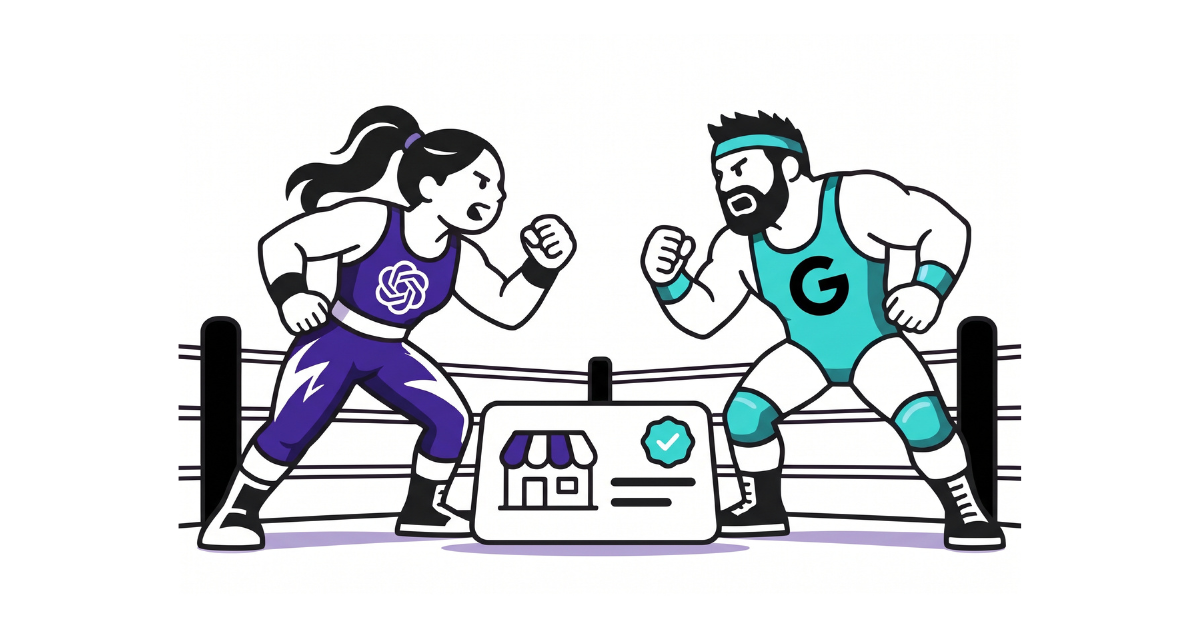


Can ChatGPT go head to head with Google? With its latest rollout, OpenAI is clearly positioning itself to try.
On November 10, OpenAI launched Businesses in ChatGPT in beta. Companies can now create verified business profiles, update information about their products and services, and, if eligible, launch a dedicated business agent that answers customer questions inside ChatGPT. The Hub also reports basic insights such as profile views, business mentions and website clicks.
If that sounds familiar, it should. It mirrors Google Business Profile nearly feature for feature. OpenAI calls it "an early step in bringing businesses more deeply into ChatGPT." I'd call it the clearest signal yet that ChatGPT wants to be a discovery engine, and not just an assistant.
Businesses get a more direct role in telling their story
For marketers, one of the biggest opportunities is having more influence over the information ChatGPT uses to describe their business. Until now, brands have had little say in how a generative engine describes them. ChatGPT pieced together answers from whatever it could find, outdated or not.
Verified profiles change that. Businesses can now put accurate, first-party information directly in front of the model and its users. That is exactly what marketers have been asking for since AI answers started replacing clickable search results.
The rollout also brings more visibility into your brand's presence on ChatGPT. The Business Hub reports first-party data such as profile views, business mentions and website clicks, showing brands how they appear in ChatGPT straight from the source.
It's also as an early step toward the kind of visibility Google Search Console gives marketers. It isn't as deep yet; Search Console breaks performance down by query, and it's unclear whether OpenAI will share the prompts that surface a brand. But it's a clear step up from third-party AI visibility tools, which estimate presence from sample prompts. Even limited platform data gives marketers a more reliable baseline.
The reality check: Google still owns search
Let's be clear about the current search landscape. Google holds 91.05% of the search market, and it already offers AI search features of its own. A business profile alone won't convince anyone to switch.
So what would? ChatGPT's advantage is everything it does beyond search. People already use it to write, plan, research, analyze and shop. Each of those tasks is another reason to stay on the platform, and every minute spent there is a minute not spent on Google.
ChatGPT may never take the top spot, but it doesn't need to. Becoming a credible second option would be enough to break Google's dominance in a way no competitor has managed in two decades.
An on-ramp to advertising
Read between the lines and this is also about growing monetization. It's telling that OpenAI's VP of Monetization, Benji Shomair, briefed reporters on the launch.
The business profile is step one. It's a free, win-win relationship that gets businesses to acknowledge ChatGPT as a legitimate marketing channel before anyone is asked to spend. Brands get control and visibility. OpenAI gets verified business data and a roster of engaged advertisers-in-waiting.
Just as important, the insights dashboard lets OpenAI prove its case. Profile views, mentions and clicks are proof of concept and proof of audience. Once businesses see real customers finding them in ChatGPT, the jump to paid placement becomes an easy conversation.
What brands should do now
My advice is to start learning while the platform develops, and to claim your profile early. The cost is low and the upside is substantial.
- Verify and complete your profile. Treat it with the same care as your Google Business Profile.
- Audit what ChatGPT already says about you. Correct gaps before customers find them.
- Watch the insights. Use the early data to build your baseline before ad dollars enter the picture.
- Plan for paid. If advertising follows, the brands with established profiles and performance history will be ready first.
ChatGPT may not dethrone Google. But for the first time in a long time, search has a real second front, and smart brands will show up on both.