

A new website can unlock growth, clarify your brand, and create a better experience for your customers. But choosing the right website design agency can feel anything but clear.
Start by defining your goals and budget, deciding whether an agency is the right fit, researching a few teams whose work matches your needs, comparing proposals, and confirming scope, timeline, ownership, and support before you sign.
Hiring an agency also requires trust. You may be investing anywhere from a few thousand dollars to six figures into a project with real business implications. It is reasonable to worry about paying too much, choosing the wrong platform, losing control of your site, or ending up with something your team cannot maintain.
That is why we created this guide. We are a website design agency, but we are also strategic partners who believe clarity comes first. Sometimes the right answer is an agency. Sometimes it is a freelancer, an in-house team, or a simpler build. This guide will help you understand the difference before you make the decision.
Do You Need an Agency, a Freelancer, or to Build It Yourself?
Not everyone who searches for how to hire a website design agency actually needs the help of a whole agency. Before you start researching agencies, figure out which of four paths fits your project, because picking the wrong one has the potential to waste money and time.

A DIY website builder like Wix, Squarespace, or Webflow is the right call if you're a solo owner with a simple brochure site, a tight budget, and the time to build it yourself. You'll spend little beyond a monthly subscription, trading costs for your own hours, and a limit on what the site can do.
A freelance web designer fits well-defined, smaller projects, like a single-location business site, a portfolio, or a landing page tied to one campaign. You get one person's full attention at a lower price than an agency, but also one person's bandwidth and a project that stalls if they get busy or move on.
A website design agency is built for hiring someone to build a website when the stakes are higher. Use an agency for a revenue-critical site, a redesign tied to a rebrand, a company with multiple stakeholders who need to sign off, or a project needing strategy, design, development, copywriting, and SEO working together.
A digital marketing agency has a process and a reputation riding on delivery, and they take full accountability for the project from start to finish.
An in-house hire makes sense only if you have enough ongoing work to keep someone busy year-round and a budget for a full-time salary, benefits, and management overhead.
Here's how the four stack up at a glance:
- DIY Website Builder: $0-50/month. Best for simple sites, tight budgets, and hands-on owners willing to build it themselves.
- Freelance Designer: $1,000-8,000/project. Best for defined, smaller projects and lower budgets.
- Website Design Agency: $10,000-75,000+/project. Best for complex, revenue-critical sites and full-service needs.
- In-House Hire: $70,000+/year. Best for ongoing, high-volume web and design work.
If your project is simple and self-contained, save money with a website builder or a freelancer. But if your site is complex, public-facing, and central to your business's growth, an agency is the better call.

The Benefits of Hiring a Website Design Agency
The real benefit of hiring a website design agency is not just a better-looking site. It is a team built to create a specific business outcome.
When you hire an agency, you are bringing together strategists, designers, developers, copywriters, and SEO specialists who already know how to work as one. Instead of assembling that expertise yourself, you get a proven process designed to uncover what your audience needs, clarify what your brand should communicate, and create a digital experience that supports growth.
That structure shows up in meaningful ways. You get clear milestones, shared accountability, and the bench strength to handle complexity, from custom functionality and CRM integrations to e-commerce, SEO, accessibility, and multi-stakeholder feedback. Design decisions are guided by business goals like trust, conversion, lead generation, and customer experience, not visual preference alone. And after launch, you have a team that understands your site, your strategy, and the choices behind both.
That matters because your website is not a one-time project. It is often the first place people go to decide whether your brand feels credible, relevant, and worth trusting. Stanford Web Credibility Research found that 75% of consumers judge a brand’s credibility based on its website design, and that impression keeps evolving after launch. A strong website needs ongoing maintenance, performance monitoring, content updates, security checks, and strategic improvements to keep working as your business grows. The launch is the beginning, not the finish line.
How to Find and Shortlist Website Design Agencies
The fastest way to find a web designer or agency worth talking to is a referral from someone whose site you've actually used and liked, not a generic search. Start there. Ask peers in your industry, your investors, or your board who built their site and whether they'd hire that team again.
When referrals run out, move to structured sources. Agency directories like Clutch and DesignRush let you filter by industry, project size, and verified reviews. Platform partner directories from Webflow and Shopify surface agencies certified on the platform you're considering. Portfolio platforms like Awwwards and Behance are useful for inspiration but rarely for vetting business results. Use local search if you want a team you can meet in person.
From those sources, build a list of three to five agencies worth an actual conversation.
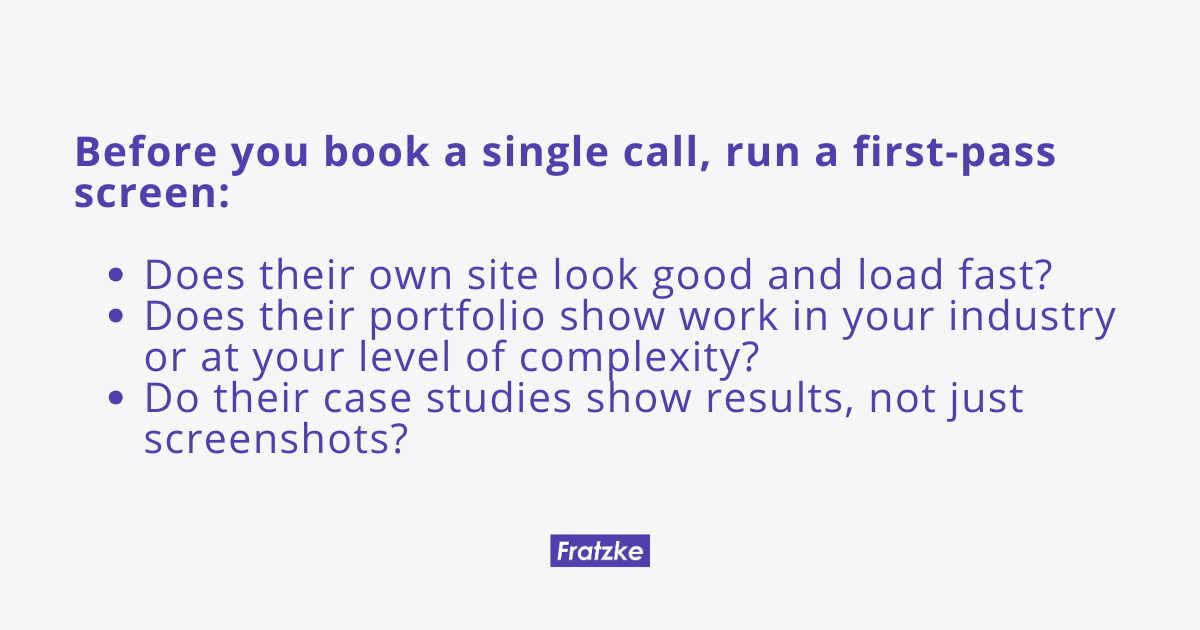
Before you book a single call, run a first-pass screen:
- Does their own site look good and load fast? An agency that can't get this right on their own marketing site is a warning sign about what they'll deliver for you.
- Does their portfolio show work in your industry or at your level of complexity? A portfolio full of simple brochure sites doesn't tell you much about their ability to handle integrations, e-commerce, or a multi-stakeholder redesign.
- Do their case studies show results, not just screenshots? Traffic growth, conversion lift, or lead volume tells you they think about outcomes. A gallery of pretty homepages tells you they think about aesthetics.
Agencies that pass this screen are worth a call. The ones that don't have already told you what you need to know.
Fratzke has handled website design for complex companies like TruTeam and Environments for Living, and our full portfolio is on our website for buyers to evaluate.
How to Evaluate and Pick the Right Agency
Picking a website design agency comes down to five checkpoints, and the cheapest bid or the flashiest portfolio rarely wins on its own. Once you've got three to five agencies on a call, evaluate each against the same criteria.
Portfolio and Relevant Experience
Good portfolio evidence is work in your industry or at your complexity level, live links you can actually click through and test, and case studies that show outcomes like traffic, conversions, or leads, not just before-and-after screenshots. If an agency can't point to results, ask why directly.
Process, Communication, and Project Management
A good agency can describe its process in one breath, covering discovery, wireframes, design, build, QA, and launch. You should get a named point of contact, not a rotating cast, and the responsiveness you get during the sales process previews what working together will feel like. If they are slow or vague before you've signed, it won’t improve after they have your deposit.
Strategy and SEO Capability, Not Just Visuals
This is where a lot of buyers get burned. A beautiful site nobody can find, or one that tanks your existing rankings during migration, isn't a win. Ask directly how the agency approaches conversion, page speed, and search visibility. Ask specifically how they handle redirects and SEO continuity when a site moves platforms. A team that can't answer this clearly hasn't done it enough times to do it safely.

Who Actually Does the Work
Confirm whether the people in your sales calls are the people who will design and build your site, and whether any work is outsourced or offshored. This affects the quality and how fast you get answers during the project. A distributed team is fine as long as the agency is straightforward about it when you ask.
Proposal and Scope Clarity
A strong proposal spells out deliverables, timeline, milestones, revision rounds, and price in plain language. A vague proposal, heavy on philosophy and light on specifics, predicts a scope dispute later. If you can't tell exactly what you're getting and for how much, ask for a revised version before you sign.
Across all five, the agency that wins isn't the one with the lowest number or the most awards. It's the one whose process, expertise, and answers you actually trust.
How Much Does It Cost to Hire a Website Design Agency?
Hiring a website design agency typically costs $10,000 to $75,000 or more per project, with the final amount driven almost entirely by project complexity, not by which agency you choose. Vague "it depends" answers don't help you budget, so here's what the ranges actually look like by project type:
- Small Business Site: $10,000 - $25,000. Includes custom design, several page templates, a content management system (CMS), and basic SEO setup.
- Mid-Market or B2B Site: $25,000 - $60,000. Includes strategy, custom design, third-party integrations, SEO, and content development.
- Enterprise or Complex Build: $60,000 - $150,000+. Includes full strategy, a custom build, deep integrations, and a managed migration.
- Ongoing Support Retainer: $1,500 - $10,000/month. Covers updates, optimization, SEO, and maintenance after launch.
Treat these as typical ranges, not guarantees. Your market, your scope, and your specific agency will move the number in either direction.
What actually drives cost within those ranges:
- Number of pages and templates. A five-page site and a fifty-page site are different projects, even at similar design complexity.
- Custom design versus template-based design. Fully custom work costs more but gives you something competitors can't easily copy.
- Custom functionality and integrations. E-commerce, gated content, CRM connections, and membership portals all add development time.
- Content and copywriting. Sites built around words you haven't written yet cost more than sites where you're supplying finished content.
- SEO. Technical setup, keyword strategy, and migration planning are either included or quoted separately; know which before you compare proposals.
- Ongoing support. A one-time build and an ongoing retainer are different line items, and skipping the second is how sites go stale within a year.
One pattern worth knowing before you compare bids is that the cheapest quote is often the most expensive one once you account for the revision rounds, missing functionality, and post-launch fixes that weren't in scope to begin with. A proposal that looks 30% cheaper than the others usually means fewer revisions, offshore production, or a narrower definition of "done." Ask what's not included before you assume you found a deal.
Questions to Ask Before You Hire a Website Design Agency
The questions you ask in an agency sales call tell you more than the answers they volunteer, since a good agency raises scope and ownership unprompted, while a weak one waits to be asked. Bring this list to every call and compare the answers side by side.
Suggested Questions to Ask
- What does your process look like from kickoff to launch?
- Can I see case studies with real results, not just screenshots?
- Who on your team will actually do the work, and is any of it outsourced?
- What platform or CMS will you build on, and why?
- Who owns the website, the code, and the design files after launch?
- How do you protect my existing SEO and rankings during a redesign or migration?
- What is included in the price, and what costs extra?
- How are revisions and change requests handled?
- What does support look like after launch, and what does it cost?
- Can I talk to two or three past clients?
The ownership and SEO questions are the ones most buyers forget, and most competing guides skip entirely. An agency that hesitates on who owns the site and code after launch, or that doesn't have a clear answer for protecting your rankings during migration, is telling you something important before you've signed anything.
Red Flags to Watch For
The biggest red flags when hiring a website design agency aren't about price; they're about ownership and lock-in. These aspects are exactly what get buried until after the contract is signed. Watch for these before you commit:
- Vague scope or no written proposal. If deliverables, timeline, and price aren't in writing, you can't hold the agency to what was promised verbally.
- Refusing to clearly state who owns the site. This is the single most expensive red flag. If an agency hedges on ownership of the code, design files, or content after launch, you may not actually own what you paid for.
- Proprietary CMS lock-in. Some agencies build on closed platforms that only they can edit or host, meaning switching agencies later means rebuilding from scratch. Ask whether you can leave and take the site with you.
- No SEO or migration plan. An agency that hasn't considered how a redesign affects your existing rankings is asking you to gamble with traffic you've already earned.
- A portfolio of templated lookalike sites. If every example shares the same layout with different logos dropped in, that's likely what you'll get too.
- Prices far below every other quote. A low price isn't automatically a problem, but a price dramatically below the rest of your shortlist usually means something's missing: offshore production, template design, or change fees that show up later.
- Poor communication during the sales process. If they're slow or vague while trying to win your business, expect the same once you've paid the deposit.
- No clear point of contact. If you can't get a straight answer about who manages your project day to day, no one actually owns your account.
None of these are automatically disqualifying on their own, but more than one or two is a strong signal to keep looking.
What Happens After You Hire (and After Launch)
A typical engagement runs through kickoff and discovery, design, build, structured revision rounds, quality assurance testing, and launch.
What happens after launch is where buyers get burned most often, because it's the part nobody asks about until something breaks. Do they offer support after launch? Confirm who handles maintenance, security updates, and bug fixes, and what that costs if it's not already included.
Confirm how SEO continuity is protected in the weeks after launch, since research suggests up to a third of website migrations experience significant SEO-related performance issues, with some sites losing 50% or more of their organic traffic when redirects and technical SEO aren't handled correctly.
Buyers planning a redesign of a complex B2B site should treat SEO continuity as a non-negotiable part of the proposal, not an add-on. It's worth reviewing how Fratzke approaches B2B website design and migration planning before you finalize a shortlist.
Choosing an Agency You'll Actually Want to Work With
The agency you hire should be the one whose process, expertise, and honesty you trust enough to put your business in their hands for the next few months and beyond. Because you're not just buying a website, you're buying a working relationship through discovery calls, revision rounds, inevitable mid-project changes, and ongoing support.

Before you sign anything, confirm ownership of the site and code, confirm how your SEO will be protected through the build, and make sure the proposal in front of you matches what was promised on the call. A good agency will welcome every one of those questions.
Fratzke works with mid-sized and enterprise teams who need a website that's built on strategy, not just style, and that holds up technically long after launch. If you're evaluating agencies and want a straight answer about whether we're the right fit for your project, contact us.
Frequently Asked Questions About Hiring a Website Design Agency
How much does it cost to hire a website design agency?
Most website design agency projects range from $10,000 to $75,000 or more, depending on complexity. A small business site typically runs $10,000-25,000, a mid-market or B2B site $25,000-60,000, and an enterprise build $60,000-150,000+. Ongoing support retainers add $1,500-10,000 per month on top of the initial build.
Should I hire a web design agency or a freelancer?
Choose a freelancer for smaller, well-defined projects with a tighter budget, and an agency for complex, revenue-critical sites that need strategy, design, development, and SEO working together. Freelancers offer lower cost and one person's full attention; agencies offer a structured process, more bandwidth, and accountability if something goes wrong mid-project.
Is hiring a website design agency worth it?
It's worth it when your site is complex, tied to revenue, or part of a larger rebrand, because the structured process and full team typically deliver a better business outcome than a single freelancer or a DIY builder can. For a simple brochure site with a tight budget, a freelancer or website builder is usually the more cost-effective choice.
How do I find a good web design agency?
Start with referrals from people whose sites you've actually used, then check directories like Clutch and DesignRush, platform partner lists for Webflow or Shopify, and local search. Shortlist three to five agencies, then screen their own website speed, portfolio relevance, and whether case studies show measurable results before you book a call.
How long does it take an agency to build a website?
A small business site typically takes four to eight weeks, a mid-market or B2B site eight to sixteen weeks, and an enterprise or highly custom-built site four to six months or longer. Timeline depends heavily on how quickly your team provides content and feedback, since slow internal approvals are the most common cause of delay.
What should I look for in a web design agency's portfolio?
Look for live links you can actually click through, work in your industry or at your level of complexity, and case studies that show measurable outcomes like traffic or conversion gains, not just visual screenshots. A portfolio with no results data tells you the agency optimizes for looks over business impact.
Who owns my website after the agency builds it?
This depends entirely on what's written into your contract, which is why you need to confirm it before signing, not after. Reputable agencies grant full ownership of the code, design files, and content to the client at project completion; some agencies on proprietary platforms retain more control, which can lock you in if you ever want to switch providers.
Can a web design agency also handle SEO?
Yes, and a strong agency should be able to, since search visibility and site structure are connected from day one of a build. Ask specifically how the agency handles technical SEO, redirects, and ranking continuity during a redesign or platform migration, since this is exactly where many otherwise-good builds lose existing organic traffic.



.avif)


