A B2B marketing audit shows you what’s working, what isn’t, and where your biggest opportunities lie. It looks at how well your marketing supports a longer, more complex buying process, and whether it is helping you attract the right leads, support sales, and drive growth.
A complete audit may cover your brand, website, SEO, content, paid media, demand generation, CRM, conversion paths, analytics, and the handoff between marketing and sales.
For B2B marketing leaders, the goal is not simply to produce a list of fixes. It is to create a clear picture of where you are today, decide where you need to go, and build a practical roadmap for getting there.
In this guide, we’ll explain why B2B marketing audits matter, what to evaluate, how the process works, and how to turn your findings into a focused plan for growth.
A B2B Marketing Audit Connects Performance to Revenue: A B2B marketing audit connects channel performance to lead quality, revenue objectives and the customer journey.
Strong Audits Look Beyond Individual Campaigns: The strongest audits examine strategy, execution, data and organizational processes—not individual campaigns in isolation.
Findings Should Lead to Clear Next Steps: Audit findings should culminate in prioritized recommendations, owners, timelines and performance benchmarks.
An Outside Perspective Uncovers Blind Spots: An outside perspective can help lean teams uncover blind spots and create alignment without adding to their day-to-day workload.
What Is a B2B Marketing Audit?
Unlike a standard digital marketing audit for a consumer-focused business, a B2B marketing audit accounts for longer sales cycles, multiple decision-makers, and the important connection between marketing and sales.
It looks beyond clicks, traffic, and individual channels to determine whether your marketing works as a connected system, attracting the right prospects, building trust, generating qualified leads, and supporting sales throughout the buying process.
That broader perspective matters. Gartner found that companies with CMOs who are effective at “market shaping”, using customer and market insight to identify and meet unmet needs, are 2.6 times more likely to exceed revenue and profit goals.
At Fratzke, we use our Benchmark Method™ to capture this thorough view. By combining an outside-in review with performance data and stakeholder insights, we establish a clear picture of what’s working, where gaps exist, and which opportunities deserve priority.
A B2B marketing audit helps leaders build that understanding by showing where the customer journey is breaking down across channels, and which improvements are most likely to support growth.
As B2B marketing evolves, gaps can emerge between campaigns, digital experiences, and larger business goals. New platforms, changing buyer expectations, and competing priorities can gradually pull marketing efforts in different directions.
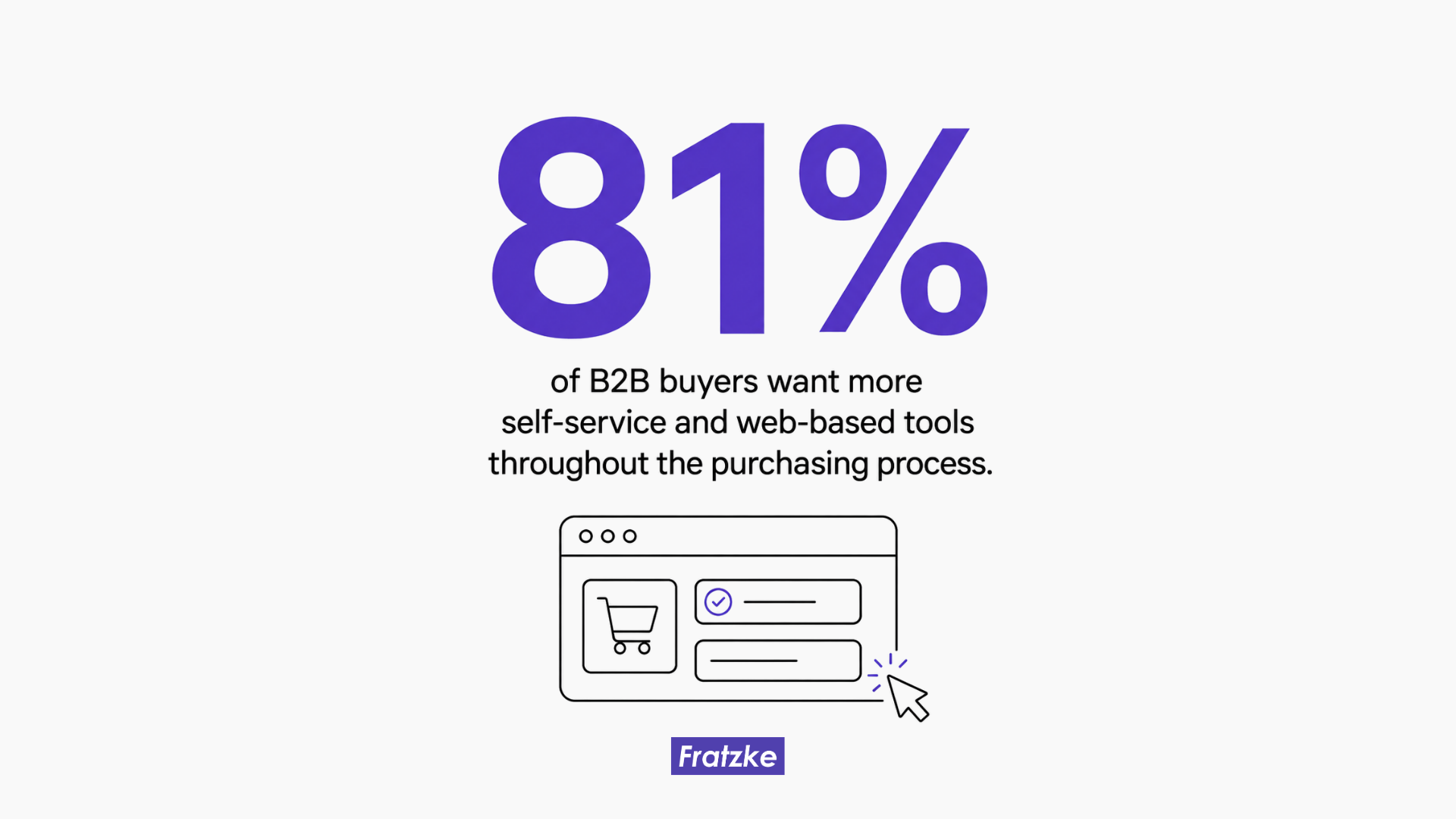
These issues are easy to miss in individual channel reports. Outdated messaging, disconnected experiences, wasted spend, and gaps in measurement can make it harder for buyers to find the information and support they need. Deloitte found that 81% of B2B buyers want more self-service and web-based tools throughout the purchasing process.
Why Marketing Audits Matter for B2B Brands
We saw this firsthand during a marketing audit for a national distribution brand. Its business customers wanted more self-service tools and digital support, revealing an opportunity to better serve customers online throughout the buying journey.
“Most B2B companies misdiagnose the problem because they aren’t looking at the full sales cycle from awareness to conversion. When marketing and sales are evaluated in isolation, companies spend money fixing symptoms instead of addressing what’s actually holding back growth.” - Ryan Fratzke, Partner & Executive Strategist
Regular B2B marketing audits help leaders uncover needs like these, respond to changing expectations, and keep marketing investments aligned with business goals. Instead of reacting to isolated metrics or the latest tactic, teams can focus on improvements that create a better customer experience and support sustainable growth.
A thorough B2B marketing audit looks beyond individual channels to understand how well your entire marketing system supports customers and business goals. Fratzke’s Benchmark Method combines an outside-in review with performance data to identify what is working, where gaps exist, and which opportunities should be prioritized.
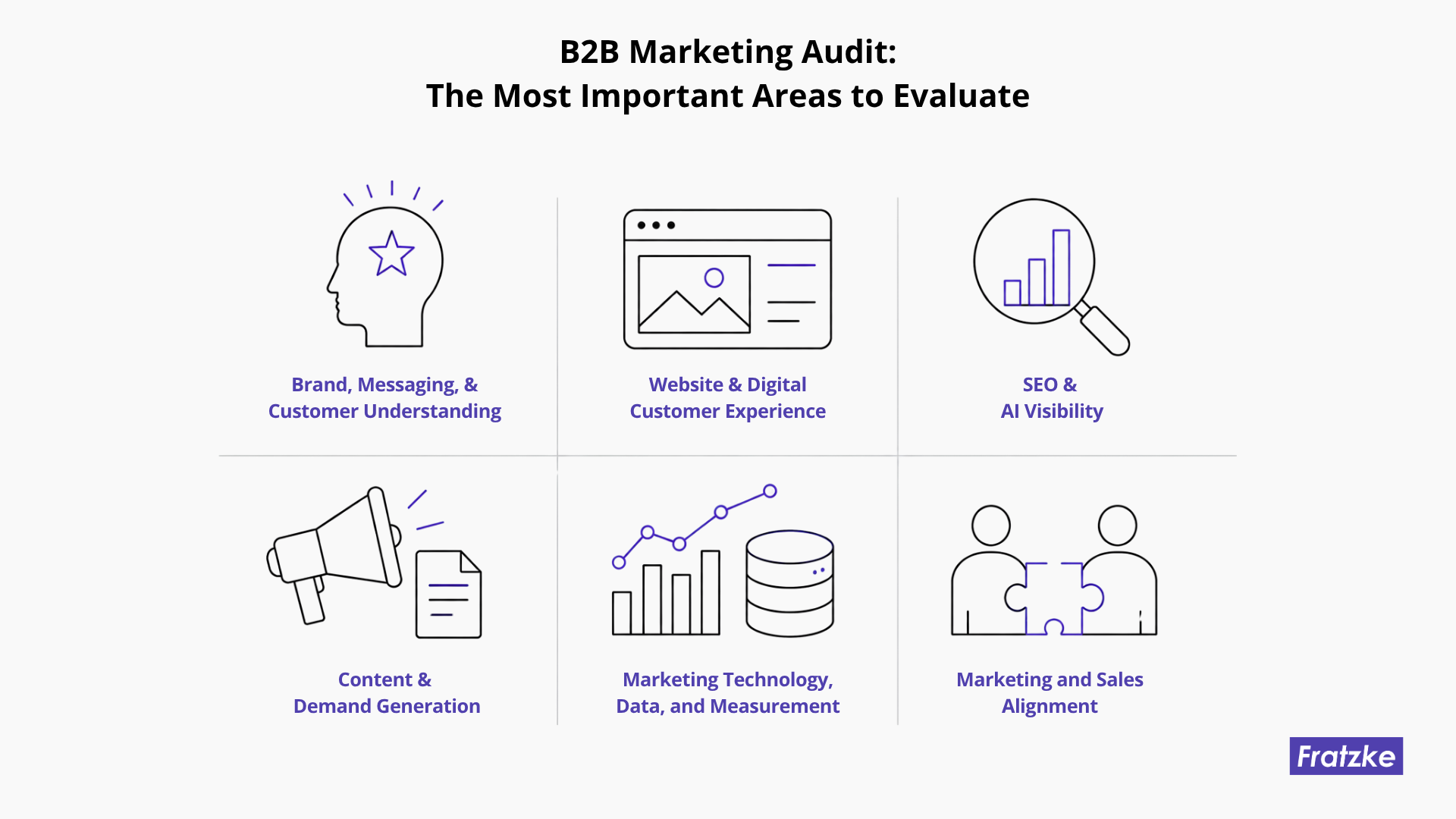
While the scope should reflect each organization’s needs, we typically recommend that a B2B marketing audit evaluates the following areas.
The Most Important Areas to Evaluate
Brand, Messaging, and Customer Understanding
Your marketing should clearly communicate who you serve, what makes your company different, and why customers should choose you. An audit evaluates whether your positioning and messaging reflect customer needs and remain consistent across your website, content, campaigns, and sales materials.
This may include reviewing:
Brand positioning and value proposition
Audience and customer insights
Message clarity and consistency
Competitive differentiation
Alignment between marketing and sales messaging
Website and Digital Customer Experience
For many B2B buyers, your website is the first place they evaluate your company. An audit examines whether the experience makes it easy for different decision-makers to find answers, understand your value, and take the next step. This may include reviewing:
Navigation and information architecture
Mobile responsiveness and accessibility
Site speed and technical performance
Landing pages and conversion paths
Calls to action, forms, and contact options
Content for different audiences and buying stages
SEO and AI Visibility
An SEO audit and AI visibility audit shows whether customers can find your company when researching their needs and evaluating potential solutions. It considers both traditional search performance and how clearly your content communicates expertise as AI-powered search changes the discovery process. This may include evaluating:
Technical SEO health
Keyword and search-intent alignment
Metadata and internal linking
Organic visibility and traffic trends
Visibility in AI-generated answers and citations
Brand authority and third-party mentions
Content gaps and topical authority
Competitor visibility
Content and Demand Generation
Content should do more than attract traffic. It should answer customer questions, build confidence, generate qualified interest, and help buyers move forward. A content marketing audit examines:
Content alignment with customer needs and buying stages
Engagement and conversion performance
Calls to action and next-step pathways
Campaign and landing-page effectiveness
Lead quality and progression
Opportunities to update, consolidate, or create content
Channels, Campaigns, and Paid Media
Individual marketing channels can appear successful while producing limited business impact. An audit evaluates how campaigns and channels work together like social media, email, and digital advertising, and whether they are reaching the right audiences, supporting the customer journey, and contributing to meaningful outcomes. This may include reviewing:
Channel roles and performance
Audience targeting
Campaign messaging and creative
Paid-media efficiency
Conversion performance
Attribution and contribution to qualified leads
Marketing Technology, Data, and Measurement
Reliable data is essential for understanding performance and making informed decisions. An audit reviews whether the organization’s technology, tracking, and reporting provide a clear view of the customer journey. This may include evaluating:
Analytics and conversion tracking
CRM and marketing-automation workflows
Data quality and platform integration
Attribution and reporting
KPIs and performance benchmarks
Gaps that limit decision-making
Marketing and Sales Alignment
A B2B audit should follow the customer journey beyond lead generation. It examines whether marketing and sales share clear definitions, processes, and information, and whether qualified opportunities receive timely, consistent follow-up. This may include reviewing:
Lead definitions and qualification criteria
Marketing-to-sales handoffs
Follow-up processes and timing
CRM ownership and workflows
Sales-enablement content
Feedback between marketing and sales
Together, these findings should create the foundation for your full audit report. At Fratzke, we call this our Benchmark Report, and it includes an objective view of current performance, clear comparisons and scores, and prioritized recommendations that leaders can use to make better decisions.
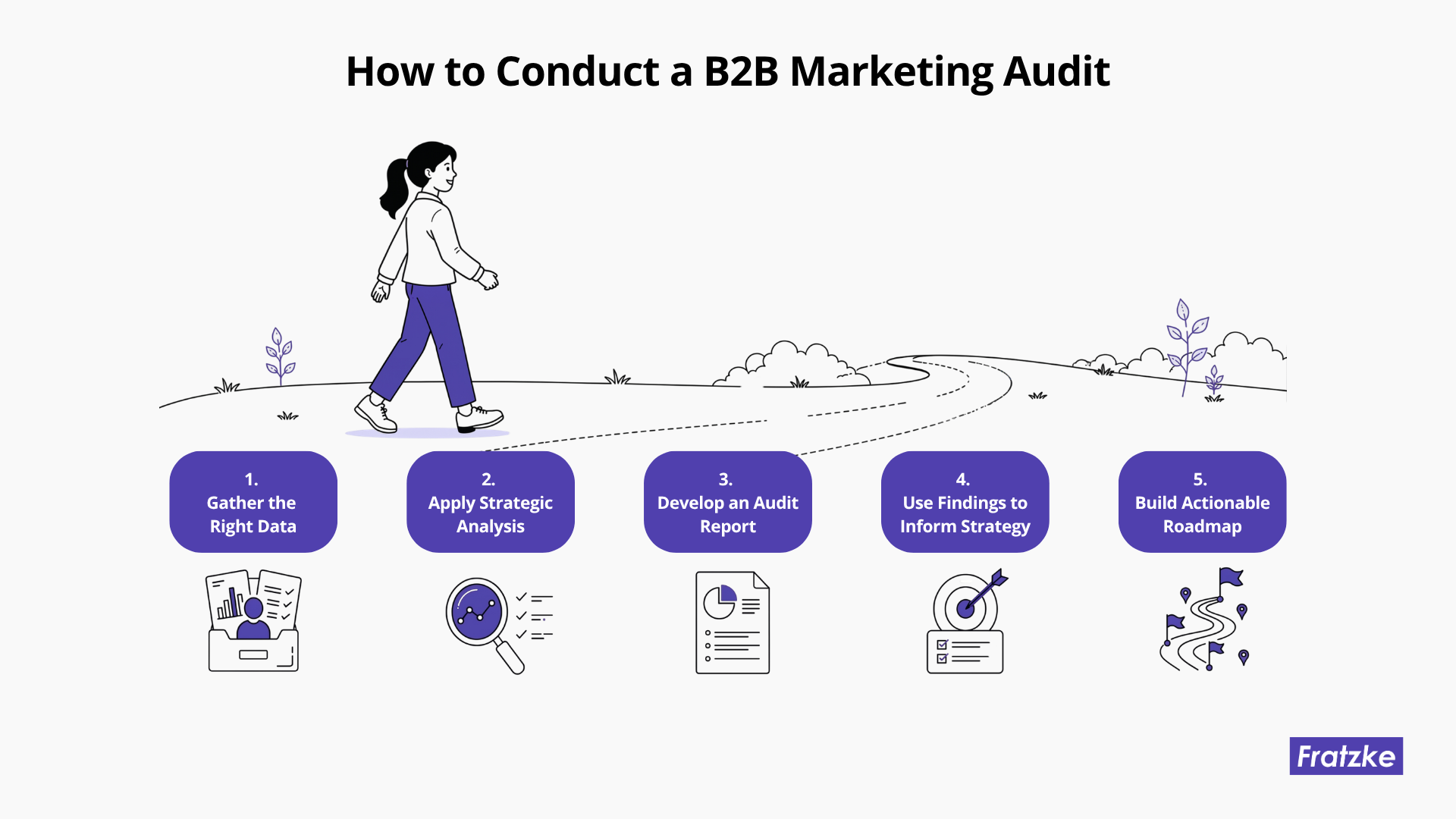
A thorough B2B marketing audit should follow a structured process that moves from evidence to action. The five stages below reflect the same principles behind the Fratzke Benchmark Method™ while giving you a practical framework for conducting your own audit.
How to Conduct a B2B Marketing Audit
1. Gather the Right Data
Start by collecting information across your marketing strategy, website, analytics, customer experience, channels, technology, sales processes, and competitive landscape. Include both quantitative performance data and qualitative insights from customers, employees, and other stakeholders.
The goal is to understand how your marketing performs as a connected system across your customer journey.
2. Apply Strategic Analysis
Next, look beyond surface-level metrics to identify the factors influencing performance. Evaluate your findings against business goals, customer needs, industry best practices, and the competitive landscape.
Your analysis should reveal:
What is working well
Where gaps or inconsistencies exist
What may be limiting performance
Which risks require attention
Where the strongest opportunities lie
At Fratzke, this is where we apply our Benchmark Method to turn data into a clear, objective assessment.
3. Develop an Audit Report
Bring your findings together in a comprehensive report that establishes a baseline for current performance. Summarize the most important strengths, weaknesses, risks, and opportunities in a format leadership can easily understand.
A useful audit report should do more than document observations. It should show where marketing stands today and create a reference point for measuring future progress.
4. Use the Findings to Inform Your Strategy
Prioritize recommendations based on business goals, customer impact, organizational readiness, and potential value. This prevents teams from treating every finding as equally urgent or pursuing disconnected improvements.
Fratzke uses our Benchmark Index™ Scorecard to support this step, helping leaders distinguish immediate priorities from longer-term opportunities.
5. Build an Actionable Roadmap
Finally, translate the prioritized recommendations into a practical roadmap. Define the sequence of work, expected outcomes, ownership, timing, and measures of success for each initiative.
The roadmap should give your team a clear path from insight to implementation. At Fratzke, we organize this work through our Guiding Light Method™ so audit findings lead to focused action rather than becoming another report that sits on a shelf.
A successful B2B marketing audit should leave you with three things: an objective view of current performance, a focused set of priorities, and a practical roadmap for growth.
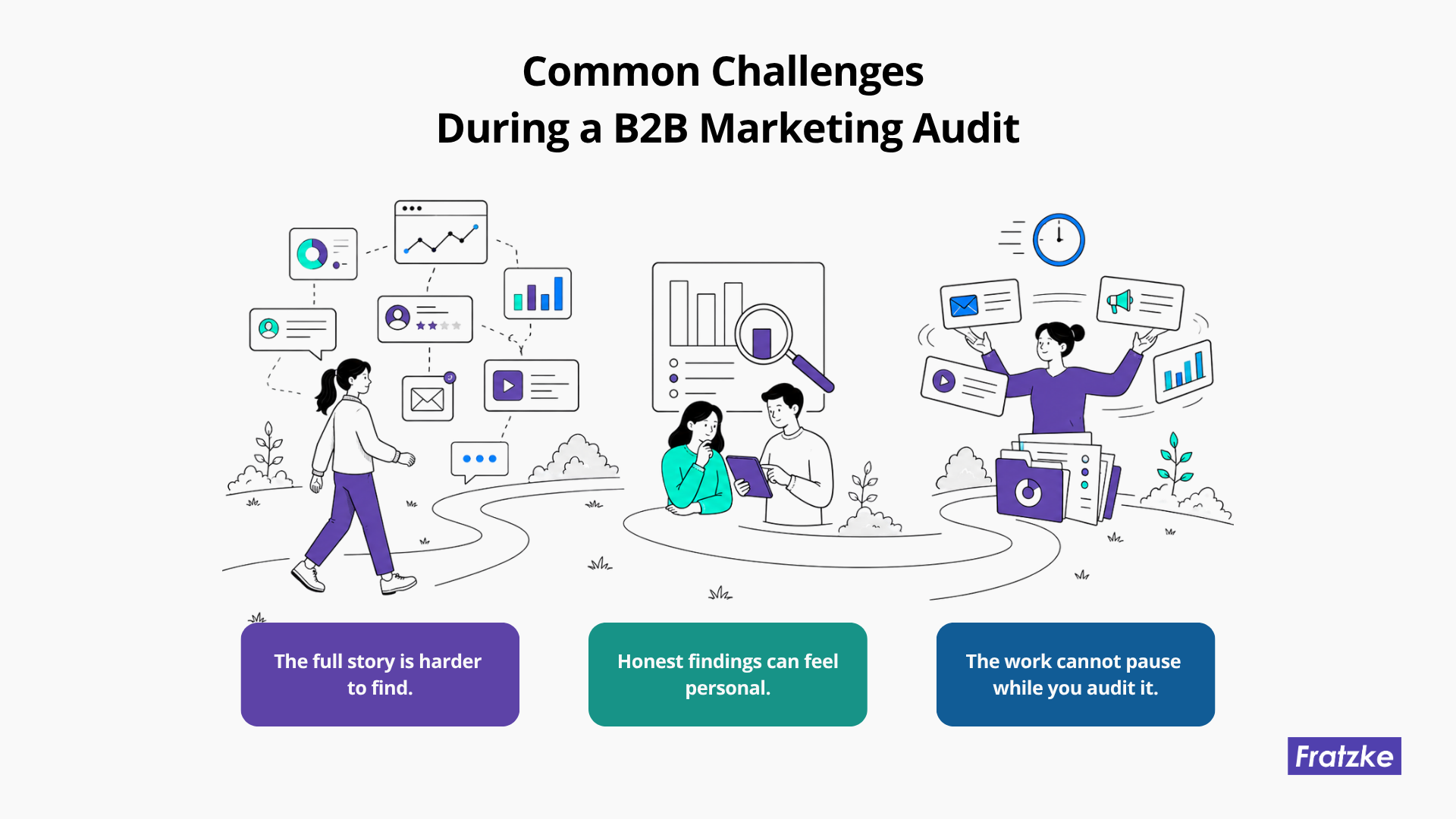
If your marketing feels difficult to evaluate, you’re not alone. Many brands face similar obstacles when conducting a B2B marketing audit. Below are some common challenges we've seen:
The data is everywhere. The full story is harder to find. The information you need is often scattered across analytics platforms, CRM reports, campaign dashboards, and customer conversations. Each source tells part of the story, but few teams have the time or perspective to connect the dots.
Honest findings can feel personal. An audit can also surface tough questions. When teams have invested deeply in their work, findings about underperforming campaigns or inefficient processes can be difficult to hear. The most productive audits create space for honest conversation, shared learning, and better decisions. The goal is to uncover what will help everyone move forward.
The work cannot pause while you audit it. Then there is the challenge almost every marketing team knows well: limited bandwidth. Auditing the work while keeping campaigns moving can stretch an already busy team even further. An experienced outside partner can bring an objective point of view, carry the analytical workload, and help turn findings into focused priorities.
Fratzke's B2B Digital Marketing Audit services helps teams see the full picture, identify the opportunities that matter most, and build a practical roadmap for growth.
When marketing efforts feel scattered, performance is difficult to measure, and priorities keep competing for attention, it becomes harder to know where to focus next.
A strong B2B marketing audit gives your team more than a list of problems. It should also reveal what is working, what is getting in the way, and where your next investment can make the greatest impact.
With the right insights, your team can make smarter decisions, strengthen the customer experience, and bring marketing activity into closer alignment with business goals. The result is a focused strategy your team can understand, support, and put into action.
Fratzke combines research, data, and human-centered thinking to help ambitious teams turn insight into intentional execution. We work as an extension of your team, bringing senior strategic guidance and the hands-on support needed to carry the work forward. Because an audit should not just end with a report. It should also spark what comes next.
How often should a B2B marketing audit be conducted?
Most companies benefit from conducting a full marketing audit once per year. Quarterly reviews can also help teams monitor performance trends and adapt more quickly. Frequent evaluation keeps marketing aligned with changing business goals.
What is the difference between a standard digital marketing audit and a B2B marketing audit?
A standard digital marketing audit evaluates overall strategy, channels, campaigns, brand positioning, technology, and performance. A B2B marketing audit examines those same areas through the lens of a longer, more complex buying journey involving multiple decision-makers.
It also places greater emphasis on marketing and sales alignment, lead quality, account-based marketing, content across the buyer journey, and marketing’s contribution to pipeline and revenue. In short, the fundamentals are similar, but a B2B marketing audit is tailored to how business buyers research, evaluate, and approve purchasing decisions.
What tools are commonly used during a B2B marketing audit?
Teams often rely on platforms like Google Analytics, SEMrush, Ahrefs, HubSpot, and CRM reporting systems. These tools help measure traffic, rankings, conversions, and engagement. Combining quantitative data with qualitative analysis creates stronger insights.
Can a marketing audit improve ROI?
Yes. Marketing audits help identify wasted spend, underperforming campaigns, and conversion issues that reduce efficiency. Optimizing those areas often leads to a stronger ROI without increasing the overall budget.
How long does a B2B marketing audit take?
The timeline depends on the size of the company and the depth of the evaluation. Smaller audits may take a few weeks, while larger enterprise reviews can take several months. Organized data and clearly defined goals help streamline the process.
About The Contributors
James Fratzke is a Partner and Executive Strategist at Fratzke with more than a decade of experience helping mid-market and enterprise organizations improve their digital marketing strategies, customer experiences, and marketing operations. His work spans digital marketing audits, competitive benchmarking, performance measurement, strategic growth planning, and leading enterprise website design and development initiatives for brands including Disney, Dollar Tree, Patagonia, Advance Auto Parts, Ferguson, Jelly Belly, Pentair, and Crocs. James has contributed to or been featured in publications including Forbes and the Orange County Register, has spoken at industry events, and serves on the CSUF College of Business and Economics Executive Council. View Full Profile.
Fratzke is a top-rated strategic agency that helps mid-market and enterprise brands spark growth through customer insights, brand strategy, marketing, and creating digital experiences. Since our founding in 2017, we've worked with leading brands across industries including Razer, TopBuild, REI, DTS, and TiVo, partnering from research and strategy through implementation. We combine data, technology, and human-centered storytelling to help brands better understand their customers, strengthen their market position, and create consistent growth over time. Learn More.
Ready to Benchmark Your Digital Marketing Performance with an Expert Audit?
Fratzke's Digital Marketing Audit gives you an objective view of where you stand today, how you compare, and which opportunities deserve the greatest attention.




.png)
.avif)