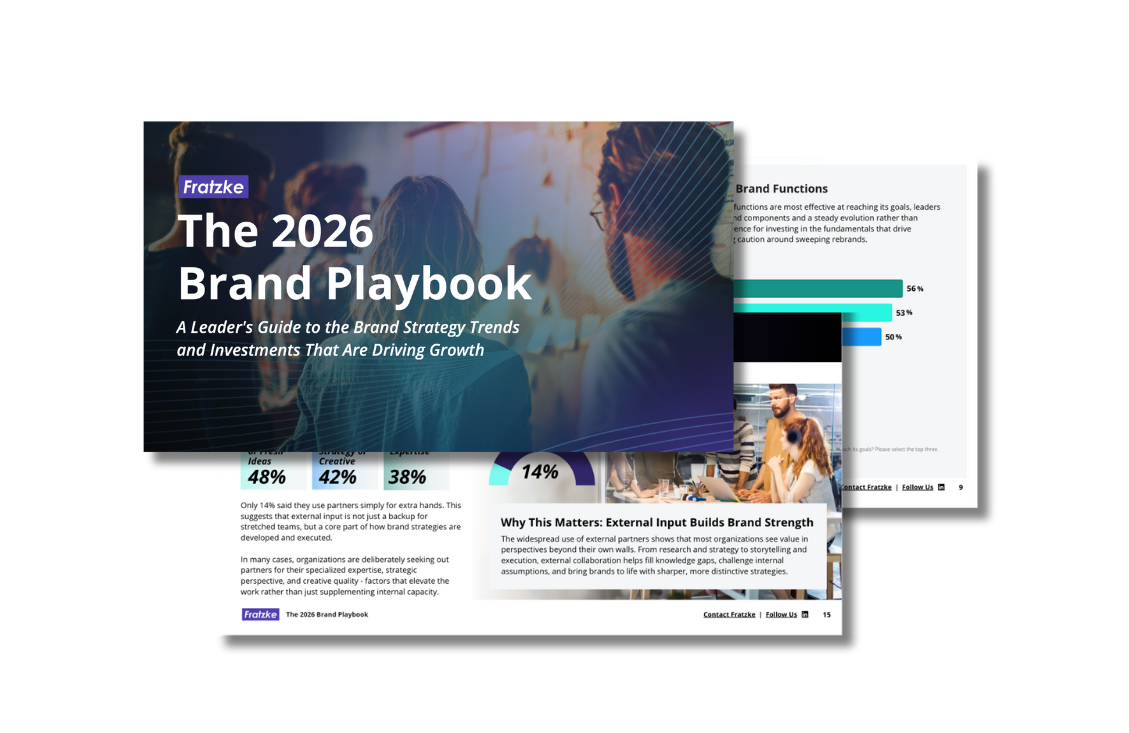
The clearest brand strategy trend heading into 2026 is a preference for evolution over reinvention. Brand leaders are investing in brand storytelling, research, and strategy refinement rather than sweeping rebrands, and they are leaning more heavily on strong leadership, external partners, and early-stage AI to get there. These findings come from Fratzke's 2026 Brand Playbook, an original survey of 100+ brand leaders at mid-market and enterprise organizations.
In this guide, we'll walk through the four biggest brand strategy trends from Fratzke's research: why evolution is outperforming revolution, how leadership and clarity drive brand confidence, why most organizations lean on external partners, and where AI fits into brand strategy today. We'll also share what each trend means for your organization and how to apply it.
Key Takeaways
Evolution over revolution: Brand storytelling (56%), brand research (53%), and brand strategy (50%) are rated the most effective ways to strengthen a brand. Large-scale rebrands rank lowest, at 18%.
Leadership and clarity fuel brand confidence: Strong leadership and vision (42%) and effective strategy communication (41%) were the most frequently selected contributors to successful brand strategy.
Outside partners play an essential role: Nearly 7 in 10 organizations said they work with external firms. Fresh perspective, quality and specialized expertise matter far more than simply adding hands.
AI adoption is nearly universal, but strategically underused: 81% of brands use AI in brand work today, mostly for content and workflow tasks, leaving brand governance and consistency as the next frontier.
The 2026 Brand Playbook is built on a survey of 101 brand leaders across industries, regions and business models. Most respondents work at companies with 51 to 1,000 employees (79%) and annual revenue between $6 million and $500 million (72%). The sample includes B2B organizations (26%), B2C organizations (23%) and organizations serving both markets (50%).
The respondents also bring senior decision-making experience: 61% are marketing executives at the director level or above. The survey examined which brand functions leaders consider effective, how strategies are set and communicated, how teams use outside partners and where AI is creating value or concern.
Trend 1: Evolution Over Revolution
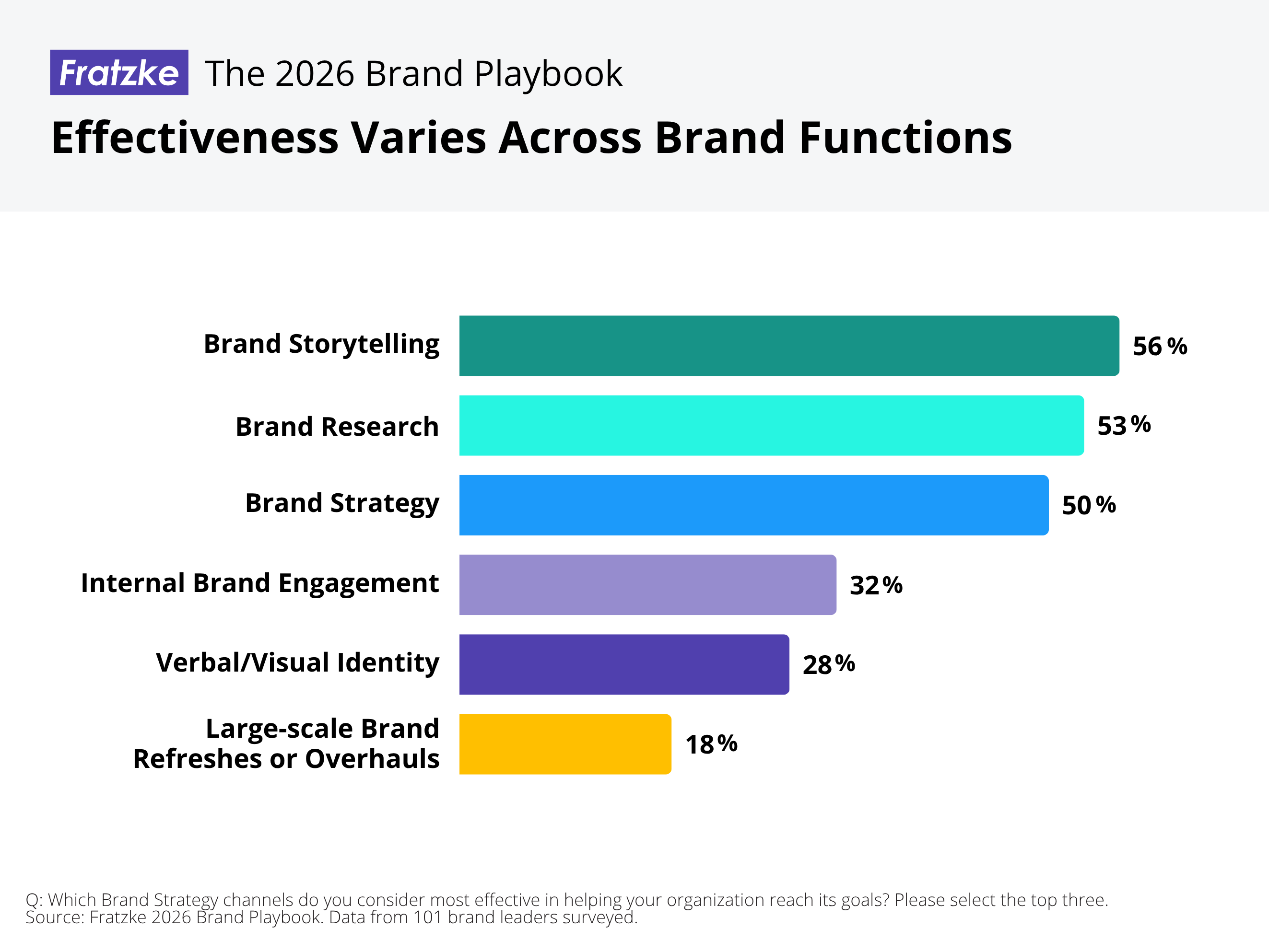
When Fratzke asked brand leaders which functions were most effective at reaching their goals, the pattern was clear. Brand storytelling (56%), brand research (53%), and brand strategy (50%) topped the list. Large-scale brand refreshes and overhauls came in last, at just 18%.
The data reflects a climate where sweeping rebrands carry meaningful business risk, not just reputational risk. Two recent examples show why leaders are cautious. Cracker Barrel's reported $700M rebrand removed a long-standing character from its logo, triggering a stock dip, public criticism, and political backlash that forced a reversal within days. Jaguar faced similar backlash for retiring a heritage mark as part of its shift to electric vehicles, with critics arguing the brand had abandoned its legacy.
The lesson isn't that brands should avoid evolving. It's that evolution should build on existing equity instead of erasing it.
What Brand Leaders Can Do
Protect what already works. Identify the assets, associations and experiences customers value before deciding what to change.
Use research as a guardrail. Ground decisions in customer needs, employee experience, competitive context and brand performance—not internal preference alone.
Define the business case for change. Connect each proposed shift to a strategic need, such as entering a market, improving relevance, supporting growth or reducing confusion.
Bring the story and experience with you. A brand change becomes real through the messages, behaviors and customer interactions that follow it.
Plan for reaction and adoption. Test thoughtfully, prepare leaders and employees, and give audiences enough context to understand the change.
Curious where reinvention makes sense versus where it backfires? The 2026 Brand Playbook breaks down when bigger changes are warranted and how to protect your brand while making them.
Brand strategy performance starts with how clearly leadership defines and communicates direction. 52% of brand leaders describe themselves as “very satisfied” with their brand strategy performance, while 43% say they are only “somewhat satisfied.” That gap points to a specific cause: strategy quality, not effort.
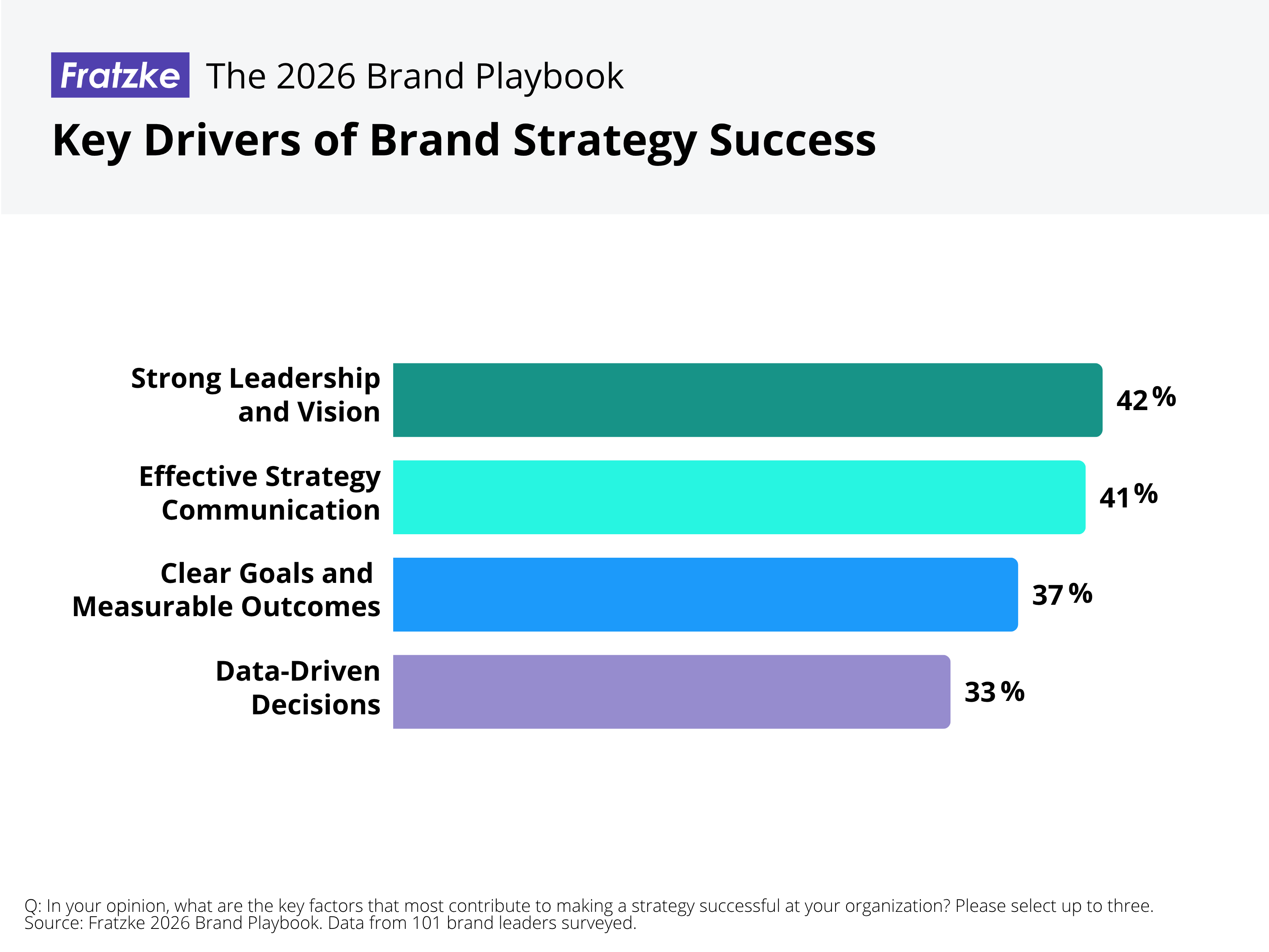
When asked what makes a brand strategy successful, leaders pointed to strong leadership and vision (42%) and effective strategy communication (41%) ahead of clear goals and measurable outcomes (37%) and data-driven decisions (33%). Having a strategy is not the same as having a strategy people can act on.
Clarity follows the same pattern. 58% of respondents say their overall brand strategy is “very clear,” but that clarity is not distributed evenly across every discipline:
Brand Function
% Rated Most Effective
Brand Storytelling
56%
Brand Research
53%
Brand Strategy
50%
Internal Brand Engagement
32%
Verbal/Visual Identity
28%
Large-Scale Brand Refreshes or Overhauls
18%
Source: Fratzke 2026 Brand Playbook. Data from 101 brand leaders surveyed.
Visual identity tops the list, which tracks. Managing how a brand looks is more straightforward than shaping how it thinks and sounds. Strategy and research require long-term vision, and storytelling and verbal identity require nuance and consistency across every team producing content.
"Organizations that focus on evolving their brand with purpose, aligning teams, and applying emerging technology with intentionality will be the ones that drive brand affinity and growth." - Ryan Fratzke, Partner & Executive Strategist
How Strategy is Set Can Influence Outcomes
A strategy cannot guide the organization if leaders have not made its choices clear. Teams need to understand who the brand is for, what it promises, how it is different and what those decisions mean for their work. Leadership creates focus by setting those boundaries and reinforcing them when priorities compete.
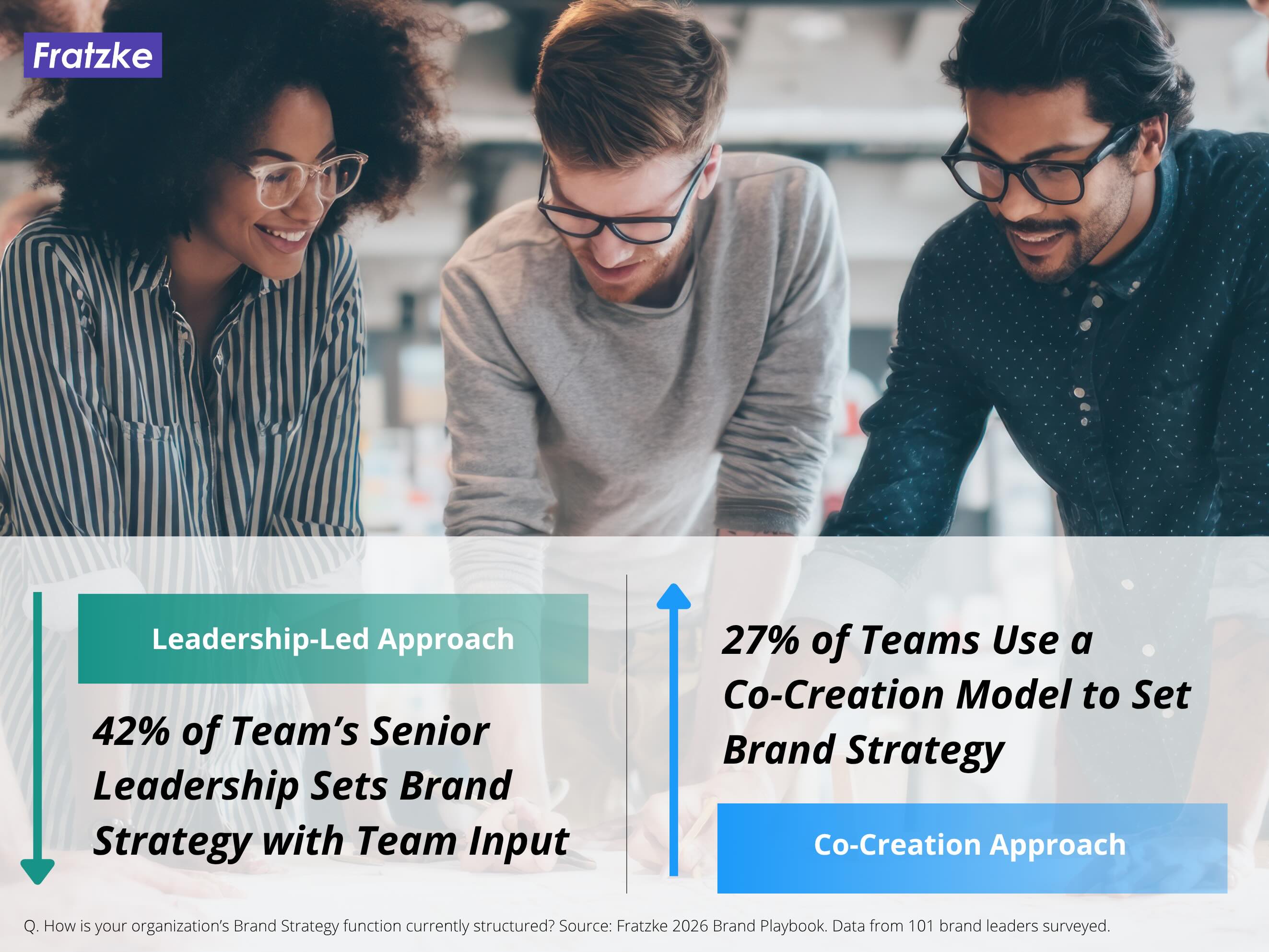
The research suggests that many organizations already use a blended model. Forty-two percent say senior leadership sets brand strategy with team input, while 27% describe a co-created approach. Leader and Advanced organizations are more likely to use the leadership-led model (49%), while less mature organizations are more likely to co-create with teams (39%).
That pattern should not be read as an argument against participation. It points to a useful distinction: teams can inform the strategy and help translate it into action, but leaders still need to make and own the choices.
What Brand Leaders Can Do
Set direction at the top. Strong brands start with leadership clearly defining where the brand is going.
Communicate “why” behind the strategy. A documented strategy only works if teams understand the reasoning behind it.
Build in measurable goals. Clear, specific outcomes make a strategy easier to execute and evaluate.
While team structures vary widely, our research found that most organizations do not develop their brand strategy in a silo.
Fratzke found organizations split fairly evenly across three team structures: hybrid teams with a mix of in-house team members and external partners (36%), primarily relying on external partners (33%), and primarily relying on in-house teams (32%). Across all three, 69% of organizations work with an external firm in some capacity, and 59% prefer boutique, mid-size, or specialized agencies over large full-service shops.
The reasons brands bring in outside help are often strategic. Leaders cited outside perspective or fresh ideas (48%), higher-quality strategy or creative (42%), and access to specialized expertise (38%) as their top reasons for partnering externally. Only 14% said they use partners simply for extra hands.
Reason for Working With External Partners
% of Leaders
Outside Perspective or Fresh Ideas
48%
Higher Quality Strategy or Creative
42%
Access to Specialized Expertise
38%
Extra Capacity or Hands
14%
Source: Fratzke 2026 Brand Playbook. Data from 101 brand leaders surveyed.
What Brand Leaders Can Do
Choose partners for expertise, not just bandwidth. The strongest partnerships add capability your team doesn't already have.
Look past the largest agencies. Boutique and specialized firms often provide more senior attention and faster execution.
Treat partnership as an extension of your team. The best external relationships operate with the same accountability as an internal hire.
Trend 4: AI in Brand Strategy: Widespread but Still Tactical
AI has moved from experimental to expected. 81% of brand leaders say their organization now uses AI in brand work, most often ChatGPT (77%), Canva (55%), Google AI (44%), and Copilot (35%).
Most AI use remains tactical. The top applications are enhancing brand strategy and messaging (51%), writing or editing content (45%), generating images or visual assets (44%), and automating tasks, reports, and workflows (41%).
Top AI Applications
% of Leaders
Enhancing Brand Strategy and Messaging
51%
Writing or Editing Content
45%
Generating Images or Visual Assets
44%
Automating Tasks, Reports, and Workflows
41%
Source: Fratzke 2026 Brand Playbook. Data from 101 brand leaders surveyed.
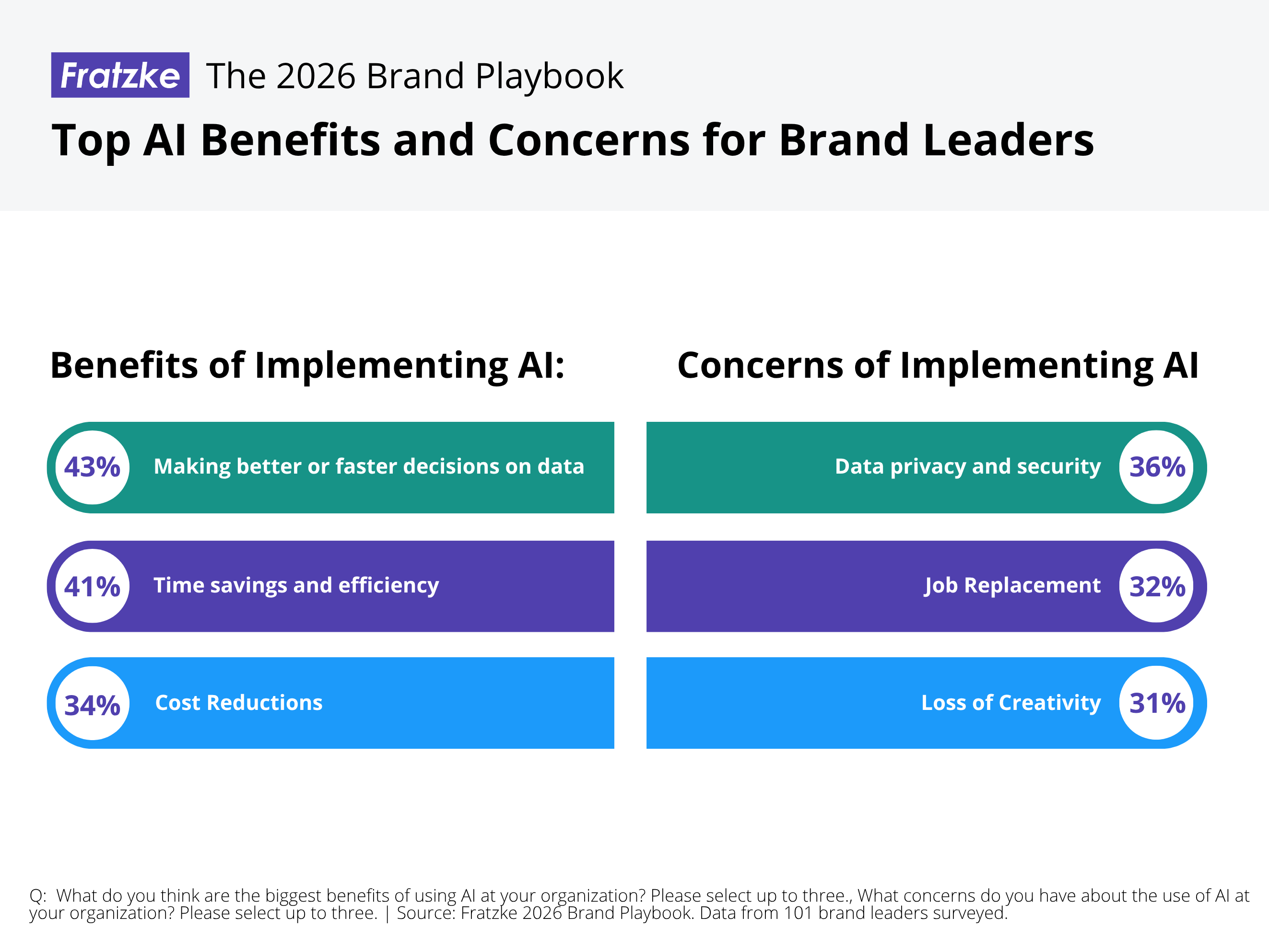
The benefits leaders report are what you'd expect from tools built for speed: better or faster data-driven decisions (43%), time savings (41%), and cost reductions (34%). The concerns are just as clear. Leaders worry about data privacy and security (36%), job replacement (32%), and loss of creativity (31%).
Here's the opportunity many teams are missing. AI adoption is high, but almost no one is applying it to the areas where brand leaders struggle most: governance, consistency, and tone of voice. Speed is not strategy, and a brand that sounds generic or inconsistent across channels loses the trust it worked to build.
What Brand Leaders Can Do
Train AI on brand-approved assets. Feed it your guidelines, tone of voice, and past campaigns so outputs start closer to on-brand.
Treat AI output as a first draft. Keep a human in the loop for nuance, judgment, and fact-checking.
Set guardrails for consistency. Monitor AI-assisted output across channels to catch tone or design drift early.
Balance efficiency with authenticity. The brands that stand out will use AI for speed while protecting the creativity that makes them memorable.
Across all four trends, one theme holds: brand strength comes from foundational discipline, not dramatic reinvention. Objective benchmarking, clear direction-setting, and consistent execution matter more than a flashy new look or a quick AI-generated campaign.
That discipline is exactly what Fratzke's own frameworks are built to support. The Fratzke Benchmark Method gives leaders an objective read on where their brand stands today. The Fratzke Guiding Light Method turns that insight into a shared vision and a prioritized roadmap. And the Fratzke Growth Framework connects the two into one continuous cycle of benchmarking, strategy, and execution.
If your organization has a defined strategy but struggles with follow-through, that mirrors what most of the leaders in this research reported. Closing the gap between confidence and consistent execution starts with benchmarking where you stand today, defining a shared vision leadership can communicate clearly, and building a roadmap your whole team, and any external partners, can execute against.
Grow your brand by taking the following steps:
Taken together, the findings point to a brand agenda built around focus rather than novelty. The organizations best positioned to create durable growth will strengthen the foundations that help every team make better decisions.
Invest in research and storytelling Use customer, employee and competitive insight to understand which perceptions create value, which need to change and which parts of the brand deserve protection. Translate those insights into a story that is distinctive, relevant and easy for people to repeat.
Lead with clarity Set a clear direction at the leadership level, invite the right input and communicate the resulting choices across the organization. Give teams practical tools and examples that turn strategy into consistent decisions.
Find partners who elevate strategy and execution Evaluate partners on the quality of their thinking, not just the volume of their output. The right team should bring perspective, specialized expertise and a higher standard of strategy or creative while working as an extension of the internal team.
Use AI to reinforce the brand Apply AI where it can improve speed, access and consistency, but establish clear boundaries for data, quality and approval. Keep human creativity and accountability at the center of the work.
Ready to Strengthen Your Brand Strategy?
Download The 2026 Brand Playbook for the complete findings, or talk with Fratzke about turning customer insight into a clearer brand strategy and a practical roadmap for growth.
Download Your Free Copy of the 2026 Brand Playbook. Get the Report.
What is the biggest brand strategy trend for 2026?
The clearest trend is a shift toward evolution over revolution. Brand leaders rate storytelling, research, and strategy refinement as far more effective than large-scale rebrands, which ranked last in Fratzke's 2026 survey.
Why are large-scale rebrands riskier right now?
Rebrands increasingly become cultural and political flashpoints. Recent examples from Cracker Barrel and Jaguar show how quickly public reaction can force a reversal, even when changes were carefully tested internally.
What makes a brand strategy successful?
Survey respondents most often selected strong leadership and vision, effective strategy communication, clear goals and measurable outcomes, and data-driven decisions. In practice, the strategy also needs to translate into usable choices for teams.
Should brand strategy be led internally or by an external partner?
Most organizations use a combination of both. 69% of brands in Fratzke's research work with an external partner, most often for outside perspective, higher-quality strategy or creative work, and specialized expertise rather than just added capacity.
How can leaders measure brand strategy maturity?
Assess whether the brand is clearly defined, consistently expressed, differentiated, adopted internally, reflected in the customer experience and measured over time. Fratzke’s five-level scale runs from Laggard to Leader.
When should a company hire an external brand strategy partner?
Outside support is most useful when the organization needs objective research, fresh perspective, specialized expertise, senior strategic depth or help translating strategy into consistent execution.
How are brands using AI in brand strategy today?
81% of brand leaders report using AI, primarily for content creation, visual assets, and workflow automation. Fewer organizations are yet applying AI to brand governance or consistency, which represents the next major opportunity.
How often should we revisit our brand strategy?
There's no universal timeline, but strategy should be reviewed whenever business goals shift, performance data reveals gaps, or a benchmark assessment shows your brand has fallen behind the market. Fratzke recommends periodic benchmarking rather than waiting for a crisis to force a review.
About The Contributors
Lisa Fratzke is a Partner and Executive Strategist at Fratzke, helping organizations drive growth through human-centered brand, marketing, and communications strategies. She specializes in blending data-driven insight, brand storytelling, digital experiences, and the principles of human behavior to help brands build authentic connections inside and out with their employees, customers, and their communities.
With more than 15 years of experience, including nearly a decade in-house at The Walt Disney Company, she has advised senior leaders and guided work for brands including Disney, REI, Razer, DTS, and TiVo. Lisa has been a featured speaker for Ragan, Microsoft, and the American Marketing Association, and has been published by ANA, ACCP, IABC, Ragan, and more. View Full Profile
Fratzke is a top-rated strategic agency that helps mid-market and enterprise brands spark growth through customer insights, brand strategy, marketing, and creating digital experiences. Since our founding in 2017, we've worked with leading brands across industries including Razer, TopBuild, REI, DTS, and TiVo, partnering from research and strategy through implementation. We combine data, technology, and human-centered storytelling to help brands better understand their customers, strengthen their market position, and create consistent growth over time. Learn More.
Build a Stronger Brand Strategy
Turn your business goals into a clear brand strategy focused on the opportunities that can create the greatest impact.