Welcome to Two Hits & A Miss!
I'm Ryan Fratzke, Co-Founder and Partner at Fratzke. Each week, I share two moves I think brands got right and one that might have missed the mark across marketing, business strategy, AI and customer experience.
This week, Google puts its search data to work for holiday shoppers, OpenAI gives businesses a way to manage their presence in ChatGPT, and a new study asks whether AI customer service is working as well as companies think.
Plus, in a new bonus section “Hit or Miss”!
Starbucks, Trader Joe's and McDonald's have me wondering whether everything really needs to come in a mystery box.
Let's get into it.
Hit #1: Google Makes Data Useful

Google sees more than one billion shopping-related searches every day. That's a lot of information about what people are interested in buying.
Google recently released its annual Holiday 100, a gift guide built around products and categories gaining attention in search. If you're struggling to figure out what to buy someone for the holidays, this is actually a pretty good place to start.
It's also a smart way to bring more people to Google Shopping. The Holiday 100 gives shoppers a reason to explore products on Google's platform, where the company can generate revenue through shopping ads.
Some of the trends are pretty interesting:
- Searches for lymphatic sculpting face brushes jumped 400%.
- Classic toy train sets surged 240%.
- Podcast microphones climbed 115%.
And perfume was the most-searched type of gift set. (That blows my mind 🤯)
What I like most is that Google didn't need to create something entirely new. It took data it already had and turned it into content people might actually find useful.
I wonder how many other companies are sitting on valuable customer information that could be put to work in the same way.
Hit #2: OpenAI Takes a Page From Google's Playbook

On November 10, OpenAI introduced Businesses in ChatGPT, allowing eligible companies to claim their business, manage information and see how customers discover them through ChatGPT.
Sound familiar?
It's essentially the beginning of what Google built years ago with Google My Business.
Google understood that giving businesses free tools to manage their information made its platform more useful to consumers. It also created relationships with those businesses that could eventually turn into advertising revenue.
Having spent years in multi-location marketing, I've seen how important Google's business listings became for brands with hundreds or thousands of locations.
I think we're watching OpenAI follow a similar playbook. Between introducing advertising and now business listings, ChatGPT is looking more and more like a direct competitor to Google.
My philosophy as a marketer has always been simple: When a platform gives you tools to manage your business information, use them.
Claiming your business won't guarantee better rankings, but it's an easy step worth taking.
If your business is eligible, go claim it.
The Miss: Expedia Opens My Eyes to AI Customer Support

It's been a while since I've had to call customer support. But this week, I needed to change an upcoming trip, which led to my first real experience with an AI customer service agent at Expedia.
I wasn't impressed.
First, Expedia makes it surprisingly difficult to even find a phone number. After jumping through hoops just to make a call, I was greeted by an AI agent that seemed more interested in keeping me from reaching a human than solving my problem.
The whole experience was bizarre. The agent tried a little too hard to sound human, even making clicking noises in the background as if someone were typing. It was like talking into an empty void, except the void was pretending to be a person.
Which brings me to an interesting finding from Twilio's 2026 Customer Insights Series.
86% of businesses believe customers are satisfied with their AI-powered customer service. Only 51% of consumers agree.
That's a 35-percentage-point gap between what companies think they're delivering and what customers are experiencing.
I suspect part of the problem is what businesses are measuring. They're celebrating how many calls AI handles and how much money it saves. Meanwhile, customers just want their problems resolved.
AI has plenty of potential to improve customer support. But when it creates more friction than it removes, we've missed the point.
Automating a bad experience doesn't make it a good experience. It just makes it cheaper to deliver.
Bonus: Hit or Miss? The Mysteries of Life
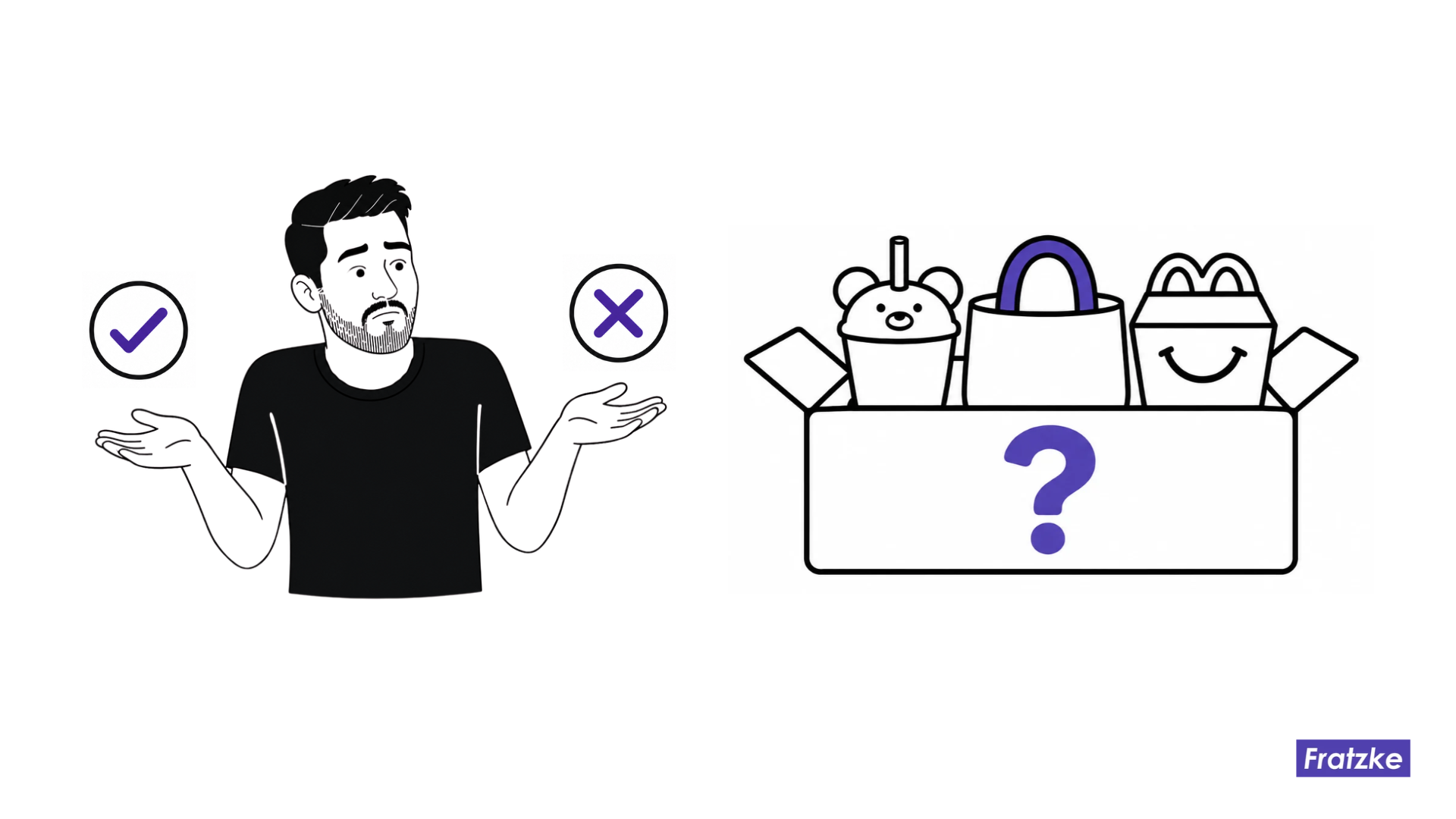
I'm starting to think we've taken the mystery box trend a little too far.
Last week, I gave Starbucks credit for its handmade holiday campaign. This week, it's selling $39.95 Bearista collectible cups in mystery boxes, with five possible characters, including a rare golden bear.
For research purposes, I stopped by my local Starbucks to see what all the excitement was about. Sold out. Apparently, people started lining up at 4:30 in the morning.
Yikes.
And Starbucks isn't alone.
Trader Joe's is bringing back its $2.99 mystery packs featuring three reusable shopping bags with surprise designs. People are posting videos of themselves opening grocery bags to find out which grocery bags they bought.
Who knew grocery bags could be this exciting?
Then there's McDonald's, which took the original mystery box, the Happy Meal, and added a Hello Kitty x Godzilla collection with eight possible characters.
A mystery box inside a mystery box. Boxception?
I get why brands love this. Surprise creates excitement, collectibles encourage repeat purchases, and the unboxing becomes content.
But does everything need to be a collectible experience?
Remember when older generations told millennials they'd be able to afford a house if they stopped buying $6 lattes?
Well, now the lattes are $8 and apparently we're spending $40 on mystery coffee cups.
Look, everyone has things they enjoy spending money on. But maybe the mystery isn't what's inside the box. It's how much we're willing to spend to find out.
I don't know. Just some food for thought.
What do you think? Hit or Miss?
That's it for this week's Two Hits & A Miss.
As always, I hope these stories gave you something interesting to think about, a new perspective, or at least a good laugh.
Thanks for reading, and I'll see you next week.
Sources:
Google, Holiday 100 gift guide (November 9, 2026)
OpenAI, Introducing Businesses in ChatGPT (November 10, 2026)
OpenAI, Setting up your business on ChatGPT
Twilio, The AI Expectations Gap (November 9, 2026)
Starbucks, Bearista Surprise Box collection (November 9, 2026)
USA Today, Trader Joe's mystery packs (November 2, 2026)
McDonald's, Hello Kitty & Friends x Godzilla Happy Meal (August 18, 2026)