The biggest digital marketing trend in 2026 is not a single channel, platform, or AI tool. It is the growing performance gap between marketing organizations that invest with clarity and those that struggle to turn plans into consistent execution.
Fratzke surveyed more than 350 marketing leaders across B2B, B2C, and hybrid organizations to understand how teams are investing, building strategy, executing their plans, and using AI. The findings show strong confidence and increased investment across marketing, but they also reveal where progress is stalling.
For CMOs and senior marketing leaders, that gap has real business consequences. More spending does not create sustainable growth when the strategy is unclear, teams are misaligned, or AI adoption moves faster than governance. This article explores the four defining trends from Fratzke’s 2026 Digital Marketing Trends Report and what leaders can do about each one.
Key Takeaways
Marketing Investment Is Rising Across Nearly Every Function: Growth is led by performance marketing at 78%, social media at 76% and content marketing at 75%.
High-Maturity Teams Invest Beyond Execution: More than 80% increased spending in analytics and measurement, customer experience strategy, research and insights, and brand strategy.
Strategic Clarity Remains Limited: Only 40% of marketing teams describe their strategy as very clear, and just 39% say they execute it very effectively.
Execution Confidence Rises Sharply With Maturity: 92% of Advanced and Leader organizations say they execute well, compared with 57% of lower-maturity teams.
AI Is Mainstream but Still Tactical: Sixty-one percent of teams use it, while fewer than one in five use it for media planning, decision support or brand strategy.
Fratzke's 2026 Digital Marketing Trends Report reflects insights from more than 350 marketing leaders across a range of industries, company sizes, and business models. Most respondents work at organizations with 501 to 5,000 employees, and 59% represent companies with annual revenue between $11 million and $500 million. The audience was evenly divided between marketing executives at the director level and above and marketing management roles.
To make sense of the differences in how teams operate, participants rated their own organization's marketing maturity using a five-point scale:
Maturity Level
Definition
Laggard
No strategy. Marketing is reactive, fragmented, and lacks alignment with business goals.
Emerging
Some basic tactics (email, social) exist. Efforts are inconsistent with limited data use.
Competent
Strategy is defined and applied across key channels. Campaigns are consistent with basic analytics.
Advanced
Marketing is data-informed, multi-channel, and aligned with broader business objectives.
Leader
Marketing is predictive, automated, and drives innovation. Fully customer-centric and performance-optimized.
Throughout the report, and this article, "Advanced and Leader" organizations are treated as the "high maturity" cohort, compared against "lower maturity" teams (Laggard, Emerging, and Competent). That framing is what makes the findings useful. It isn't just a snapshot of what marketers are doing; it's a way to see how maturity may impact decisions and impact.
Trend 1: Mature Teams Are Investing Behind the Channels
Most marketing teams feel confident in their approach. Two-thirds (66%) describe themselves as Advanced or Competent, and 93% report having a dedicated marketing budget. That alone signals something important: organizations are increasingly treating marketing as a core business function, not a line item to trim when times get tight.
Investment is up across nearly every channel, with three areas seeing the sharpest increases:
Channel
Share Reporting Increased Investment
Performance Marketing
78%
Social Media Marketing
76%
Content Marketing
75%
Source: Fratzke 2026 Digital Marketing Trends Report. Data from 350 marketing leaders surveyed.
These three channels are the cornerstones of modern marketing, and as customer acquisition costs and paid media prices continue to climb, it makes sense that teams are doubling down on the channels most directly tied to traffic and measurable outcomes.
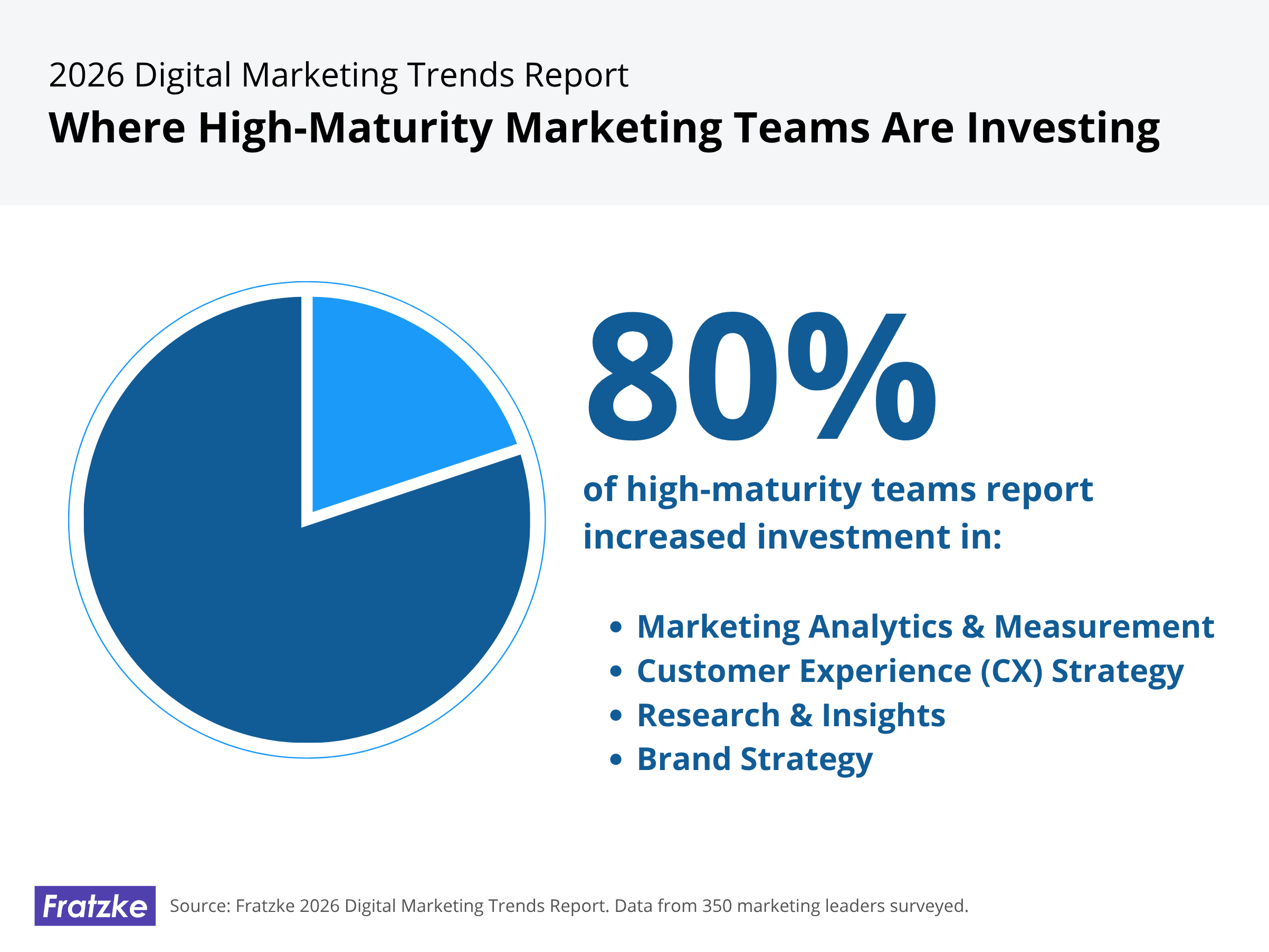
But where high-maturity teams pull ahead is in what else they fund. More than 80% of Advanced and Leader organizations report increased investment not just in executional channels, but in the functions that support insight-driven strategic planning: Marketing Analytics & Measurement, Customer Experience (CX) Strategy, Research & Insights, and Brand Strategy.
Why this matters: This is a clear divide. While most teams are heavily investing in lower-funnel execution, Advanced and Leader organizations are also dedicating substantial resources to the functions that support long-term success. Marketing maturity isn't just a self-assigned label. It shows up in how teams actually deploy their resources, and it's a strong signal of how they're thinking about growth beyond the next quarter.
See What's Inside the Full 2026 Digital Marketing Trends Report. Download Now.
Trend 2: Strategic Clarity Remains Uncommon
Nearly every team claims to have a digital marketing strategy. Far fewer can say it's actually clear. Only 40% of respondents describe their marketing strategy as "very clear," the level of clarity needed for real alignment, focus, and execution. High-performing organizations are nearly three times more likely to report that clarity, and the gap only gets wider at the channel level.
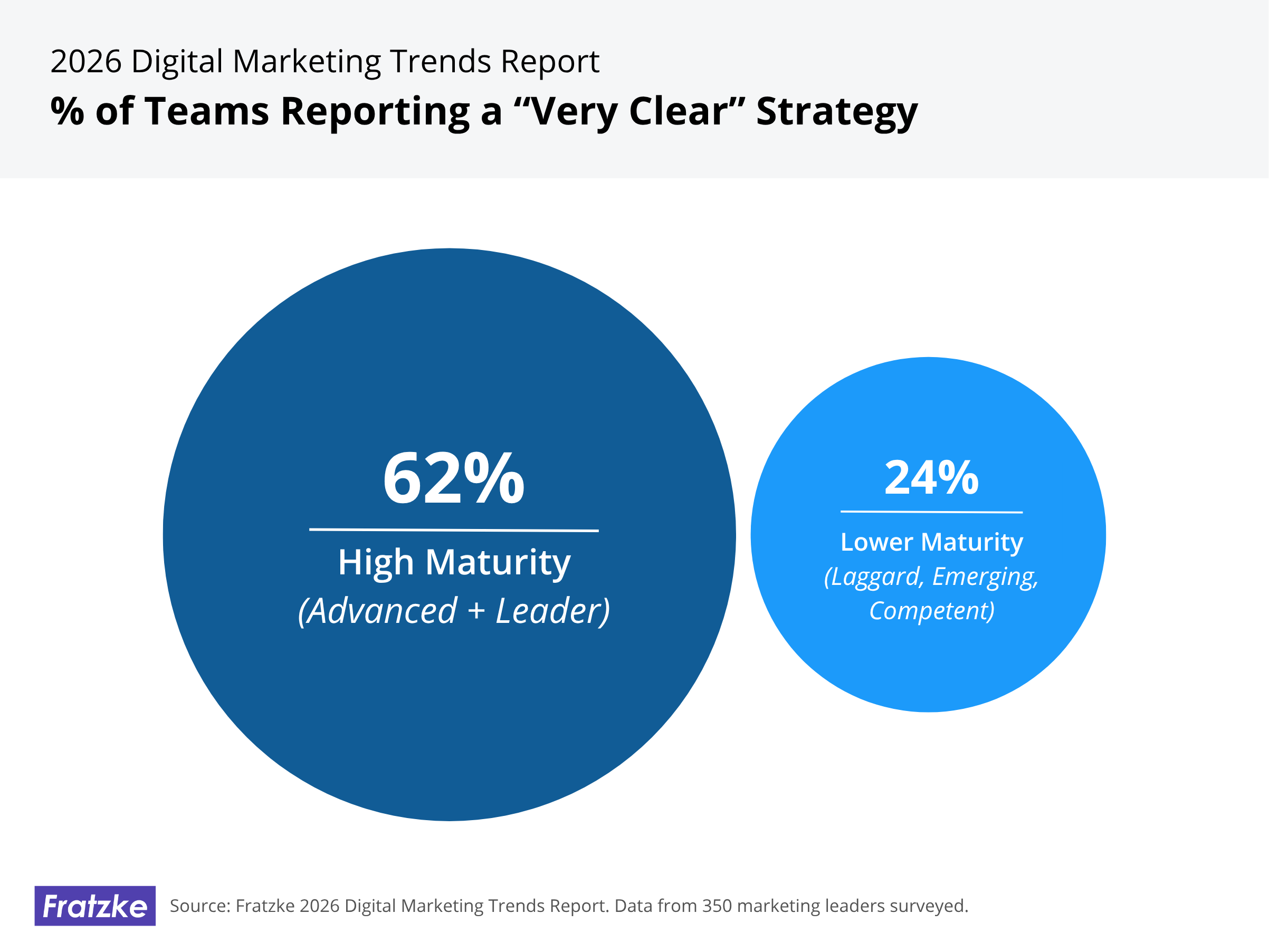
Among Advanced and Leader organizations, 62% say their strategy is "very clear," compared to just 24% of lower-maturity teams.
That's a 38-point gap between the top and everyone else, and it holds across specific channels:
Channel
Advanced + Leader
Lower Maturity
Brand Strategy
60%
20%
Customer Experience
58%
20%
Email Marketing
52%
17%
Measurement & Analytics
49%
17%
SEO
48%
18%
Social Media
47%
22%
Source: Fratzke 2026 Digital Marketing Trends Report. Data from 350 marketing leaders surveyed.
Strategy that's "somewhat clear" isn't the same as strategy the whole team can act on. Without a shared understanding, even well-funded, well-staffed teams risk misalignment.
Four Conditions Make Strategy Easier to Act On
So what actually makes a strategy clear? When asked what contributes most to strategic success, respondents pointed to four consistent themes:
Strong leadership and vision (38%)
Clear goals with measurable outcomes (36%)
Use of data and insights (34%)
Effective communication of the strategy itself (34%)
One respondent put it simply:
"We had the building blocks of a strategy, but struggled to get everyone on the same page. Clarifying the goals and how we'd measure them made all the difference." - 2026 Digital Marketing Trends Survey Respondent
Why this matters: A good strategy isn't a document that lives in a shared drive. It's a measurable, communicated framework that guides decisions across the organization. Most leaders don't feel their strategy has reached that bar yet, and without shared understanding and the ability to track progress, teams can't move with the speed the current landscape demands.
Trend 3: Effective Execution Is a Key Differentiator
Having a strategy is one thing. Following through on it is another. Just 39% of respondents say they execute their strategy very effectively, and the single biggest predictor of execution confidence isn't budget or headcount. It's marketing maturity.
92% of Advanced and Leader organizations say they execute well, compared to only 57% of Emerging, Laggard, and Competent teams.
Based on verbatim survey responses, four recurring issues hold teams back:
Structural & Operational Gaps - Many teams lack internal alignment and clear processes to turn strategy into action. Mature teams have the structure to follow through; others don't.
Strategy Lacks Precision - "Somewhat clear" isn't enough. Without a well-defined strategy, teams can't execute with confidence or consistency.
Resource Constraints - Limited staffing, expertise, or budget clarity weakens execution, even when the strategy itself is sound.
Leadership Disconnect - Top-down strategy without buy-in across levels creates breakdowns in execution and momentum.
External Partners Are Being Asked to Raise the Level of the Work
To close these gaps, many teams are turning to outside partners. 61% of organizations use external partners, and 87% are satisfied with the results. The top reasons teams go outside their own walls:
Better creative and strategy (49%)
Specialized expertise (38%)
Faster execution (36%)
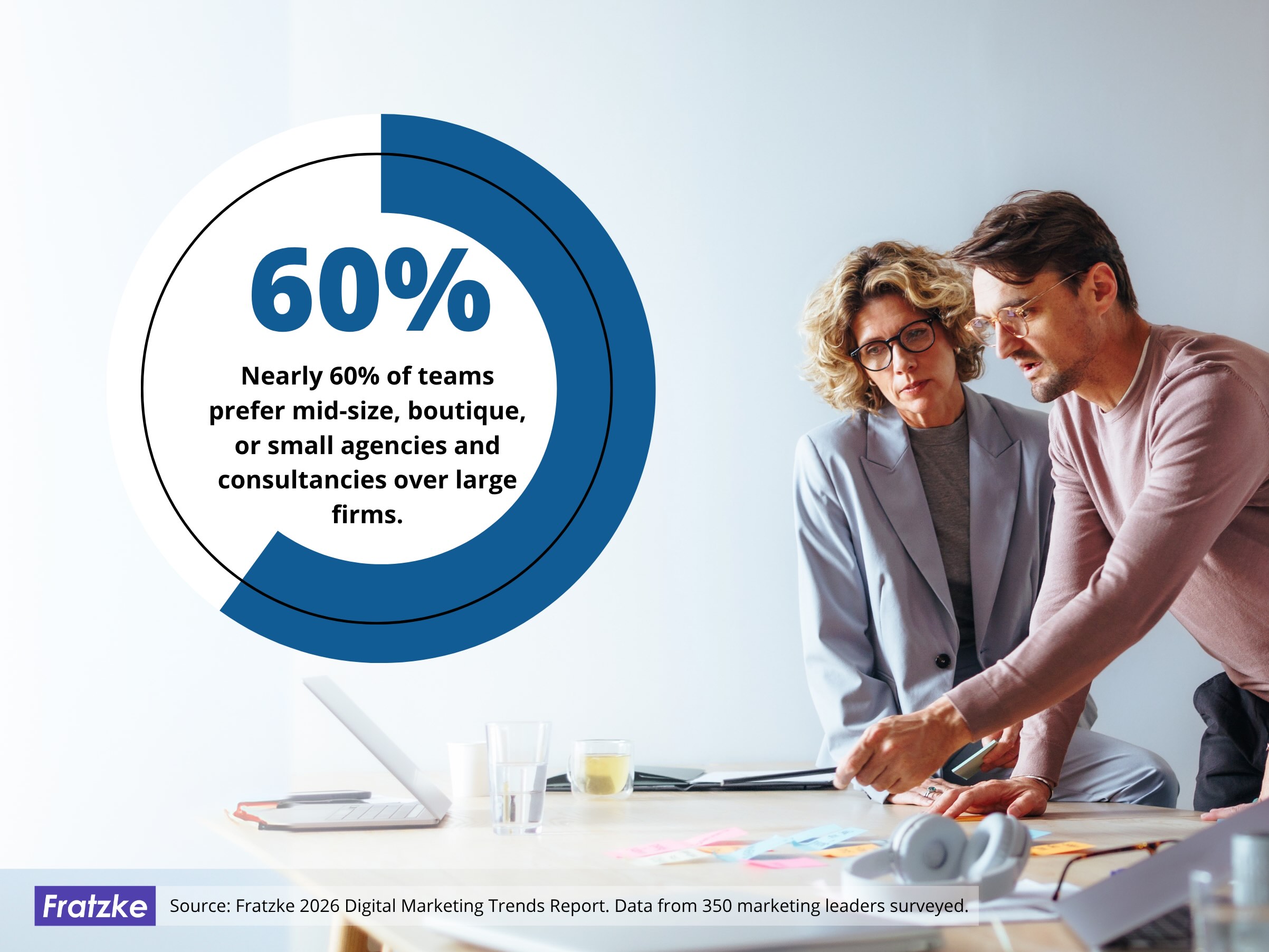
Interestingly, nearly 60% of teams prefer mid-size, boutique, or small agencies and consultancies over large firms. One respondent's comment captures why:
"Our agency doesn't just deliver assets, they help shape our thinking." - 2026 Digital Marketing Trends Survey Respondent
Mature organizations in particular are looking for partners who contribute to strategic thinking and elevate execution, not just add bandwidth. Dissatisfaction tends to show up when partners are seen as purely tactical, misaligned, or inconsistent, which is exactly where boutique firms tend to differentiate: flexibility, focus, and closer collaboration.
Why this matters: Execution is where strategy gets tested, and too often, where momentum gets lost. The gap between average and high-performing organizations isn't just what they plan. It's how consistently they follow through. Companies with higher marketing maturity are more confident in their ability to execute, more disciplined about where they invest, and more likely to get real value from the partners they bring in.
See How Fratzke Helps Organizations like Razer Close the Strategy-to-Execution Gap. Read the Case Study.
Trend 4: AI Adoption Is Outpacing Strategic Integration
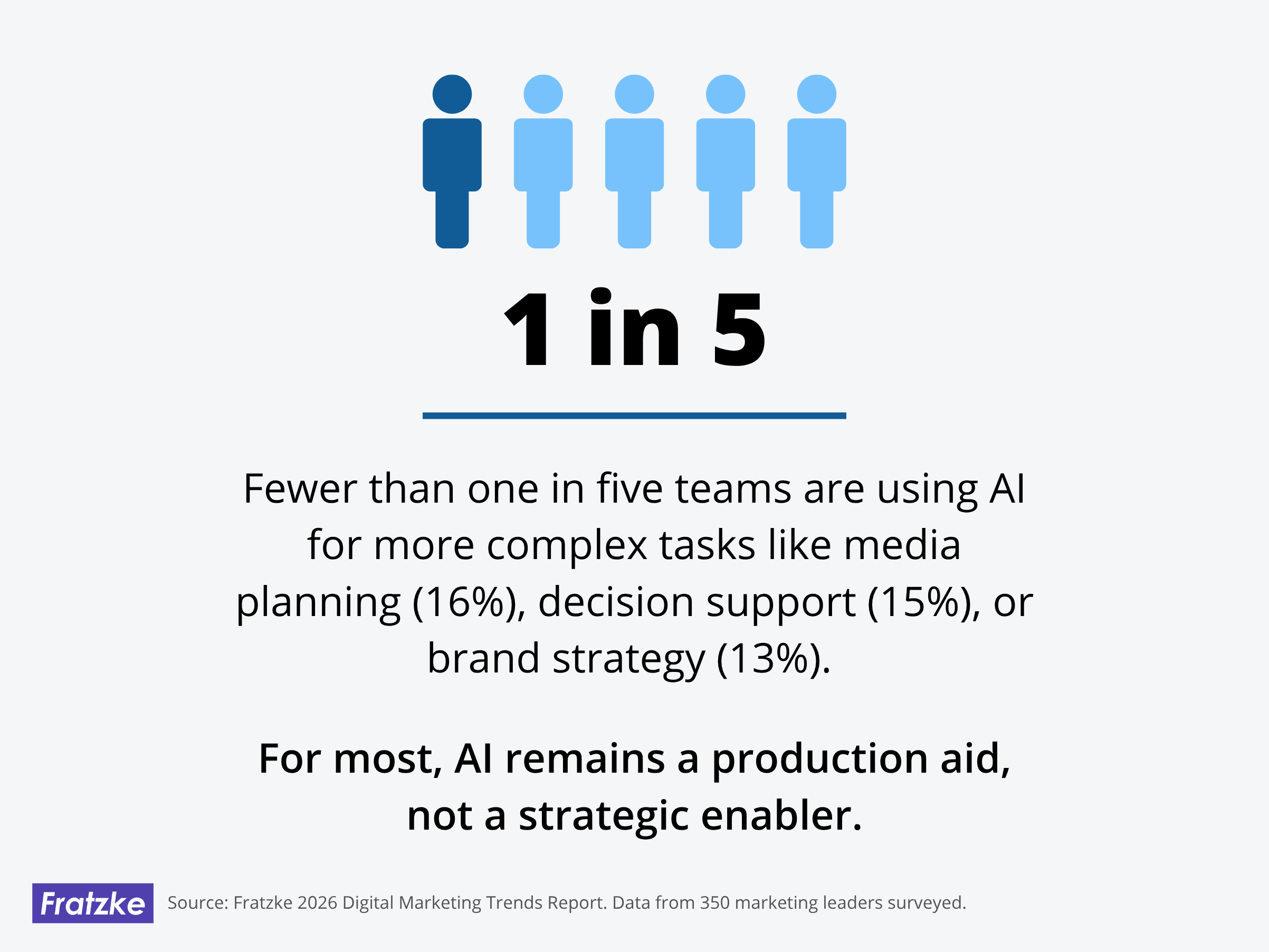
AI has fully entered the marketing mainstream. 61% of teams report active use, but most of that use is tactical, concentrated in content and creative output rather than strategic decision-making. Notably, fewer than one in five teams are using AI for more complex tasks like media planning (16%), decision support (15%), or brand strategy (13%).
Today's AI use breaks down like this:
AI Use Case
Share of Teams Using It
Content writing
53%
Visual generation
48%
Reporting and analytics
44%
Campaign personalization
37%
Media planning
16%
Decision support
15%
Brand strategy
13%
Source: Fratzke 2026 Digital Marketing Trends Report. Data from 350 marketing leaders surveyed.
Marketers aren't lacking access to AI. Many lack a roadmap. The surge in adoption reflects real curiosity, paired with inconsistent capability. Many teams are unsure how to evaluate tools, govern usage, or connect AI efforts to strategic outcomes, so even well-funded teams default to low-stakes tasks. As one respondent noted:
"AI's great for writing faster, but I don't trust it for strategic content." - 2026 Digital Marketing Trends Survey Respondent
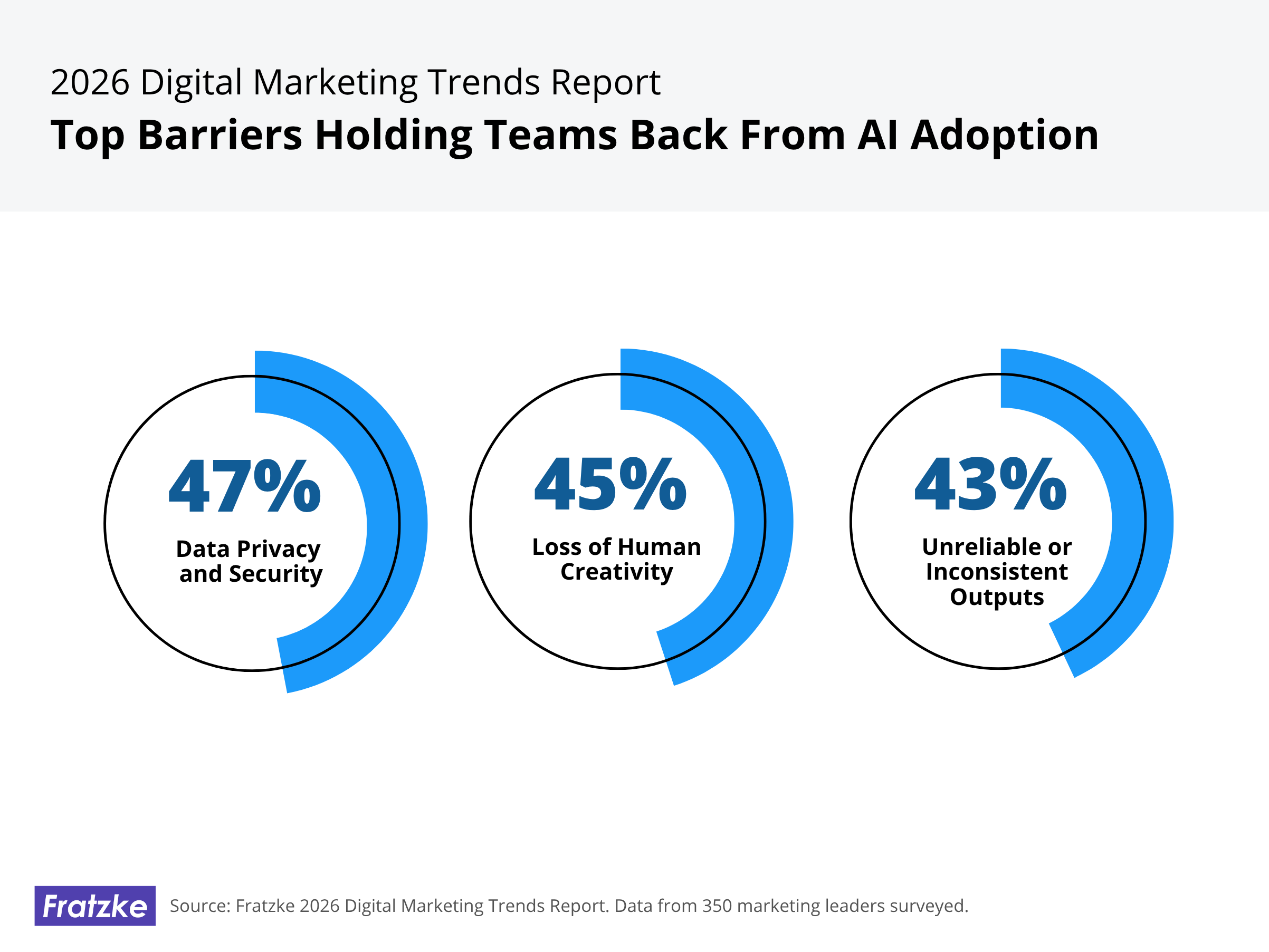
Deeper integration is limited by a lack of governance more than a lack of interest. The top barriers teams cite:
Data privacy and security (47%)
Loss of human creativity (45%)
Unreliable or inconsistent outputs (43%)
As with budget, strategy, and execution, maturity shapes AI adoption too. Advanced and Leader organizations aren't just more likely to use AI. They're more likely to use it across a wider range of applications, trust its outputs, integrate it into planning and decision-making, and actually track its effectiveness. Lower-maturity companies tend to use AI reactively, confined to content creation with minimal oversight.
Why this matters: AI is quickly becoming table stakes. Treating it as a shortcut rather than a strategic tool risks missing its full potential. Teams that invest in governance and integrate AI into planning, not just production, are the ones positioned to unlock long-term value from it.
A Look Forward: Six Moves to Build Marketing Maturity in 2026
Marketing is evolving quickly, but not evenly across organizations. The gap between confident and consistent execution is widening, and high-performing teams aren't just spending more on short-term wins. They're investing in the capabilities that enable long-term growth: research, analytics, and the insights that drive stronger customer experiences, brand positioning, and marketing strategy.
The good news: the divide between Laggard and Leading organizations can be bridged. The report points to six specific moves.
Make strategy actionable. Having a strategy is just the starting point. Top teams ensure clarity, communication, and alignment so every function understands the plan and their role in it.
Invest in the right capabilities. High-performing teams invest beyond social and content, building capabilities in analytics, brand, CX, and research insights to fuel smarter, longer-term growth.
Operationalize execution. Execution improves with structure. Define ownership, streamline processes, and measure consistently to drive performance and accountability.
Find partners that add value. The right partners bring focus, alignment, and speed. Look for collaborators who feel like part of your team, not another vendor to manage.
Use AI with intention and strategy. AI is everywhere, but impact is uneven. Move past quick wins by setting clear use cases and governance so AI can enhance planning and performance at scale.
Benchmark performance with a digital marketing audit. Regularly assess your strategy, channels, technology, and performance to identify gaps, prioritize opportunities, and build a clear roadmap for improvement.
Get the Full 2026 Digital Marketing Trends Report. Download Now.
How Fratzke Helps Teams Close the Gap
Fratzke helps mid-sized and enterprise marketing teams close the gap between ambition and execution. Many organizations have strong plans, solid budgets, and expanding tech stacks, but their teams are stretched thin, and the pressure to perform keeps rising while time, clarity, and support stay limited.
That's where Fratzke's process comes in, using the same maturity lens as this report:
Benchmark: The Fratzke Benchmark Method establishes an objective, data-backed understanding of where your organization stands today, compared to your industry and competitors.
Strategize: The Fratzke Guiding Light Method turns those insights into a clear, shared vision and a prioritized Growth Roadmap.
Execute: Through the Fratzke Growth Framework, our team partners with yours to activate that roadmap and measure results, closing the exact gap this report identifies between strategy and consistent execution.
FAQs About the 2026 Digital Marketing Trends Report
What is the Fratzke 2026 Digital Marketing Trends Report based on?
The report is based on a survey of more than 350 marketing leaders across a range of industries, company sizes, and B2B, B2C, and hybrid business models, most from mid-market and enterprise organizations.
What is marketing maturity, and how is it measured?
Marketing maturity is a five-point scale, from Laggard to Advanced, that describes how strategic, data-informed, and aligned an organization's marketing function is with its broader business goals. Fratzke used this scale to compare investment, strategy clarity, execution, and AI adoption across organizations of different maturity levels.
What actually separates high-performing marketing teams in 2026?
It isn't bigger budgets or headcount. The report found that marketing maturity, meaning clear strategy, disciplined execution, and intentional investment in analytics, CX, and brand, is the strongest predictor of consistent performance.
Is AI adoption actually improving marketing performance?
For most teams, not yet in a strategic sense. 61% of teams use AI, but the majority of that use is tactical (content, visuals, reporting). Fewer than 1 in 5 teams use AI for media planning, decision support, or brand strategy, where Advanced and Leader organizations are pulling ahead.
How can my team close the gap between strategy and execution?
The report points to five moves: making strategy actionable, investing in supporting capabilities like analytics and CX, operationalizing execution with clear ownership, finding partners who add strategic value, and using AI with intention rather than as a shortcut.
About The Contributors
James Fratzke is a Partner and Executive Strategist at Fratzke with more than a decade of experience helping mid-market and enterprise organizations improve their digital marketing strategies, customer experiences, and marketing operations. He helps private equity firms assess target companies through marketing due diligence and identify opportunities to create value across their portfolio companies. His work spans digital marketing audits, competitive benchmarking, performance measurement, strategic growth planning, and leading enterprise website design and development initiatives for brands including Disney, Dollar Tree, Patagonia, Advance Auto Parts, Ferguson, Jelly Belly, Pentair, and Crocs. James has contributed to or been featured in publications including Forbes and the Orange County Register, has spoken at industry events, and serves on the CSUF College of Business and Economics Executive Council. View Full Profile.
Fratzke is a top-rated strategic agency that helps mid-market and enterprise brands spark growth through customer insights, brand strategy, marketing, and creating digital experiences. Since our founding in 2017, we've worked with leading brands across industries including Razer, TopBuild, REI, DTS, and TiVo, partnering from research and strategy through implementation. We combine data, technology, and human-centered storytelling to help brands better understand their customers, strengthen their market position, and create consistent growth over time. Learn More.
Build a Stronger Marketing Strategy
Turn your business goals into a clear marketing strategy focused on the opportunities that can create the greatest impact.



.avif)


.avif)