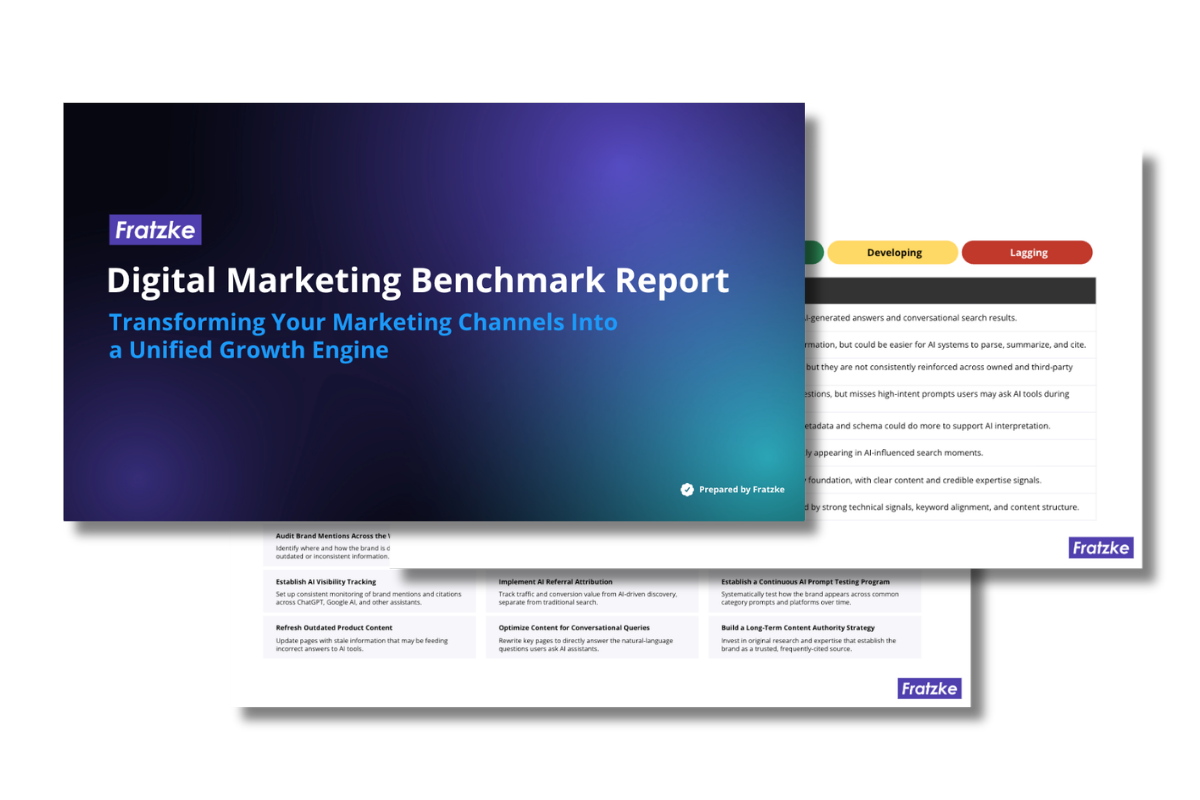
A marketing audit for private equity portfolio companies is a thorough evaluation of whether a company’s marketing strategy, team, channels, customer experience, technology, and measurement capabilities can support its revenue goals and create value at exit.
Marketing is consistently one of the least-managed functions inside a portfolio company. Operators know the revenue and EBITDA targets. What they often lack is a clear understanding of whether marketing can generate the pipeline needed to reach them.
In our work with private equity firms and portfolio company leaders across industries, we’ve found that the strongest audits go beyond identifying gaps. They also establish a consistent baseline, show where investment can unlock growth, and turn findings into a prioritized roadmap.
In this guide, we’ll explain when to audit marketing across the deal lifecycle, what to evaluate, how to compare performance across a portfolio, and how to connect every recommendation to pipeline, revenue, and enterprise value.
Key Takeaways
- Marketing Is a Value-Creation Driver, Not Just a Cost: Treat marketing as a lever that supports the growth plan, and not simply a line item to reduce.
- Audit at Three Critical Moments: Run a marketing audit during diligence, immediately after acquisition, and annually through exit.
- Consistent Scoring Creates a Portfolio-Wide Benchmark: Use the same scoring system across portfolio companies to make marketing maturity comparable company to company.
- Every Finding Should Connect to Value Creation: Tie each finding to a revenue goal, value-creation priority, owner, timeline, and exit strategy.
- Turn the Audit Into a Growth Roadmap: An audit creates clarity, and a roadmap creates growth.
Why a Marketing Audit Matters in Private Equity Value Creation
A marketing audit is the diagnostic that starts the value-creation work. It should not be saved for the moment growth stalls.
During diligence or annual planning, marketing budget can look like an easy line item to cut for short-term earnings. Sometimes spending should be reduced, but cutting without understanding what drives pipeline can trade a quick fix now for a larger revenue problem later.
That is why we treat marketing as a growth lever. The question is not simply, “How much are we spending?” It is: “What is this investment producing, what could it produce, and what capabilities must be strengthened to reach our value-creation plan?"
"I've sat in enough diligence meetings and portfolio reviews to know that marketing only earns a seat at the table when it's tied to the growth plan. A solid audit gives leaders something to act on: what's working, what to cut, and where to put money so pipeline and enterprise value keep building through the hold." - Ryan Fratzke, Partner & Executive Strategist
The upside is measurable: McKinsey found that companies that make marketing a strategic growth capability achieve 2.3× the revenue growth of their peers. For private equity leaders, the opportunity is to build marketing into a measurable capability that supports growth.
A useful marketing audit should reveal:
- If marketing can generate enough qualified pipeline
- Which channels create returns and which waste budget
- Whether positioning supports pricing power and the exit narrative
- Whether the team, data, and technology can scale
- Which improvements deliver immediate and compounding value
At exit, acquirers price the predictability of revenue after close. A portfolio company with improving acquisition economics, clear attribution, growing owned visibility across organic and AI search, and a repeatable marketing operating system earns a stronger valuation.
Read to Turn Marketing Into a Measurable Value-Creation Lever? Download the Private Equity Digital Marketing Growth Playbook
When to Run a Marketing Audit Across the Private Equity Lifecycle
The right time to run a private equity portfolio company marketing audit depends on where you are in the deal lifecycle. There are three key moments when a marketing audit creates the most value. The lens changes at each stage, but the scoring system should remain consistent so performance can be compared over time.
1. During Diligence: Start From the Outside In
Before acquisition, access to first-party analytics, CRM data, team members, and operating processes may be limited. That does not mean marketing has to remain a blind spot.
An outside-in audit can still tell you a lot. It looks at how customers discover and experience the brand, how the company stacks up against competitors, how visible it is in search and AI-generated answers, and whether the digital experience actually supports the growth assumptions in your deal model.
The goal isn't false precision. It's spotting material risks, validating opportunities, and walking into management conversations with sharper questions. Think of it as your first benchmark, one you can test and confirm after close.
"The first step in our Benchmark Method is an outside-in review, and it's one of the most useful things a firm can do before a deal even closes. Run that audit during diligence and it does two things at once: it helps you size up the opportunity, and it sets the benchmark you'll use to inform the investment decision itself and track progress over time." - Lisa Fratzke, Partner & Executive Strategist
2. Immediately After Acquisition: Validate From the Inside Out
Once the deal closes, it's time to go deeper. Now you have full access: analytics, CRM data, budgets, campaign performance, the MarTech stack, internal processes, and the people doing the work every day.
This inside-out view either confirms what diligence suggested or gives you a more accurate picture to work from. Either way, you walk away with a clear marketing baseline, a line connecting performance to the revenue plan, and a short list of priorities worth focusing on during the hold. At Fratzke, we use our Benchmark Index™ Scorecard to do exactly this. It gives you an objective read on a portfolio company's marketing performance and digital maturity, so you can see where they stand today, compare them to others in the portfolio, and track how things improve over time.
What you get back should feel useful, not overwhelming. We bring the scorecard and supporting insights together into an executive-ready report, then follow it with a sequenced roadmap: clear owners, what it will take to invest, when things should happen, and how you'll know it's working.
3. Annually Through Exit: Measure the Trend
Repeat your digital marketing audit every year through exit, using the same core dimensions and scoring logic each time. Annual benchmarking shows leadership whether the marketing function is getting more capable, more efficient, and more valuable over time.
It also gives you a consistent way to compare companies across your portfolio. If a revenue target shifts, a marketing leader turns over, performance stalls, or the competitive landscape changes, that annual audit can expand into a more focused diagnostic.
As exit approaches, lean on the benchmarks you've built over time to show real progress. The story should already be there in the data: how marketing performance, capabilities, and pipeline contribution grew across the hold.
One note: Scope can differ by trigger. A diligence audit can run in one to two weeks. A full 100-day audit typically takes two to four weeks.
Are You a PE Portfolio Manager Looking for a Marketing Audit? Check out our Private Equity Portfolio Company Marketing Audit service.
How to Run the Marketing Audit for Private Equity Portfolio Companies, Step by Step
A strong marketing audit brings outside-in market evidence and inside-out performance data together. The following approach turns both perspectives into a consistent process for establishing your performance baseline, assessing marketing maturity, prioritizing investment, and connecting findings to value creation.
Step 1: Set Scope, Objectives, and Baseline
Ask: What must be true of marketing for the company to reach its revenue goals and support the intended exit?
Start by getting clear on the fundamentals: what revenue targets does the company need to hit, what role should marketing play in getting there, and what questions does the audit actually need to answer? From there, build the clearest baseline the available evidence allows.
During diligence, that baseline is mostly outside-in. It might include estimated channel investment, search visibility, website performance, competitive positioning, customer sentiment, and whatever demand-generation activity you can observe from the outside.
Once the deal closes, swap those estimates for an inside-out baseline built on first-party data, including: total marketing investment, pipeline and revenue by source, customer acquisition cost by channel, customer lifetime value, channel performance, etc.
Step 2: Audit Strategy and Positioning
Ask: Does the positioning reflect what the company sells today, the customers it wants next, and the value-creation story leadership is building?
Look at the strategic foundation behind the company's marketing. That means digging into the ideal customer profile, customer research, buyer needs, decision drivers, value proposition, competitive landscape, and market positioning.
Then compare how leadership describes the business with what customers and the market actually say. During diligence, you'll likely lean on external research, customer reviews, competitive analysis, and observable market signals. Once you're inside, validate those findings with customer data, interviews, win-loss insights, and conversations with marketing and sales.
The goal is to determine whether the company understands who it needs to reach, what those customers value, and why they should choose the brand over an alternative.
Step 3: Audit the Customer Experience, Content, and Digital Visibility
Ask: Does the customer experience turn the company's positioning into visibility, trust, and qualified demand?
Once the strategic foundation is clear, look at how well it actually comes to life across the customer journey. That means reviewing the website, content, search visibility, conversion paths, brand consistency, and presence in AI-generated answers. See it through the customer's eyes: Can the right people find the company, quickly understand its value, trust its expertise, and take the next step?
Then bring in first-party performance data to see if that experience is actually working. Look at traffic quality, content engagement, organic trends, conversion rates, lead quality, and performance across the touchpoints that matter most.
Owned visibility compounds over the hold, but it takes time to build. If the audit turns up a material gap in organic or AI-search visibility, start closing it early. Learn more in our article: “How to Audit Your Brand’s AI Visibility”.
We saw the value of this connected approach in our work with Razer, a technology brand within a private equity portfolio. Fratzke evaluated the customer journey, digital visibility, competitive positioning, and multichannel marketing performance across a key product category. The audit gave leadership a clearer view of where growth opportunities existed and provided a strategic roadmap for improving digital performance over time.
See how Razer used a digital marketing audit to uncover opportunities for growth. Read the Case Study.
Step 4: Audit the Team, Leadership, and Operating Model
Ask: Does the company have the leadership and capabilities required to execute the revenue plan? What would stop if one person left tomorrow?
This step is about whether the organization behind the brand can actually execute the revenue plan. Look at marketing leadership, team capabilities, decision rights, agency relationships, processes, and how much the function depends on a handful of key people.
This is mostly an inside-out review. Interviews, org charts, workflows, budgets, and operating plans will tell you whether the company has a repeatable marketing function or a set of activities held together by individual effort.
A marketing function that can transfer easily is easier to scale and easier for a future owner to trust. The audit's job is to surface capability gaps early enough to address them thoughtfully.
Step 5: Audit Channels and Demand Generation
Ask: Which channels generate qualified demand? Which can scale? Which create an owned asset, and which stop producing the moment spending stops?
Review spending and performance across the channels that matter most to the business: paid search, paid social, organic search, content, email, events, partnerships, outbound, referrals, and AI-search visibility.
The outside-in view shows where and how the company shows up in the market, how competitors attract demand, and what customers experience along the buying journey. The inside-out view reveals what those channels actually cost and produce. Pull pipeline contribution, customer acquisition cost, conversion rates, lead quality, and revenue wherever the data allows, and evaluate each channel by its role in the customer journey rather than on its own.
This isn't about cutting every channel that can't prove last-click revenue. It's about understanding each channel's role in the buying journey and whether the total mix can support efficient growth.
Step 6: Audit Measurement and Pipeline Attribution
Ask: Can leadership see how much pipeline marketing created or influenced, which activities contributed, and whether performance is improving?
For an operating partner, this is one of the most consequential parts of the audit. Review CRM and analytics reporting, then ask marketing and sales leaders to explain how marketing-sourced and marketing-influenced pipeline are defined, tracked, and reported. Compare that internal reporting against the activity you can see from the outside. A company can look active in the market and still lack the measurement discipline to show what that activity actually produces.
Without trustworthy measurement, leadership can't confidently decide what to protect, what to stop, or where new investment could create value. Fix the foundation first, then optimize the dashboard.
Step 7: Audit the MarTech Stack and Data
Ask: Is the data reliable enough to guide investment decisions? Which tools add value, which overlap, and where does the stack depend on one vendor or person?
Inventory the technology supporting the buyer journey, including the CRM, marketing automation, analytics, advertising platforms, SEO tools, intent data, chat, and reporting systems. Then map how data actually moves between them. This inside-out review should tell you whether the systems behind the customer experience are reliable, integrated, and easy to hand off.
A clean, documented MarTech and data foundation reduces friction today and makes the business easier to understand at the next transaction.
Step 8: Score, Prioritize, and Map to Value Creation
Ask: Which opportunities have the clearest path to revenue or enterprise-value impact? Which can create momentum now, and which need a longer runway?
Bring the outside-in and inside-out evidence together in a standardized scorecard, and look for alignment as well as contradiction. Bring the outside-in and inside-out evidence together in a standardized scorecard, and look for where they align and where they contradict each other. That contradiction is often where the real insight lives.
For example, in an audit we ran for a technology portfolio company, the brand had strong awareness, but its website experience failed to communicate the unique value of its individual software solutions. A competitor spotted the gap and moved in.
At Fratzke, we use our Benchmark Method™ to establish that baseline, then apply the Fratzke Growth Framework™ to turn it into a sequenced roadmap. The scorecard tells you where things stand. The roadmap tells you what to do next, and in what order.
For each priority, identify:
- The revenue or value-creation goal it supports
- The recommended action
- The likely business impact
- The required investment and capabilities
- The timing and dependencies
- The metric that will show progress
The goal is more than a snapshot. Repeat the same digital marketing audit every year, and you build a credible performance trend, a clear read on whether marketing maturity is improving, and stronger evidence of value creation when it's time to exit.
How to Build a Portfolio-Wide Marketing Benchmark
One audit shows you a single company's marketing health. Run the same audit across the portfolio, and you've built a value-creation tool the whole firm can use.
At Fratzke, we use the Benchmark Method to audit portfolio companies at scale using a common set of dimensions, scoring criteria, and evidence requirements for every company. The scoring should be consistent, while the recommendations remain tailored to each company's market, business model, maturity, and value-creation plan.
A portfolio-wide Digital Marketing Benchmark Index can help your firm:
- Compare marketing maturity across companies
- Identify shared capability gaps and investment themes
- See which companies are positioned to scale and which need foundational work
- Allocate operating resources and specialist support more intentionally
- Track progress from entry through exit
- Build institutional knowledge that improves future diligence
Auditing across your portfolio turns individual findings into a decision system. A lower score in a category doesn't automatically mean cut it. It might reveal an underbuilt capability where focused investment could unlock meaningful growth. A higher score doesn't mean leave it alone, either. It might point to a proven engine worth accelerating.
Over time, leaders will gain a clearer view of what strong marketing looks like across different business models, where recurring risks appear, and which investments consistently strengthen pipeline and enterprise value.
The Marketing Audit Scorecard for PE Portfolio Companies
Use a consistent 1-to-5 scale for each dimension, with clear evidence requirements behind every score. We use the Fratzke Benchmark Index scoring system, as outlined below:
- 1 - Lagging: Significant gaps are limiting performance and growth.
- 2 - Developing: Foundational capabilities exist but require strategic improvement.
- 3 - Competitive: Performs well but has clear opportunities for improvement.
- 4 - Strong: Performs above average with opportunities to strengthen its advantage.
- 5 - Leader: Sets the benchmark within the industry.
Score the following six dimensions consistently across the portfolio. The order mirrors the marketing-audit process, moving from strategic direction and customer experience to execution, measurement, and infrastructure.
Use the same core scorecard during diligence, immediately after acquisition, and at each annual review.
The trend matters more than any single rating. Tracking movement across the same dimensions shows whether marketing is becoming a stronger contributor to growth, where further investment may create value, and whether the function is becoming a more transferable asset at exit.
Ready to drive growth across your portfolio? Download the Private Equity Digital Marketing Growth Playbook
Turning Marketing Audit Findings Into Value Creation
The audit is the Diagnose stage. Value is created when leadership turns those insights into strategy, action, measurement, and continuous improvement.
The Fratzke Growth Framework provides a useful operating rhythm:
- Diagnose: Establish the current-state benchmark and identify the most important gaps and opportunities.
- Strategize: Define the shared direction and prioritize a Growth Roadmap aligned with the investment thesis and revenue goals.
- Execute: Activate the roadmap with the right internal and external capabilities.
- Measure: Track performance against clear objectives and give leadership visibility into business impact.
- Optimize: Improve the work continuously and establish a new benchmark as the business evolves.
Start with the few findings most likely to influence value. Common levers include:
- Positioning and pricing power: Clarify the market position and value story to improve differentiation, sales conversations, and the exit narrative.
- Acquisition efficiency: Redirect resources toward the channels and journey improvements most likely to produce qualified demand efficiently.
- Pipeline predictability: Strengthen measurement, attribution, and sales-marketing alignment so leadership can plan with greater confidence.
- Owned visibility: Build brand, content, organic search, and AI-search presence that can compound rather than disappear when media spending stops.
- Organizational scalability: Close leadership, process, and technology gaps that create key-person risk or limit execution.
An audit gives you clarity, and a roadmap transforms that clarity into growth. Give every priority an owner, a business case, a measure of success, and a place in the broader value-creation plan.
Should the PE Marketing Audit Be Internal or External?
An internal audit can be fast and practical when the operating partner or portfolio marketing leader has the experience, access, and capacity to run it objectively. It is well suited to a directional review or a focused check on a known issue.
The tradeoff is perspective. Teams are naturally close to the strategies, systems, and assumptions they use every day. They may also lack a common benchmark that makes findings comparable across the portfolio.
An external partner can add objectivity, cross-functional depth, competitive context, and a consistent scoring methodology. That support is especially useful when:
- The audit will influence a material investment decision
- Leadership needs an independent view of the marketing function
- Data, attribution, SEO, AI visibility, or customer experience require specialist expertise
- The firm wants a repeatable benchmark across several portfolio companies
- The findings need to align executives, the board, and the management team
In practice, the strongest approach is often collaborative. Internal leaders provide context and access; an external partner brings structure, pattern recognition, and an unbiased point of view.
For example, CVC, a leading private equity firm, partnered with Fratzke to bring an independent, data-driven perspective to the growth strategy of a leading technology company in its portfolio. By combining customer research, market analysis, and competitive benchmarking, the work gave leadership clearer visibility into changing customer expectations, category positioning, market gaps, and the investment priorities most likely to support long-term value creation.
See How CVC Used Market Research and Competitive Benchmarking to Strengthen a Portfolio Company’s Growth Strategy. Read the Case Study.
Marketing Is a Value-Creation Lever, Not a Line Item
Marketing should earn its investment by showing how it drives the growth plan. But nobody should cut that budget before understanding what it's actually producing and what future pipeline depends on it.
A disciplined marketing audit makes that call possible. It shows you the wasted spend worth stopping, the productive work worth protecting, and the underbuilt capabilities where investment could create real value.
Run an audit for every portfolio company in your fund. Revisit it every year. Connect the findings to revenue and the exit strategy. Over time, you'll get a much clearer view of how marketing contributes to each company, and exactly where the next dollar will have the greatest impact.
Ready to Uncover Your Portfolio Company’s Greatest Marketing Opportunities? Get Your Digital Marketing Audit Started Today.
Frequently Asked Questions About PE Marketing Audits
What is a marketing audit for a private equity portfolio company?
A marketing audit for a private equity portfolio company is a structured assessment of the company's marketing strategy, team, channels, measurement, and brand, evaluated against what drives pipeline and enterprise value at exit. The deliverable is a scored report with a prioritized action plan the board can act on, not a general review. Every finding maps to a value-creation lever.
Why do PE firms run marketing audits on portfolio companies?
PE firms run marketing audits because marketing is one of the least-managed and highest-leverage functions inside a portfolio company. An audit shows where marketing is creating pipeline, where investment is being wasted, and which capability gaps may be limiting growth. A consistent audit also lets the firm compare marketing maturity across its portfolio and make better investment decisions.
When should a marketing audit be completed during the hold?
Run an outside-in audit during diligence, a full inside-out audit immediately after acquisition, and a consistent benchmark review every year through exit. A material change in performance, leadership, strategy, or competition may also justify a targeted review between annual cycles.
How long does a portfolio company marketing audit take?
A full post-close marketing audit typically takes two to four weeks, depending on company size and data availability. A diligence audit can be completed in seven to ten business days. The biggest variable is data cleanliness. If the CRM is disorganized and attribution doesn't exist, plan for additional time.
Who should run the audit? The operating partner, the CMO, or an external firm?
Run it internally when you need a quick directional read and stakes are low. Bring in an external partner when objectivity matters, when evaluating whether to replace the marketing leader, when technical depth is needed in areas like SEO or AI-search visibility, or when you want cross-portfolio benchmarks to calibrate the score.
How is a PE marketing audit different from a regular marketing audit?
A PE marketing audit connects every finding to value creation, the hold period, revenue goals, and exit strategy. It also uses consistent scoring so performance can be tracked over time and compared across portfolio companies.
Should marketing be cut to improve EBITDA?
Do not make an across-the-board cut without first understanding the effect on pipeline and long-term growth. Use the audit to stop low-value activity, protect productive investments, and fund the capabilities most likely to support revenue and enterprise value.
What should the audit deliver?
The final deliverable should include an executive-ready assessment, a consistent scorecard, key findings, prioritized recommendations, and a Growth Roadmap with owners, timing, investment needs, and measures of success.
How should PE firms compare marketing performance across portfolio companies?
Use the same core dimensions, evidence standards, and scoring scale across every company. Interpret the scores in the context of each company's business model and growth plan, then track the trend from entry through exit.
How to Build a Portfolio-Wide Marketing Benchmark
One audit shows you a single company's marketing health. Run the same audit across the portfolio, and you've built a value-creation tool the whole firm can use.
At Fratzke, we use the Benchmark Method to audit portfolio companies at scale using a common set of dimensions, scoring criteria, and evidence requirements for every company. The scoring should be consistent, while the recommendations remain tailored to each company's market, business model, maturity, and value-creation plan.
A portfolio-wide Digital Marketing Benchmark Index can help your firm:
- Compare marketing maturity across companies
- Identify shared capability gaps and investment themes
- See which companies are positioned to scale and which need foundational work
- Allocate operating resources and specialist support more intentionally
- Track progress from entry through exit
- Build institutional knowledge that improves future diligence
Auditing across your portfolio turns individual findings into a decision system. A lower score in a category doesn't automatically mean cut it. It might reveal an underbuilt capability where focused investment could unlock meaningful growth. A higher score doesn't mean leave it alone, either. It might point to a proven engine worth accelerating.
"Here's what makes an approach like our Benchmark Index so useful for PE: it scales. Score every portfolio company the same way and patterns start to show up, the same gaps in different companies, the same fixes working more than once. You can track how marketing maturity moves company by company, and just as important, you get a way to hand what's working at one portfolio company to the next." - James Fratzke, Partner & Executive Strategist
Over time, leaders will gain a clearer view of what strong marketing looks like across different business models, where recurring risks appear, and which investments consistently strengthen pipeline and enterprise value.
The Marketing Audit Scorecard for PE Portfolio Companies
Use a consistent 1-to-5 scale for each dimension, with clear evidence requirements behind every score. We use the Fratzke Benchmark Index scoring system, as outlined below:
- 1 - Lagging: Significant gaps are limiting performance and growth.
- 2 - Developing: Foundational capabilities exist but require strategic improvement.
- 3 - Competitive: Performs well but has clear opportunities for improvement.
- 4 - Strong: Performs above average with opportunities to strengthen its advantage.
- 5 - Leader: Sets the benchmark within the industry.
Score the following six dimensions consistently across the portfolio. The order mirrors the marketing-audit process, moving from strategic direction and customer experience to execution, measurement, and infrastructure.
Use the same core scorecard during diligence, immediately after acquisition, and at each annual review.
The trend matters more than any single rating. Tracking movement across the same dimensions shows whether marketing is becoming a stronger contributor to growth, where further investment may create value, and whether the function is becoming a more transferable asset at exit.
Ready to drive growth across your portfolio? Download the Private Equity Digital Marketing Growth Playbook
Turning Marketing Audit Findings Into Value Creation
The audit is the Diagnose stage. Value is created when leadership turns those insights into strategy, action, measurement, and continuous improvement.
The Fratzke Growth Framework provides a useful operating rhythm:
- Diagnose: Establish the current-state benchmark and identify the most important gaps and opportunities.
- Strategize: Define the shared direction and prioritize a Growth Roadmap aligned with the investment thesis and revenue goals.
- Execute: Activate the roadmap with the right internal and external capabilities.
- Measure: Track performance against clear objectives and give leadership visibility into business impact.
- Optimize: Improve the work continuously and establish a new benchmark as the business evolves.
Start with the few findings most likely to influence value. Common levers include:
- Positioning and pricing power: Clarify the market position and value story to improve differentiation, sales conversations, and the exit narrative.
- Acquisition efficiency: Redirect resources toward the channels and journey improvements most likely to produce qualified demand efficiently.
- Pipeline predictability: Strengthen measurement, attribution, and sales-marketing alignment so leadership can plan with greater confidence.
- Owned visibility: Build brand, content, organic search, and AI-search presence that can compound rather than disappear when media spending stops.
- Organizational scalability: Close leadership, process, and technology gaps that create key-person risk or limit execution.
An audit gives you clarity, and a roadmap transforms that clarity into growth. Give every priority an owner, a business case, a measure of success, and a place in the broader value-creation plan.
Frequently Asked Questions About PE Marketing Audits
What is a marketing audit for a private equity portfolio company?
A marketing audit for a private equity portfolio company is a structured assessment of the company's marketing strategy, team, channels, measurement, and brand, evaluated against what drives pipeline and enterprise value at exit. The deliverable is a scored report with a prioritized action plan the board can act on, not a general review. Every finding maps to a value-creation lever.
Why do PE firms run marketing audits on portfolio companies?
PE firms run marketing audits because marketing is one of the least-managed and highest-leverage functions inside a portfolio company. An audit shows where marketing is creating pipeline, where investment is being wasted, and which capability gaps may be limiting growth. A consistent audit also lets the firm compare marketing maturity across its portfolio and make better investment decisions.
When should a marketing audit be completed during the hold?
Run an outside-in audit during diligence, a full inside-out audit immediately after acquisition, and a consistent benchmark review every year through exit. A material change in performance, leadership, strategy, or competition may also justify a targeted review between annual cycles.
How long does a portfolio company marketing audit take?
A full post-close marketing audit typically takes two to four weeks, depending on company size and data availability. A diligence audit can be completed in seven to ten business days. The biggest variable is data cleanliness. If the CRM is disorganized and attribution doesn't exist, plan for additional time.
Who should run the audit? The operating partner, the CMO, or an external firm?
Run it internally when you need a quick directional read and stakes are low. Bring in an external partner when objectivity matters, when evaluating whether to replace the marketing leader, when technical depth is needed in areas like an SEO audit or AI-search visibility audit, or when you want cross-portfolio benchmarks to calibrate the score.
How is a PE marketing audit different from a regular marketing audit?
A PE marketing audit connects every finding to value creation, the hold period, revenue goals, and exit strategy. It also uses consistent scoring so performance can be tracked over time and compared across portfolio companies.
Should marketing be cut to improve EBITDA?
Do not make an across-the-board cut without first understanding the effect on pipeline and long-term growth. Use the audit to stop low-value activity, protect productive investments, and fund the capabilities most likely to support revenue and enterprise value.
What should the audit deliver?
The final deliverable should include an executive-ready assessment, a consistent scorecard, key findings, prioritized recommendations, and a Growth Roadmap with owners, timing, investment needs, and measures of success.
How should PE firms compare marketing performance across portfolio companies?
Use the same core dimensions, evidence standards, and scoring scale across every company. Interpret the scores in the context of each company's business model and growth plan, then track the trend from entry through exit.






.avif)