In SaaS, winning a customer is often only the beginning. A SaaS marketing audit takes an honest look at whether your marketing is actually driving the business. It goes beyond the click, the demo, or the free trial to ask what happens next: do people stick around, get value, renew, and grow with you over time.
That full-lifecycle view matters because SaaS marketing often differs from both consumer and traditional B2B marketing. The buyer and everyday user may not be the same person, the product keeps evolving, and the path to revenue may be product-led, sales-led, or a blend of both. A marketing program may look successful at the top of the funnel while weak activation, poor retention, or rising acquisition costs quietly limit growth.
We specialize in helping SaaS companies understand how marketing, sales, product usage, and the customer experience work together. In our experience, the biggest growth opportunities are often hiding between those teams and systems. An objective audit brings the full customer journey into view, helping leaders uncover where customers are getting stuck and decide where their investment can make the greatest difference.
In this guide, we’ll explain why and when to conduct a SaaS digital marketing audit, what to evaluate across the customer lifecycle, how the process works, and what an actionable audit should deliver.
A SaaS Marketing Audit Evaluates the Entire Customer Journey: A SaaS marketing audit examines the complete customer and revenue journey, not just individual campaigns or channels.
Performance Signals Can Indicate When an Audit Is Needed: An audit becomes especially important when growth slows, acquisition costs rise or marketing activity cannot be confidently connected to revenue.
Effective Audits Consider Three Perspectives: Performance should be examined from the customer, company and competitive perspectives.
Findings Should Become a Prioritized Growth Roadmap: A useful audit should establish a measurable benchmark and translate its findings into a prioritized Growth Roadmap.
Why Do a SaaS Marketing Audit?
Most SaaS marketing teams are not short on data. They have website analytics, product analytics, advertising dashboards, automation reports, CRM data, sales feedback, and customer-success insights. The harder question is whether all of that information creates a clear picture of performance.
Often, it does not.
Teams can be busy launching campaigns and reporting on results while still struggling to answer fundamental questions: Are we reaching the right buyers? Where are qualified prospects leaving the journey? Which investments are influencing revenue? What should we improve first?
A SaaS marketing audit brings those questions into one holistic review.
“An audit shouldn’t feel like a ‘gotcha’ exercise. Think of it as part detective story and part annual checkup: we follow the clues in your data, uncover what’s driving performance, and help you make smarter decisions about where to invest next.” - Lisa Fratzke, Partner & Executive Strategist
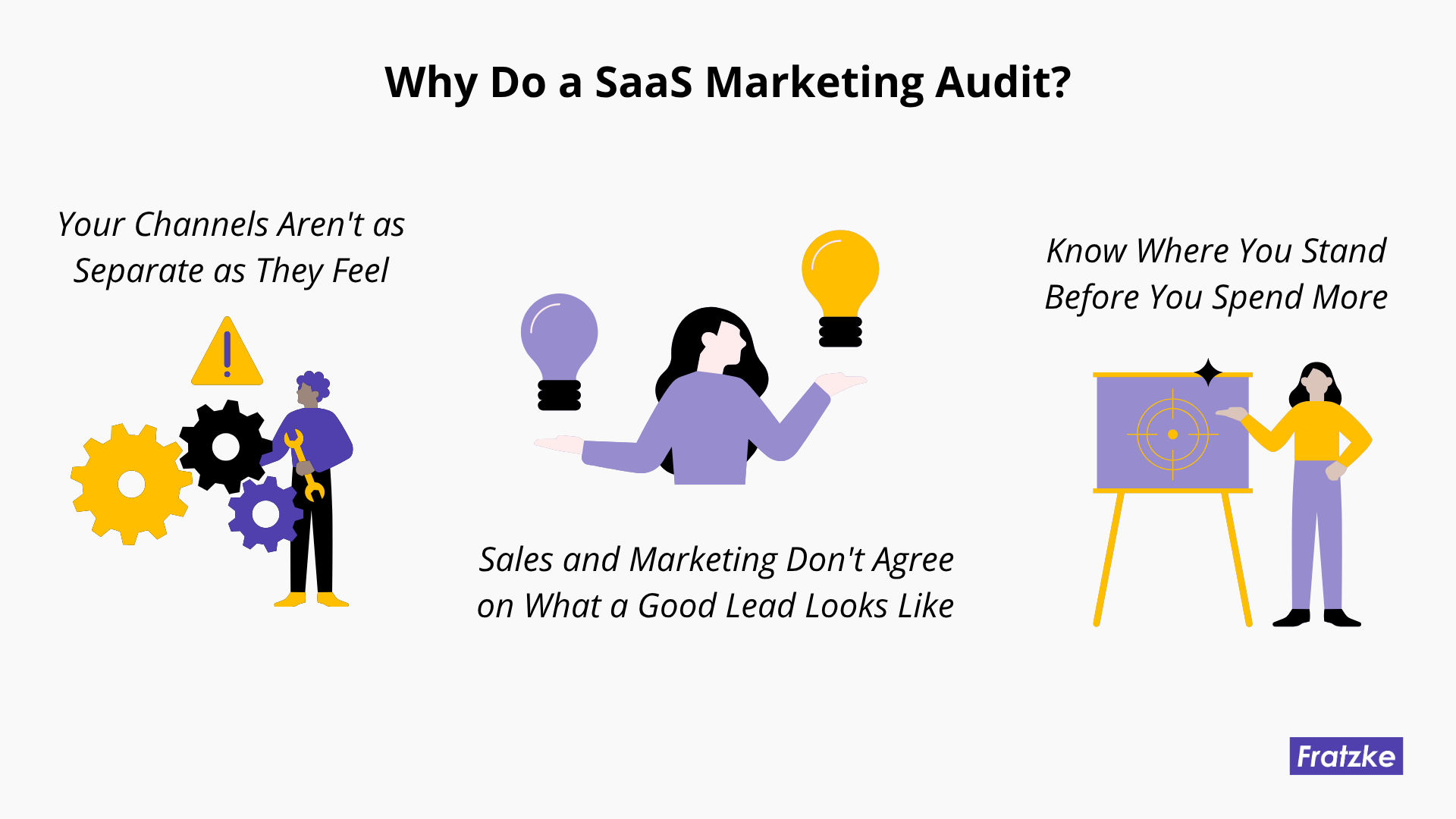
A SaaS Marketing Audit helps teams identify disconnected channels, align sales and marketing around lead quality, and understand performance before investing more.
Your Channels Aren't as Separate as They Feel
It is tempting to evaluate SEO, digital advertising, email, content, and conversion performance separately, since that makes reporting easier. But that's not how customers experience your company. A buyer might find you in a search result, read an article, click a retargeting ad, and only then ask for a demo. A product-led buyer might skip most of that and go straight from a landing page to a free trial to onboarding, without ever talking to your sales team.
In short, SaaS journeys are becoming more complex. According to a McKinsey study, B2B buyers now use an average of 10 channels during the buying process, up from five in 2016. More than half say they are likely to switch suppliers when the experience across those channels feels disconnected.
Every one of those moments sets up the next one. If your positioning is muddy, better ad targeting just sends more people to a message that doesn't land. If your demo page is confusing, more traffic just means paying more to convert the same number of people. If onboarding doesn't get people to value fast, more signups just means a bigger pile of users who never stick around. A successful SaaS marketing audit looks at how your marketing engine functions together.
Sales and Marketing Don't Agree on What a Good Lead Looks Like
If your sales team is calling marketing's leads low quality, and your marketing team feels like sales isn't following up fast enough, you're not alone.
That friction between a marketing qualified lead (MQL) and sales qualified lead (SQL) is one of the most common breakdowns in SaaS go-to-market strategies, and it rarely gets solved by arguing about definitions in a meeting. It gets solved by looking at where leads actually drop off, why, and whether marketing and sales are even optimizing for the same outcome.
You Need to Prove Marketing's Impact
MQL counts don't mean much to your CEO or your CFO anymore, and they may not mean much to sales either.
What they want to know is how marketing is influencing pipeline and revenue, in the same terms finance already uses to evaluate everything else. An audit that stops at marketing metrics won't get you there. One that connects marketing activity all the way through to pipeline influence and revenue contribution gives you a credible answer that drives buy-in and investment.
Know Where You Stand Before You Spend More
Before adding budget, headcount, a new tool, or another campaign, it's worth knowing exactly where you're starting from. At Fratzke, we use our Benchmark Method™ to look at your business from three angles: through your customers' eyes, through your own performance, and against your competitors. That gives you a fuller picture than platform metrics lone, one that shows both how you're doing and how ready you are for what's next.
The SaaS company Apptega learned this firsthand. Ahead of its next growth stage, its website wasn't telling a consistent story, generating traffic, or supporting sales. Fratzke's digital marketing audit gave the team a clear starting point to build a full website strategy from: redesign, migration, SEO, CRM integration, and a more conversion-focused experience. The result was a 200% increase in demo requests and double the organic traffic.
When Should You Conduct a SaaS Digital Marketing Audit?
You do not need to wait for marketing performance to fail. In fact, the best time to conduct a digital marketing audit is often before a major decision, when there is still time to direct your time, effort, and budget toward the right priorities.
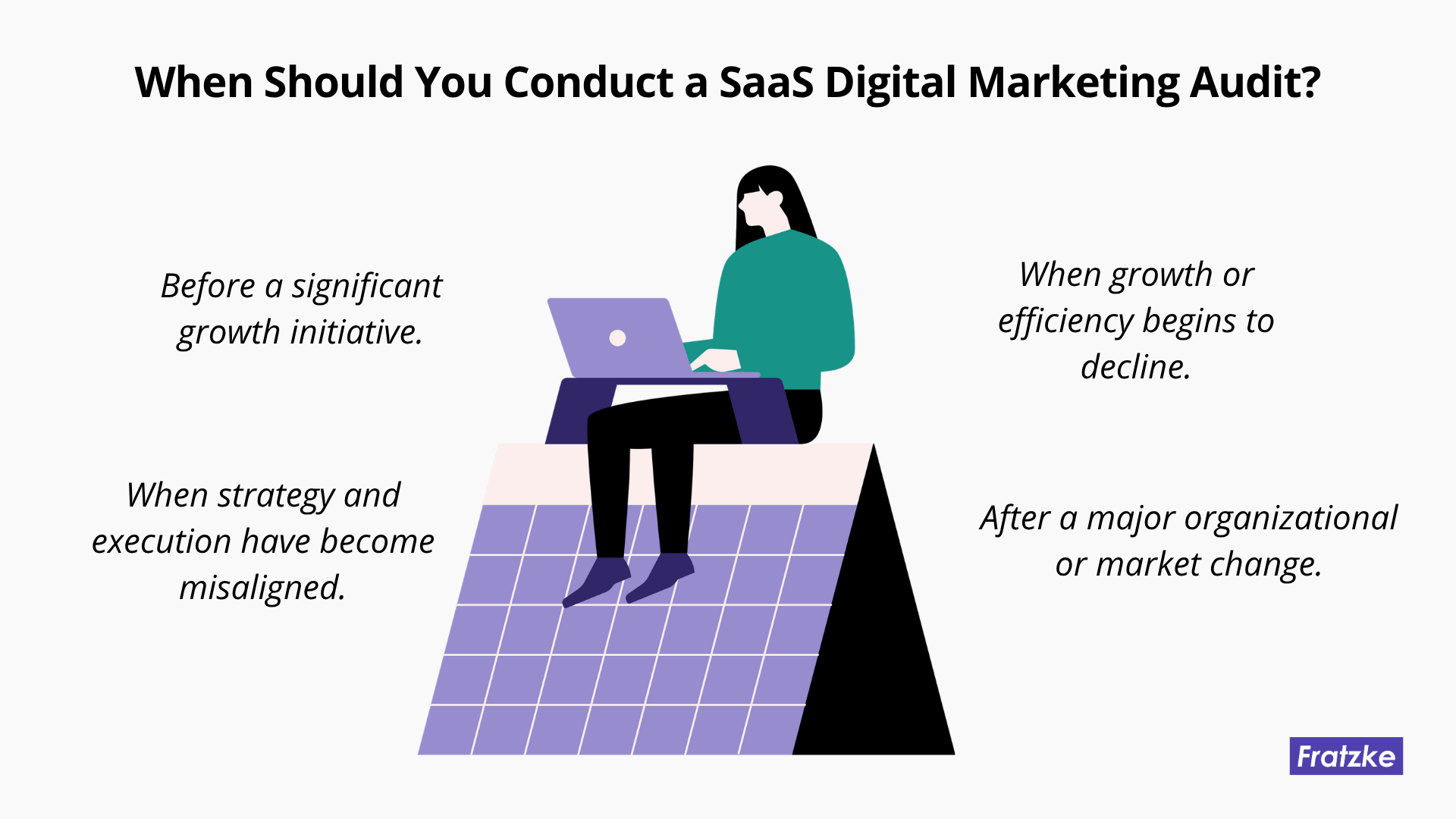
Consider a SaaS Marketing Audit before a major growth initiative, when performance declines, when strategy and execution become misaligned, or after a significant market or organizational change.
When growth or efficiency begins to decline. An audit can help when traffic or conversions have plateaued, customer acquisition costs are rising, or demos and trials are not translating into revenue. Because these challenges rarely have a single cause, an audit examines the full customer journey to uncover where momentum is being lost.
Before a significant growth initiative. Consider an audit before launching a product, entering a new market, increasing your marketing budget, repositioning your company, or rebuilding your website. It creates a clear benchmark so you can move forward without carrying outdated assumptions or performance gaps into your next stage of growth.
When strategy and execution have become misaligned. If marketing, sales, product, and customer success are working from different priorities, funnel definitions, or data, an audit can create a shared view of performance and align teams around the opportunities most likely to drive growth.
After a major organizational or market change. New leadership, a merger, a pricing change, shifting customer expectations, or a major competitive move can quickly make yesterday's strategy less effective. An audit helps you reassess the market and determine whether your strategy and capabilities still fit the opportunity ahead.
How often should you conduct an audit?
There is no universal calendar that fits every SaaS company.
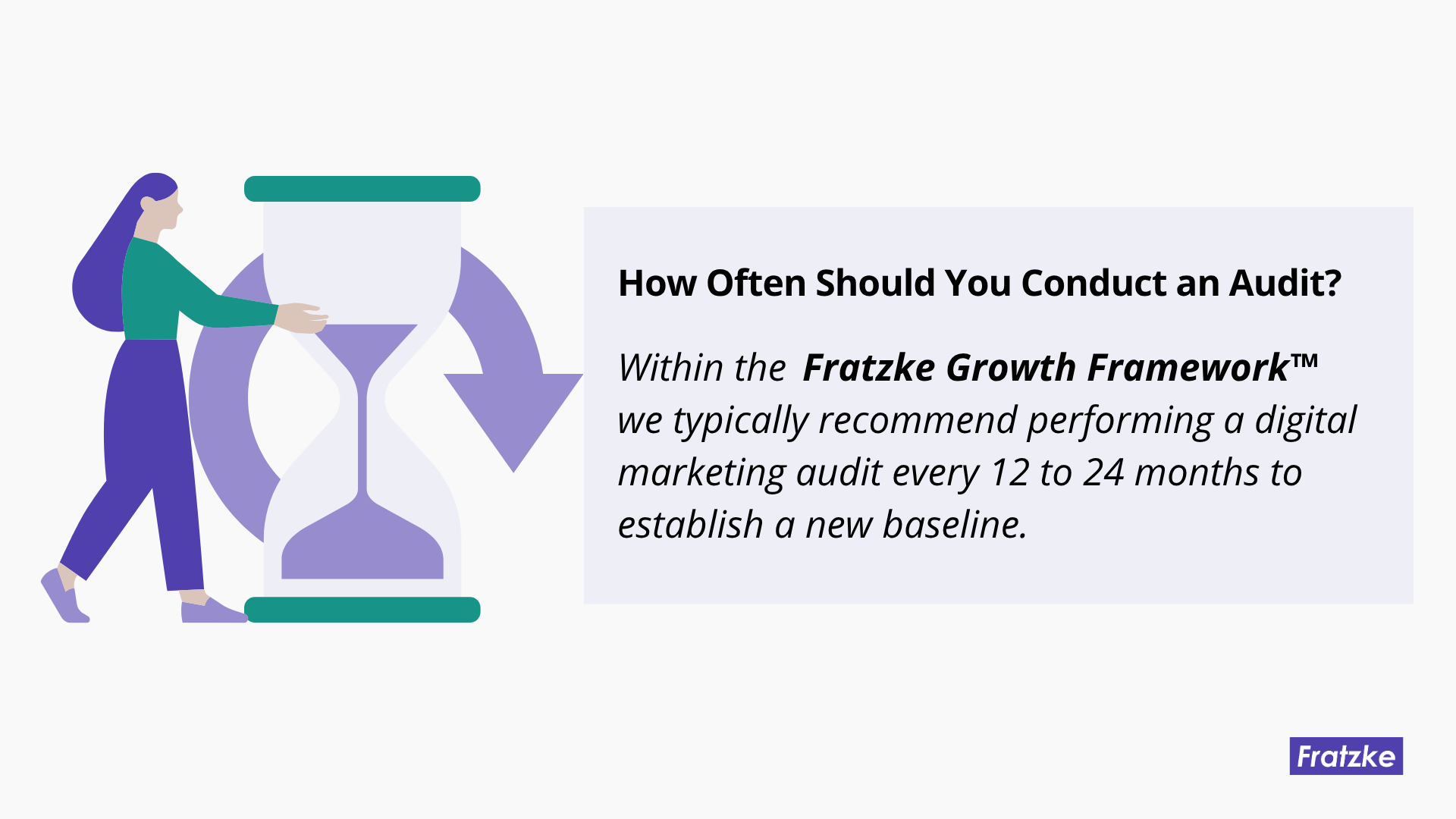
Within the Fratzke Growth Framework™, we typically recommend performing a digital marketing audit every 12 to 24 months to establish a new baseline, while measurement and optimization continue between those larger reviews.
A practical approach is to conduct a comprehensive audit at major strategic inflection points, use focused channel reviews when a particular area underperforms, measure and optimize performance continuously after the audit, and establish a new comprehensive baseline regularly as goals, capabilities, and market conditions evolve.
A fast-growing organization in a changing category may need to reassess performance more frequently than a mature company with stable audiences and channels.
A SaaS Marketing Audit every 12 to 24 months can help establish a new performance baseline and keep your growth strategy on track.
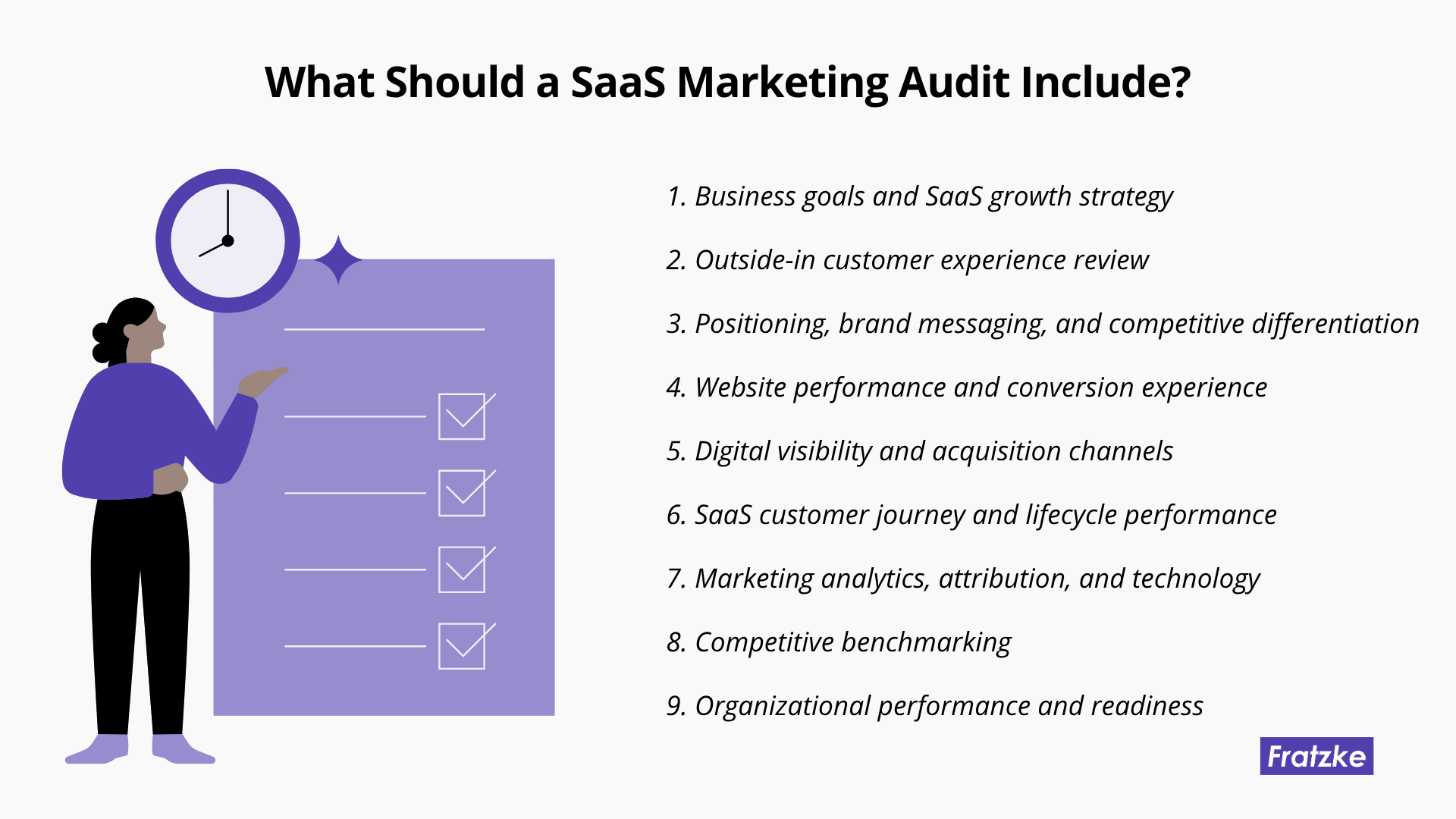
A SaaS marketing audit should evaluate your complete marketing system. The exact scope will vary by company, but the review should be broad enough to show how strategy, customer experience, channels, data, and organizational capabilities work together.
1. Business goals and SaaS growth strategy
Start with the business rather than the channels. The audit should clarify growth goals, target customers, go-to-market strategy, marketing's role, and budget and resources. This context shapes the rest of the evaluation. A channel cannot be judged fairly if the team has not agreed on what it is expected to accomplish.
2. Outside-in customer experience review
Next, look at the company as a customer would. How do prospects discover the brand? Can they quickly understand what the product does and why it matters? Do the website, content, sales experience, and product journey feel connected? Where do people encounter friction, uncertainty, or unmet expectations?
An outside-in review may examine discovery and search behavior, customer needs and decision drivers, the buying committee and user roles, the path from first interaction to trial or demo, the consistency of the marketing, sales, and product experience, and barriers to trust, understanding, or action. This customer perspective is a core part of our Benchmark Method™ because behind every data point is a human experience.
3. Positioning, brand messaging, and competitive differentiation
Strong execution cannot compensate for a message that does not resonate. The audit should review target audience, brand and product positioning, competitive differentiation, message consistency across marketing and sales materials, customer proof, case studies, and trust signals, and alignment between the promise made in marketing and the experience delivered by the product. The goal is to make the message clearer, more relevant, and more believable to the customers you want to reach.
4. Website performance and conversion experience
For many SaaS companies, the website is where your brand, demand generation, product education, and conversion come together. When that experience falls short, revenue can follow. Among B2B buyers likely to switch suppliers, 54% cite a poor digital experience, while 51% point to gaps in customer tracking across channels. Your audit should consider website navigation and content, product and solution pages, demo and trial journeys, forms and calls to action, user experience and performance, trust signals and customer proof, search visibility and content discoverability, and conversion barriers across key journeys.
Apptega's website audit is a useful example. it did not stop at page-level recommendations. It helped create the strategic vision for a more consistent story, stronger lead generation, better CRM integration, and a conversion-focused platform built for scalable SaaS growth.
Evident is an Atlanta-based SaaS company offering an AI-powered platform for automated third-party risk management, vendor compliance, and insurance verification. When its organic growth slowed, Fratzke conducted a comprehensive SEO audit and developed a prioritized strategy spanning technical SEO, keywords, competitors, and content.
With continued execution and optimization, Evident increased estimated organic traffic nearly fivefold and expanded its ranking keyword footprint by 110%. Read the Evident case study.
6. SaaS customer journey and lifecycle performance
A standard marketing audit may end at a lead or sale. A SaaS marketing audit needs to look further. Depending on your business, the customer journey may include awareness, consideration, lead, trial, or demo conversion, activation, paid conversion, onboarding, retention, expansion, and advocacy. Relevant measures may include customer acquisition cost, cost per trial or demo, lead-to-opportunity conversion, trial-to-paid conversion, demo-to-customer conversion, activation rate, time to value, churn, customer lifetime value, payback period, and net revenue retention.
No single metric tells the whole story. The goal is to understand how the stages influence one another and where the journey is creating, or losing, momentum.
7. Marketing analytics, attribution, and technology
An audit should test whether the organization can trust the information it uses to make decisions. Review areas may include analytics and event tracking, CRM and customer data, attribution and reporting, marketing technology, dashboard and reporting quality, connections among marketing, sales, product, and finance systems, and data governance.
Attribution will never make every customer journey perfectly tidy. But the company should have a consistent, credible way to interpret performance and make investment decisions.
8. Competitive benchmarking
Performance has more meaning when it has context. A company may have improved year over year and still be losing visibility or differentiation within its category. Competitive benchmarking may examine search and AI visibility, positioning and messaging, website and digital customer experience, content strategy, paid and social presence, conversion paths, offers, proof points, and trust signals, and competitive strengths and gaps.
The comparison should include direct competitors, relevant category leaders, customer expectations, historical company performance, and the business goals the team is trying to achieve.
9. Organizational performance and readiness
The strongest recommendation is not useful if the organization cannot act on it. A complete audit should consider team capabilities, roles and ownership, cross-functional alignment, processes and technology, capacity and resources, and readiness for change. This part of the audit helps turn an ideal strategy into a realistic one.
A comprehensive SaaS Marketing Audit evaluates the full marketing system, including strategy, customer experience, digital performance, analytics, competitive benchmarks, and organizational readiness.
How to Conduct a SaaS Marketing Audit
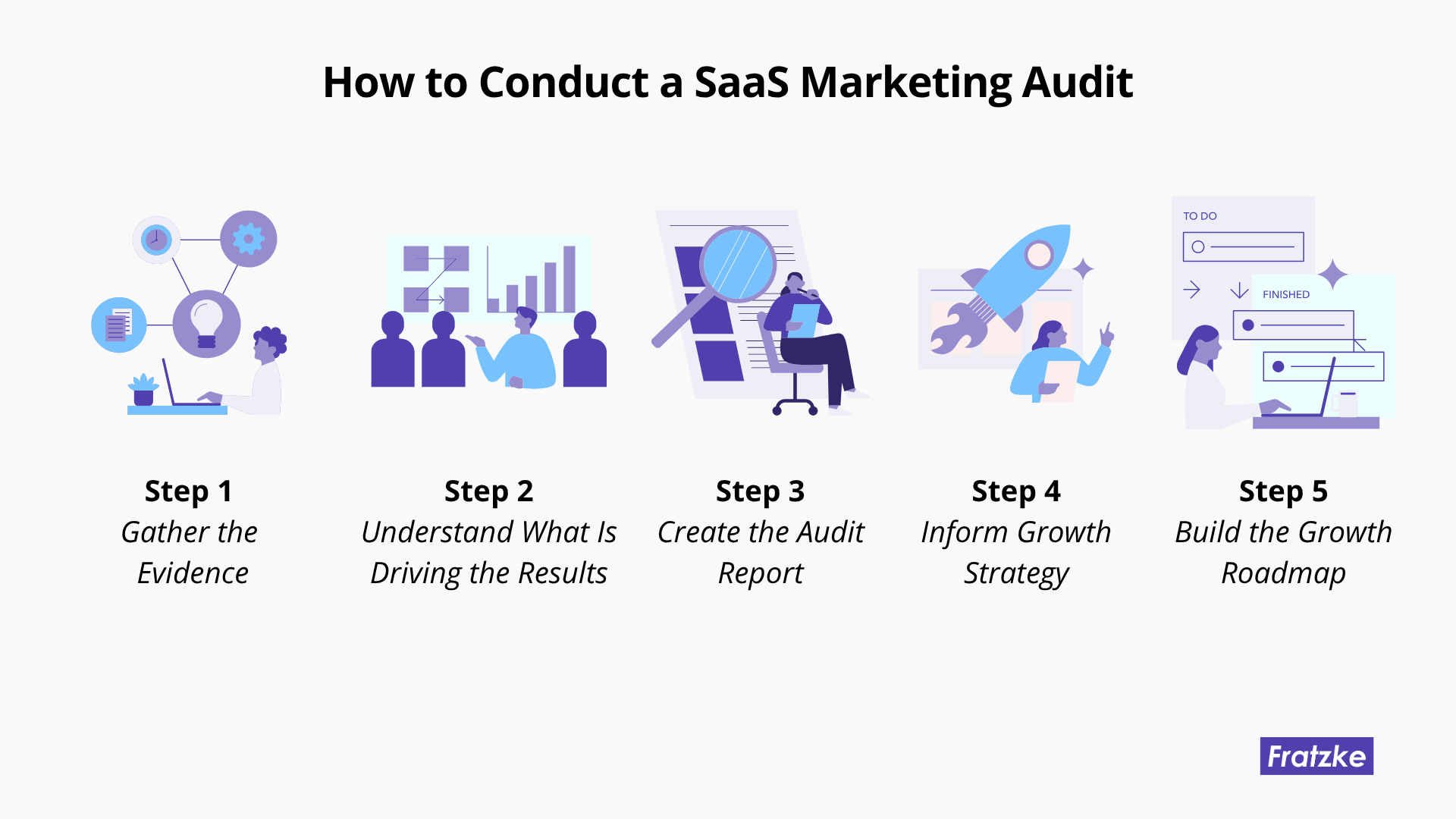
A useful audit follows a disciplined process. It gathers the right evidence, adds customer and competitive context, and turns findings into decisions. The five steps below draw on the Fratzke Benchmark Method™ and provide a practical roadmap for conducting your own audit.
Step 1: Gather the Evidence
Start by bringing together information from across your business. Review your goals, marketing plans, budgets, website and product data, sales pipeline, campaign results, customer feedback, technology, competitors, and input from the people closest to the work.
Do not rely on a single dashboard or department. Your goal is to build a complete, shared picture of where things stand and how the business works today.
Step 2: Understand What Is Driving the Results
Data tells you what happened. Your next task is to understand why. We call this phase "strategic analysis."
Look for strengths, weaknesses, risks, opportunities, customer frustrations, and competitive advantages. Pay attention to how your findings connect. If paid campaigns are underperforming, targeting may be the problem. The cause could also be unclear positioning, a confusing landing page, pricing questions, slow sales follow-up, or inaccurate tracking. Solving the wrong problem quickly still leaves you with the wrong solution.
Step 3: Create the Audit Report
Bring your findings together in a report that leaders can quickly understand and use. Following our Benchmark Method, your report should cover:
Overall marketing performance
Customer experience
Channel and conversion performance
Competitive position
Key risks and barriers
Opportunities for growth
Key findings and recommendations
Your report should help leaders understand what is happening, why it matters, and where the business has the greatest opportunity to improve.
Step 4: Inform Growth Strategy
Not every opportunity deserves the same amount of attention. Evaluate each recommendation based on how well it supports your business goals, how it will affect customers, its potential business value, its urgency, the effort and cost involved, and whether your organization is ready to act.
This step turns a long list of observations into a focused set of choices. We use the Fratzke Guiding Light Method™ to help your leadership team align around the priorities that matter most.
Step 5: Build the Growth Roadmap
Turn your priorities into a practical roadmap that defines what needs to happen, who is responsible, which steps come first, when the work should begin, and how you will measure and review progress. Your audit shows you where you are, while your roadmap gives your team a clear path forward.
Growth comes from putting the plan into action, measuring the results, and improving as you learn. That's the operating cycle behind the Fratzke Growth Framework™: diagnose, strategize, execute, measure, and optimize.
A SaaS Marketing Audit moves from gathering evidence and understanding performance to creating an audit report, informing strategy, and building a Growth Roadmap.
Should You Conduct the Audit Internally or Use an Outside Partner?
Both approaches can work. The right choice depends on the scope of the audit, the objectivity required, and the time and expertise available inside the organization.
If you do work with an outside partner, they should feel like an extension of your team. Curious enough to understand the nuances of your business, experienced enough to challenge assumptions, and practical enough to help you move forward.
Consideration
Internal Audit
Outside Partner
Company Context
Internal AuditStrong knowledge of internal history and constraints
Outside PartnerNeeds discovery to build context
Objectivity
Internal AuditExisting assumptions or priorities may influence conclusions
Outside PartnerBrings an independent perspective
Expertise
Internal AuditDepends on the specialists available internally
Outside PartnerCan provide cross-functional specialists
Competitive Perspective
Internal AuditMay be limited by tools and category exposure
Outside PartnerImplementation may require an additional scope
Ready to Benchmark Your SaaS Marketing Performance?
A SaaS marketing audit gives you an objective view of how your strategy, customer journey, channels, data, and capabilities contribute to growth. More importantly, it helps your team move from a long list of possibilities to a clear set of priorities.
Frequently Asked Questions About SaaS Marketing Audits
What is a SaaS marketing audit?
A SaaS marketing audit is an objective evaluation of how effectively a company’s marketing strategy, customer journey, channels, technology, data, and organizational capabilities support customer acquisition and recurring revenue. It identifies strengths, performance gaps, and growth opportunities, then prioritizes what the company should address first.
How is a SaaS marketing audit different from a standard marketing audit?
A standard marketing audit often focuses on campaigns, channels, leads, and sales. A SaaS marketing audit also evaluates activation, onboarding, retention, expansion, SaaS economics, and the connections among marketing, sales, product, RevOps, and customer success. It follows the customer journey beyond the initial conversion.
How long does a SaaS marketing audit take?
The timeline depends on the number of channels and markets in scope, the quality and availability of data, the number of stakeholders involved, and the depth of customer and competitive research. A focused channel audit will usually require less time than a comprehensive evaluation of the full marketing ecosystem.
How much does a SaaS marketing audit cost?
The cost depends on scope, complexity, available data, research needs, and the deliverables required. A review of one channel is different from a comprehensive audit spanning strategy, customer experience, technology, and organizational performance. A qualified partner should define the scope and provide a tailored proposal before the engagement begins.
How often should a SaaS company conduct a marketing audit?
Conduct an audit when performance changes, leadership faces a major strategic decision, or the company’s market, product, or go-to-market model evolves. Between comprehensive audits, continue monitoring and optimizing performance. Fratzke’s Growth Framework typically repeats the Benchmark Method every 12 to 24 months to create a new baseline.
What data is needed for a SaaS marketing audit?
A comprehensive audit may use business goals, budgets, website and product analytics, CRM and revenue data, advertising performance, content and SEO data, customer research, competitive research, technology information, and stakeholder interviews. The specific requirements should be defined during discovery.
Can a SaaS startup conduct a marketing audit internally?
Yes. A focused internal audit can be valuable when the scope is clear, the data is reliable, and the team has the expertise and time to review performance objectively. Start with the business questions that matter most, use consistent criteria, and prioritize recommendations rather than trying to fix everything at once.
What is the difference between a SaaS marketing audit and an SEO audit?
An SEO audit evaluates one marketing capability: organic search performance. It may cover technical SEO, content, keywords, links, user experience, and competitive visibility. A SaaS marketing audit evaluates the broader marketing ecosystem, including strategy, positioning, customer journey, channels, conversion, analytics, technology, and organizational readiness. An SEO audit can be one component of a larger SaaS marketing audit.
What happens after the audit?
After the audit, translate the prioritized recommendations into a Growth Roadmap, assign owners, define success measures, and begin implementation. Continue measuring and optimizing the work so the organization can see what is improving and where priorities need to change.
James Fratzke is a Partner and Executive Strategist at Fratzke with more than a decade of experience helping mid-market and enterprise organizations improve their digital marketing strategies, customer experiences, and marketing operations. His work spans digital marketing audits, competitive benchmarking, performance measurement, strategic growth planning, and leading enterprise website design and development initiatives for brands including Disney, Dollar Tree, Patagonia, Advance Auto Parts, Ferguson, Jelly Belly, Pentair, and Crocs. James has contributed to or been featured in publications including Forbes and the Orange County Register, has spoken at industry events, and serves on the CSUF College of Business and Economics Executive Council. View Full Profile.
Fratzke is a top-rated strategic agency that helps mid-market and enterprise brands spark growth through customer insights, brand strategy, marketing, and creating digital experiences. Since our founding in 2017, we've worked with leading brands across industries including Razer, TopBuild, REI, DTS, and TiVo, partnering from research and strategy through implementation. We combine data, technology, and human-centered storytelling to help brands better understand their customers, strengthen their market position, and create consistent growth over time. Learn More.




.avif)