A digital marketing strategy is a long-term approach for using digital marketing to achieve specific business goals. It connects what an organization wants to accomplish with the audiences, priorities, channels, resources, technology, and measurement required to get there.
The challenge is that many digital marketing strategies become lists of tactics: improve SEO, invest in paid media, create more content, redesign the website, post more frequently on social media. Those may all be worthwhile, but a collection of tactics isn't necessarily a strategy.
An effective strategy needs both direction and operational alignment. You need to know where you're going, what matters most, and what needs to be in place to make it happen.
In this guide, we'll explain what a digital marketing strategy is, how it differs from a marketing plan or tactics, and how to create one using the Fratzke Guiding Light Method and Fratzke 6 Ps Framework.
Key Takeaways
A digital marketing strategy connects business objectives with the marketing priorities and capabilities required to achieve them.
Strategy establishes where you're going and why; campaigns and tactics determine how specific parts of that strategy are activated.
Effective digital marketing strategies consider more than channels. They account for customers, resources, people, processes, technology, partners and measurement.
A useful strategy should help teams make decisions about what to prioritize—and what not to do.
Execution should be treated as part of strategy development, not something considered only after the strategy is finished.
What Is a Digital Marketing Strategy?
A digital marketing strategy is a long-term approach that defines how an organization will use digital marketing to achieve its business objectives. It establishes the goals, audiences, priorities, channels, resources, and measurement needed to guide marketing decisions and execution.
At its best, a digital marketing strategy connects business strategy with marketing activity. If the business wants to enter a new market, increase customer retention, launch a new product, build market share, or accelerate revenue growth, the digital marketing strategy should define how marketing can contribute to that outcome.
That's different from starting with a channel and asking, "What should we do with SEO this year?" Start with the business outcome. Then determine which marketing opportunities can help you achieve it.
"A digital marketing strategy shouldn't begin with channels. It should begin with the future you're trying to create and work backward from there." - Ryan Fratzke, Partner & Executive Strategist
Why Is a Digital Marketing Strategy Important?
Digital marketing teams have more options than ever: SEO, AI search, paid media, content, email, social media, video, marketing automation, conversion optimization, personalization, and more. More options don't necessarily make marketing decisions easier.
A strong digital marketing strategy helps organizations:
Create focus: Identify the marketing opportunities that matter most.
Connect marketing to business goals: Give teams a clear reason behind their priorities.
Allocate resources: Determine where budget, people, and time can create the greatest impact.
Align teams: Create shared priorities across marketing and other parts of the organization.
Make better decisions: Evaluate new opportunities against an established strategic direction.
Measure progress: Connect marketing performance to meaningful business outcomes.
Instead of asking, "What could we do?" a strong strategy helps teams answer, "What matters most?"
Digital Marketing Strategy vs. Marketing Plan vs. Campaigns vs. Tactics
The terms strategy, plan, campaign, and tactic are often used interchangeably, but they serve different purposes.
Digital Marketing Strategy
Marketing Plan
Campaign
Tactic
Purpose
Establishes direction and priorities
Organizes execution
Pursues a specific objective
Performs a specific action
Answers
Where are we going and why?
What are we going to do?
What are we trying to accomplish now?
How will we do it?
Timeframe
Long-term
Typically annual or quarterly
Weeks or months
Immediate or ongoing
Example
Build category leadership with enterprise buyers
Annual content and channel plan
New product launch
LinkedIn ad
A company might establish a strategy to become the recognized category leader within a particular market. Its marketing plan could prioritize thought leadership, search visibility, and customer advocacy. A campaign could promote an annual research report, while individual tactics might include LinkedIn ads, emails, videos, and supporting articles.
What Should a Digital Marketing Strategy Include?
There isn't one universal digital marketing strategy template. The right strategy depends on the business, its customers, the market, its capabilities, and its desired outcomes.
Most effective digital marketing strategies address:
Business goals: What outcome should marketing help create?
Customers: Who are you trying to reach, and what matters to them?
Market: What competitors, trends, and opportunities shape your strategy?
Positioning: Why should customers choose your organization?
Priorities: Where can marketing create the greatest impact?
Channels: Where and how will you reach customers?
Resources: What budget, talent, and outside expertise are required?
Technology and data: What systems are needed to execute effectively?
Measurement: How will you know whether the strategy is working?
But there's another important question organizations need to answer: Can we actually execute this strategy? That's where strategy and operational readiness need to come together.
At Fratzke, we think about digital marketing strategy through two complementary frameworks. The Guiding Light Method™ establishes strategic direction, while the Fratzke 6 Ps Framework determines what needs to be in place to turn that direction into action.
Together, they answer two fundamental questions: Where are we going, and what needs to be true for us to get there?
But what if you don’t know where to start?Our Digital Marketing Audit Services can help you identify what’s working, what’s not, and where to focus next.
1. Establish Your Guiding Light
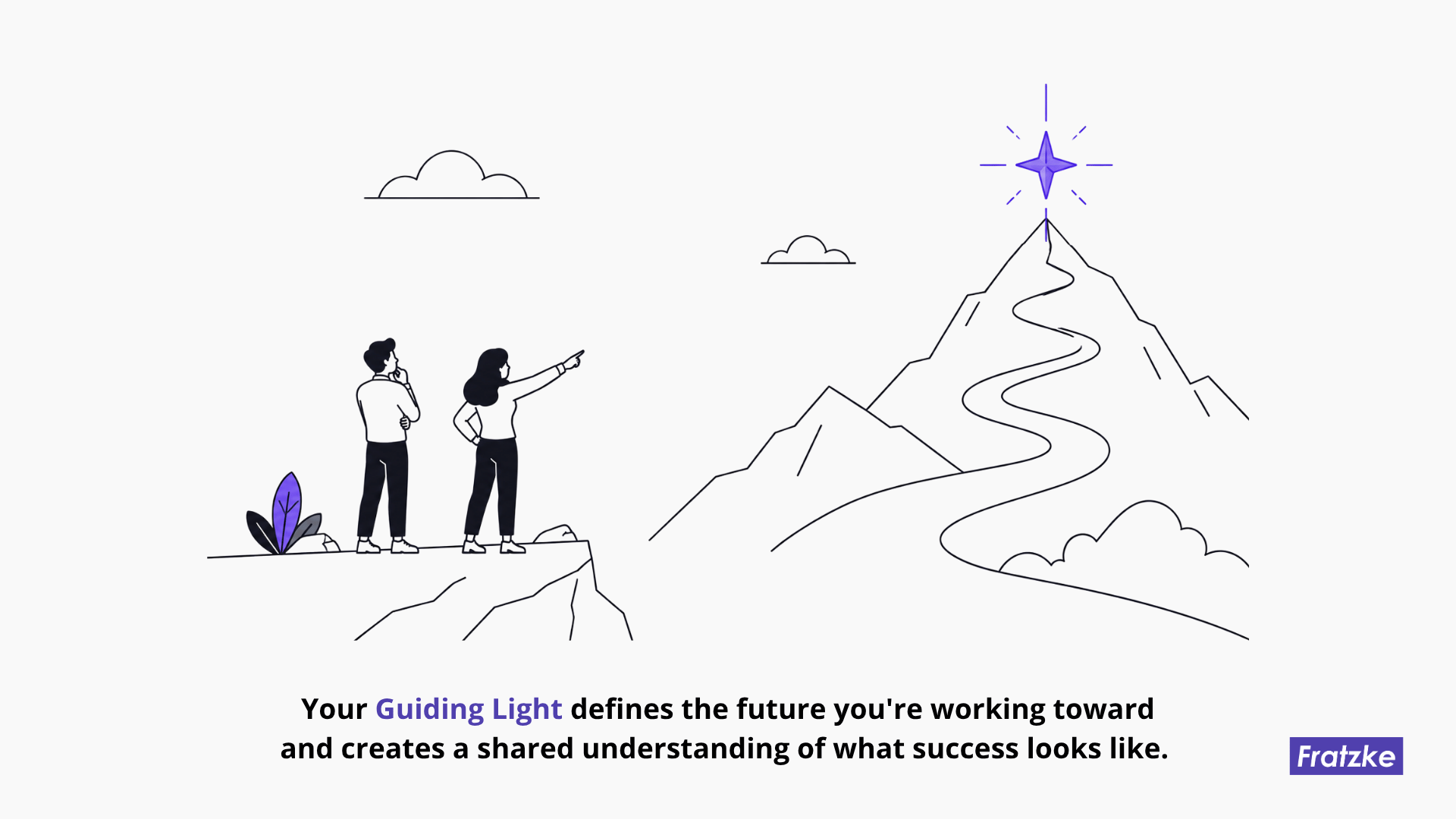
Every strategy needs a destination. Your Guiding Light defines the future you're working toward and creates a shared understanding of what success looks like. It connects the organization's larger ambition with the impact marketing is expected to help create.
This isn't the same thing as setting a marketing goal or KPI. "Increase organic traffic 20%" might be a useful goal, but it doesn't explain the larger business outcome you're pursuing.
Your Guiding Light establishes the broader destination. From there, you can translate that ambition into specific goals and measures of success. Established goal-setting frameworks such as Objectives and Key Results (OKRs) or SMART goals can be useful for making those goals clear, measurable, and actionable.
When defining your Guiding Light, consider:
Business objectives: What is the organization ultimately trying to accomplish?
Customers: Who are we trying to create value for?
Customer needs: What problems or opportunities matter most to them?
Market opportunities: Where is there room to grow or differentiate?
Competitive position: Where do we want to be relative to competitors?
Desired future state: What does success actually look like?
Marketing's role: How can marketing help create that future?
The clearer the destination becomes, the easier it is to evaluate everything that comes next.
2. Prioritize the Opportunities That Matter Most
Once you know where you're going, evaluate the opportunities available to get there. You might identify opportunities around SEO, AI search visibility, website experience, paid media, content, email, customer retention, brand positioning, or dozens of other areas. You probably can't pursue all of them.
Use your Guiding Light as the decision-making lens. Consider each opportunity based on:
Business impact: How significantly could it contribute to the desired outcome?
Customer value: Does it address something important to the customer?
Market opportunity: Is there meaningful whitespace or competitive advantage?
Organizational readiness: Are you equipped to pursue it?
Investment: What resources will it require?
Time to value: How quickly could it begin producing an impact?
This changes the conversation from "What marketing should we be doing?" to "What should we prioritize to get where we want to go?"
"Strategy is as much about deciding what not to do as deciding what to do. Your Guiding Light gives you a filter for making those decisions." -James Fratzke, Partner & Executive Strategist
3. Operationalize Your Strategy With the Fratzke 6 Ps
Defining the strategy is only half the job. A strategy can make perfect sense on paper and still struggle because the organization doesn't have the capabilities or resources required to execute it.
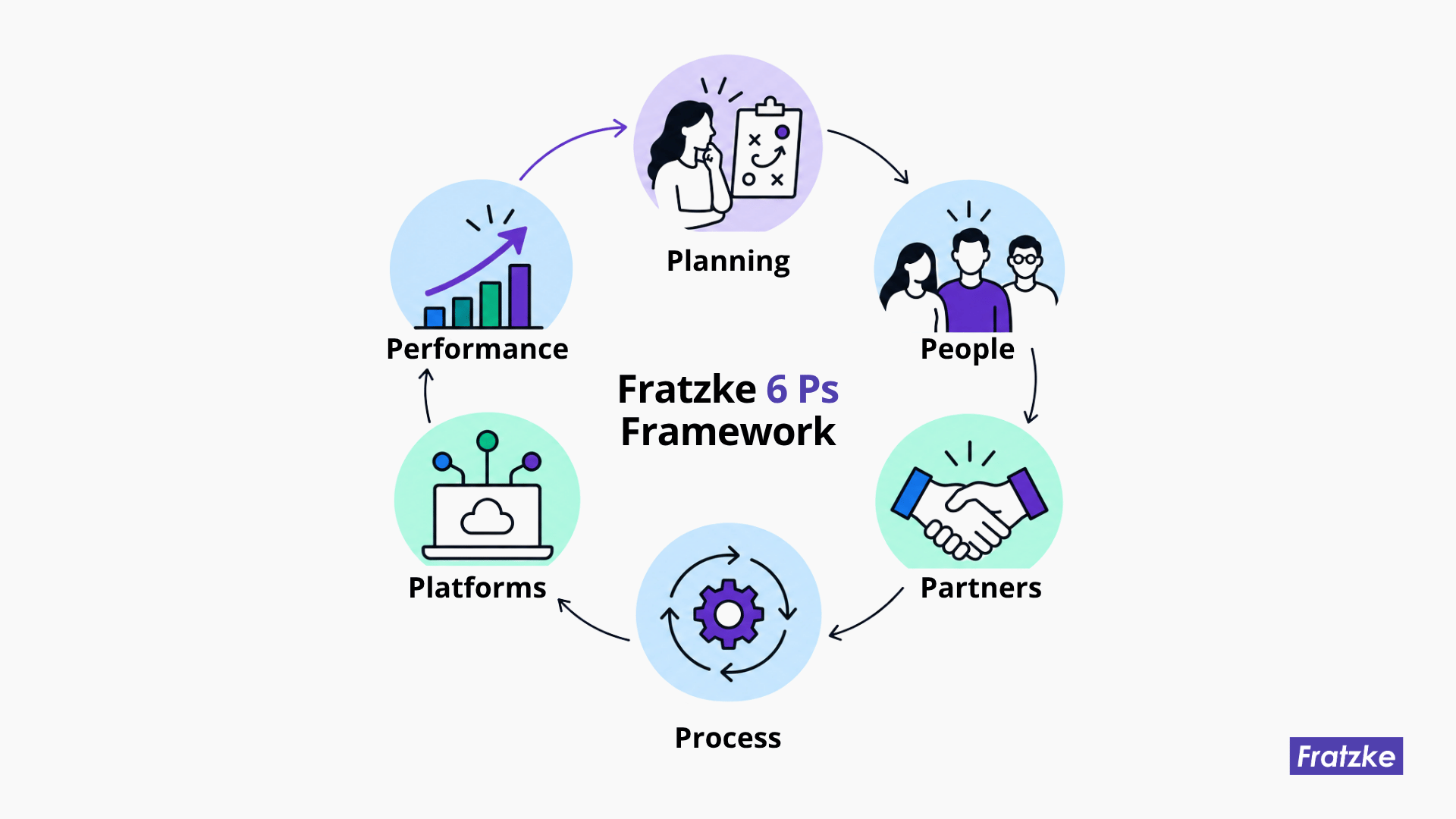
The Fratzke 6 Ps Framework looks at six interconnected elements: Planning, People, Partners, Process, Platforms, and Performance. Rather than focusing only on channels and tactics, it considers the broader marketing operating system needed to turn strategy into action.
Planning: What Are We Going to Do?
Planning translates strategic direction into a coordinated approach for execution. This is where the organization connects its Guiding Light with:
Strategic priorities and initiatives
Target audiences and customer journeys
Positioning and messaging
Marketing channels
Campaigns and programs
Budgets and resources
Roadmaps and timelines
Goals and measurement
Planning comes after you've established the direction. Don't choose channels and then build a strategy around them. Determine what you're trying to accomplish and select the right combination of initiatives to support it.
People: Who Will Make It Happen?
Every strategy eventually needs someone to execute it. People considers the internal talent, capabilities, roles, ownership, and leadership required to deliver the strategy.
Evaluate:
Who owns the overall strategy?
Who owns individual initiatives?
What capabilities already exist internally?
Where are there skill or knowledge gaps?
Does the team have enough capacity?
Which departments need to work together?
Who has decision-making authority?
The goal isn't necessarily to build a bigger team. It's to make sure responsibilities and capabilities align with the strategy.
Partners: Where Do We Need Outside Support?
Not every capability needs to exist internally. Agencies, consultants, technology vendors, freelancers, and specialists can provide expertise or capacity that would be difficult or inefficient to maintain in-house.
Consider:
Which capabilities should remain internal?
Where do we need specialized expertise?
Where would additional capacity help us move faster?
Which existing partners are critical to execution?
Are there gaps in our current partner ecosystem?
How should internal and external teams work together?
The right model may be internal, external, or a combination of both.
Process: How Will the Work Get Done?
Great ideas don't create results unless organizations can move them forward. Process includes the workflows, operating rhythms, governance, and decision-making practices that determine how marketing work gets done.
Evaluate:
How are priorities established?
How are campaigns and initiatives planned?
How are projects approved?
How quickly can decisions be made?
How do teams collaborate?
How are experiments launched and evaluated?
How often is performance reviewed?
Where are existing bottlenecks slowing execution?
Poor processes can create invisible barriers to growth. Opportunities may exist, but teams can't pursue them quickly enough. The goal isn't more process. It's the right amount of process to help teams move faster and make better decisions.
Platforms: What Technology and Data Enable the Strategy?
Technology should support the strategy, not define it. Platforms considers the technology, data, tools, and systems needed to enable execution.
Depending on the strategy, that may include:
Website and CMS
CRM
Marketing automation
Analytics and reporting
Advertising technology
Customer data platforms
SEO and AI visibility tools
Content management tools
Project management systems
AI and automation tools
Ask whether the current technology stack provides the capabilities the strategy actually requires. A sophisticated technology stack doesn't automatically create sophisticated marketing.
Performance: How Will We Know It's Working?
Performance connects execution back to the business outcome established in the Guiding Light. Rather than measuring activity in isolation, identify the marketing and business outcomes that demonstrate whether the strategy is working.
Depending on the strategy, performance measures could include:
Measurement shouldn't be the end of the process. Performance should help teams learn, optimize, reprioritize, and improve future planning.
"The best strategy in the world has limited value if the organization isn't equipped to execute it. Strategy and operational readiness have to be designed together." - Lisa Fratzke, Partner & Executive Strategist
What Digital Marketing Channels Can Support Your Strategy?
A common mistake is treating channels themselves as the strategy. SEO isn't your strategy. Paid media isn't your strategy. Social media isn't your strategy. They're potential ways to activate it.
Depending on your goals, a digital marketing strategy might use:
Website and digital experience: Support discovery, education, conversion, and customer engagement.
SEO: Build organic visibility around the searches and topics that matter to your customers.
AI search visibility: Improve how your brand, products, services, and expertise are represented across AI-powered discovery experiences.
Content marketing: Use articles, research, guides, video, case studies, and other content to educate customers and build authority.
Paid media: Create targeted visibility through paid search, social, display, and other advertising channels.
Social media: Support awareness, engagement, thought leadership, community, and demand generation.
Email and marketing automation: Nurture relationships and personalize communication throughout the customer lifecycle.
Conversion rate optimization: Improve the percentage of visitors who take meaningful actions.
Digital PR and earned media: Build awareness, authority, and trust through third-party coverage, links, reviews, and mentions.
The strategic question isn't "Which channels should we use?" It's "Which combination of channels best supports what we're trying to accomplish?"
A strong digital marketing strategy becomes more valuable when it can support the larger direction of the business. Our work with TopBuild is a good example.
Fratzke used the Guiding Light Method and 6 Ps Framework to help translate that ambition into action across TopBuild's growing portfolio of companies. That meant looking beyond individual websites or marketing channels and considering the broader operating system required to execute the strategy:
Planning: Establish a shared digital strategy and priorities aligned with TopBuild's growth objectives.
People: Align internal stakeholders around the vision, responsibilities, and work required to move it forward.
Partners: Work as an extension of TopBuild's team to provide the strategy and specialized digital expertise needed to execute.
Process: Create repeatable approaches that could support a growing portfolio of businesses and digital properties.
Platforms: Build a more connected and scalable digital ecosystem capable of evolving as TopBuild continued to grow.
Performance: Measure progress and continually identify opportunities to strengthen the digital experience and support business growth.
The result wasn't simply a new website or another marketing initiative. It was a digital foundation designed to evolve with the organization and support its broader M&A growth strategy.
Watch: CMO Testimonial
Watch Robin share her experience working with Fratzke and how the partnership helped TopBuild evolve its digital ecosystem.
How Do You Measure a Digital Marketing Strategy?
Start with the outcome you defined at the beginning. Then connect day-to-day marketing metrics with larger marketing and business outcomes.
A useful measurement structure includes:
Business outcomes: Revenue, profitability, market share, customer growth, or retention.
Marketing outcomes: Qualified demand, customer acquisition, brand awareness, or engagement.
Leading indicators: Search visibility, target-audience engagement, website traffic, or content engagement.
This prevents teams from confusing activity with performance. Publishing 50 articles is activity. Increasing organic visibility among priority customers is a marketing outcome. Generating profitable growth is a business outcome.
Your measurement system should show how those layers connect.
When Should You Update Your Digital Marketing Strategy?
A digital marketing strategy should provide long-term direction without becoming rigid. Consider revisiting it when:
Business priorities change
Customer needs or behaviors shift
New competitors emerge
Technology changes how customers discover or engage with brands
Marketing channels produce diminishing returns
Organizational capabilities change
Performance isn't progressing toward your goals
Meaningful new opportunities emerge
Importantly, changing tactics doesn't always mean changing strategy. If paid search underperforms, you might adjust budgets, targeting, creative, or channels while maintaining the same strategic direction. If the organization's underlying business priorities change, however, the strategy itself may need to evolve.
A digital marketing strategy is a long-term approach for using digital marketing to achieve specific business objectives. It defines the audiences, priorities, channels, resources, capabilities, and measurement needed to guide marketing decisions and execution.
How do you create a digital marketing strategy?
Start by defining the business outcome you're trying to achieve and understanding your customers and market. Establish your strategic priorities, determine which marketing initiatives and channels can create the greatest impact, and align the people, partners, processes, platforms, and measurement required to execute the strategy.
What should a digital marketing strategy include?
A comprehensive digital marketing strategy should address business goals, customers, market conditions, positioning, strategic priorities, channels, budget and resources, people, technology, processes, and performance measurement.
What are examples of digital marketing strategies?
Examples include building category authority through SEO and thought leadership, entering a new market through targeted content and paid media, increasing customer retention through personalization and email, or building direct-to-consumer demand through brand, search, content, and digital experiences. The specific channels should support a larger business objective rather than become the strategy themselves.
What is the difference between a digital marketing strategy and a digital marketing plan?
A digital marketing strategy establishes long-term direction, desired outcomes, and priorities. A digital marketing plan translates that strategy into specific initiatives, campaigns, timelines, budgets, responsibilities, and actions.
What is the difference between a marketing strategy, campaign, and tactic?
A strategy defines the overall direction and priorities. A campaign is a coordinated, time-bound initiative designed to support a specific objective within that strategy. Tactics are the individual actions used to execute a campaign, such as publishing an article, launching an ad, or sending an email.
What are the main types of digital marketing strategies?
Digital marketing strategies may use combinations of SEO, AI search optimization, content marketing, paid media, social media, email, marketing automation, digital PR, video, website optimization, and conversion rate optimization. These are best thought of as strategic levers or channels; the right combination depends on the business outcome.
How often should you update your digital marketing strategy?
Most organizations should formally review their digital marketing strategy at least annually while reviewing performance and priorities more frequently. Major changes to business goals, customer behavior, competition, technology, or market conditions may require the strategy to be revisited sooner.
How do you measure a digital marketing strategy?
Measure performance by connecting marketing KPIs to the business objectives the strategy is intended to support. Use a combination of business outcomes, marketing outcomes, leading indicators, and execution metrics rather than relying on channel activity alone.
The Takeaway
A digital marketing strategy shouldn't be a list of everything marketing could do. It should create focus.
Start by defining your Guiding Light: where are you trying to go, and what outcome are you trying to create? Determine which opportunities matter most, then use the Fratzke 6 Ps: Planning, People, Partners, Process, Platforms, and Performance to determine what needs to be in place to turn that strategy into action.
The result is more than a marketing plan. It's a shared direction for making decisions, allocating resources, executing priorities, and continuously improving marketing performance.
James Fratzke is a Partner and Executive Strategist at Fratzke with more than a decade of experience helping mid-market and enterprise organizations improve their digital marketing strategies, customer experiences, and marketing operations. He helps private equity firms assess target companies through marketing due diligence and identify opportunities to create value across their portfolio companies. His work spans digital marketing audits, competitive benchmarking, performance measurement, strategic growth planning, and leading enterprise website design and development initiatives for brands including Disney, Dollar Tree, Patagonia, Advance Auto Parts, Ferguson, Jelly Belly, Pentair, and Crocs. James has contributed to or been featured in publications including Forbes and the Orange County Register, has spoken at industry events, and serves on the CSUF College of Business and Economics Executive Council. View Full Profile.
Fratzke is a top-rated strategic agency that helps mid-market and enterprise brands spark growth through customer insights, brand strategy, marketing, and creating digital experiences. Since our founding in 2017, we've worked with leading brands across industries including Razer, TopBuild, REI, DTS, and TiVo, partnering from research and strategy through implementation. We combine data, technology, and human-centered storytelling to help brands better understand their customers, strengthen their market position, and create consistent growth over time. Learn More.
Turn Your Marketing Strategy Into Action
Get the strategy, expertise, and execution support you need to accelerate growth.