


Enterprise website design is the strategic practice of planning, building, and governing large-scale websites for complex organizations. It brings together brand strategy, user experience, content architecture, technology, security, and workflows to support high traffic, large content ecosystems, integrated systems, and compliance needs.
Your website is often where customers, buyers, partners, and talent decide whether a brand is credible, long before a form fill or sales conversation. The stakes are high. 70-80% of B2B buyers research a company online before making contact, making your website one of your most consequential brand impressions. And with the average cost of a data breach reaching $4.88 million in 2024, the structure behind the experience matters as much as what appears on the screen.
This guide is for CMOs, marketing directors, IT leaders, and digital teams planning or evaluating an enterprise web project. We’ll clarify what enterprise website design really requires: the strategy, systems, governance, security, and storytelling needed to create a site that grows with the business.
At Fratzke, we design and build websites at this scale, so we’ll be clear about what matters, what gets overlooked, and what enterprise teams should expect before they invest.
What Is an Enterprise Website?
An enterprise-level website is a large-scale digital platform built to serve the operating requirements of a complex organization. This includes high traffic volumes, deep content libraries, integrations with core business systems, multiple user roles and editorial teams, regulatory compliance, and governance structures that keep the site consistent and secure over time.
The word "enterprise" gets used loosely. An enterprise website is defined by operating requirements, not headcount. A 200-person B2B software company with global customers, a CRM integration, three regional sub-sites, and a compliance requirement may need an enterprise build. A 5,000-person company running a simple brochure site probably doesn't.

Enterprise vs. Regular Website
So what actually separates the two? The comparison below breaks down the operating requirements, including scale, integrations, governance, security, and structure, that distinguish an enterprise website from a regular one.
It is also worth clarifying the design-versus-development distinction, since searchers often conflate the two. Design refers to the experience users see, such as information architecture, visual hierarchy, navigation, and conversion flows. Development refers to the architecture, CMS, integrations, performance infrastructure, and code behind it.
At the enterprise level, these two disciplines are deeply interdependent and must be planned together from the start.
Essential Enterprise Website Functionality and Features
Enterprise website functionality refers to the full set of capabilities a large-scale site must have to reliably meet its business, security, and user requirements. The features that define an enterprise-grade build go well beyond what a standard CMS and theme can deliver.
Managing Content at Scale: An enterprise CMS (content management system) supports multiple editors, templated publishing, structured content models, and editorial workflows with approval stages. Without it, brand consistency breaks down, and compliance risk grows with every unreviewed page.
Role-Based Access: Role-based access means different users get different permissions across the site and CMS. A regional marketer edits their section; legal approves regulated content; an intern cannot publish to the homepage. This relates to single sign-on (SSO), which allows employees to authenticate with existing organizational credentials.
Security and Compliance: Enterprise-grade security includes SSO, multi-factor authentication (MFA), SOC 2 compliance (a framework auditing security, availability, and data privacy), data encryption in transit and at rest, and penetration testing. Healthcare, finance, and government organizations face additional requirements like HIPAA or FedRAMP that must be built into the architecture from the start.
Connecting to Other Systems : An enterprise site is a hub, not an island. That means bidirectional integrations with CRM platforms, ERP systems (enterprise resource planning, the software managing finance, inventory, and supply chain), marketing automation, and digital asset management (DAM) systems. Map your integrations before choosing a platform. The integration requirement frequently determines which CMS or DXP (digital experience platform, a CMS that also manages personalization, analytics, and multi-channel delivery) is actually viable.
Content Organization and Search: Information architecture (IA) is the structural design of how content is organized and navigated across the site. At enterprise scale, this means taxonomies and content models that accommodate thousands of pages without sprawl, plus robust on-site search when navigation alone isn't enough.
Accessibility, Speed, and Managing Multiple Sites: WCAG (Web Content Accessibility Guidelines) AA compliance is a legal baseline in many markets. Core Web Vitals are Google's performance metrics and hard ranking signals. Multi-site governance allows regional domains and sub-sites to be managed centrally. None are optional at the enterprise level.
Designing for AEO and GEO is vital from the start. When evaluating enterprise website platforms, the ability to implement structured data natively, control heading hierarchy precisely, and optimize Core Web Vitals at scale should be non-negotiable alongside design flexibility and integration capabilities.
For a deeper look at how GEO functions alongside traditional SEO, see Fratzke's guide to Generative Engine Optimization.
Enterprise Website Design Best Practices
The best enterprise websites are not the prettiest ones. They are the ones that perform by converting, scaling, staying consistent across hundreds of contributors, and loading fast for every user regardless of geography or device.
Start with Clear Business Objectives
Define what the site must achieve commercially and operationally before any visual work begins. Map audiences, define conversion actions, identify compliance requirements, and document every integration.
Organizations that skip this step end up with a beautiful site that doesn't move the metrics that matter. Discovery is not overhead. It determines whether the final product justifies the investment.
Organize Content With a Customer-Centered Mindset
Enterprise sites often hold thousands of pages across multiple products and audiences. At this scale, the risk isn't too little content - it's too much for customers to navigate.
The fix is organizing around how customers search and browse, not your internal org chart. A structure that makes sense internally may be invisible to someone searching by use case or industry.
Clear taxonomies, intuitive navigation, and scalable content models let customers move smoothly from exploring to evaluating to buying to getting support, no matter where they enter or how large the site grows. The same structure also determines how easily AI search tools can surface your content.
Design for Complex, Multi-Audience Journeys
Enterprise websites must serve very different people, often at the same time. A CFO may be evaluating your organization as a potential partner, a developer may be searching for technical documentation, and a job candidate may be exploring your culture.
Effective enterprise UX gives each audience a clear, intuitive path. Predictable navigation, differentiated audience journeys, and a thoughtful content hierarchy help visitors quickly understand where they are, find what they need, and confidently take the next step.

Protect Your Brand with a Unified Design System
A design system creates a shared foundation of components, typography, color standards, and interaction patterns that every team and sub-site can use. Without one, enterprise websites quickly drift as regions, departments, and contributors make small, inconsistent decisions over time.
We believe strong enterprise experiences require relentless consistency. A well-governed design system protects the brand, creates a more seamless customer experience, and helps teams move faster by building from proven components instead of starting from scratch.
Create Clear Paths to Conversion
A strong enterprise website should make it easy for visitors to take the next step, whether that means requesting a demo, contacting your team, downloading a resource, or learning more about a solution.
Conversion should be considered from the beginning, and not added after launch. Clear messaging, intuitive page layouts, well-placed calls to action, relevant proof points, and simple forms all help reduce friction and move customers forward with confidence.
Fratzke's B2B website design guide covers conversion architecture in depth.
Make the Experience Accessible, Fast, and Easy to Manage
Enterprise websites need to work well for every visitor, load quickly across devices, and remain consistent long after launch. Accessibility and performance should be built into the design and development process, not treated as final checks.
The site also needs clear ownership. Teams should know who can publish content, how updates are reviewed, and how brand and design standards will be maintained over time. Strong governance helps protect the experience as more teams and contributors become involved.
The Enterprise Website Development Process and What It Costs
The strongest enterprise builds follow a clear website design and development process. Understanding the stages and cost drivers helps organizations plan realistic budgets and avoid the scope creep that derails most enterprise builds.
- Stage 1: Strategy & Discovery - Define business goals, audience needs, stakeholder priorities, technical requirements, content needs, compliance considerations, and key integrations. This is where the foundation and budget clarity are built.
- Stage 2: User Experience & Journey Mapping - Map how users browse, engage, and take action. This stage includes sitemap development, navigation, content flow, page hierarchy, wireframes, and calls-to-action.
- Stage 3: Custom Development & Integration - Build the CMS, templates, custom functionality, and integrations that power the website. For enterprise builds, CRMs, ERPs, ecommerce platforms, analytics, and marketing tools are often major cost drivers.
- Stage 4: Optimization & Launch - Test performance, responsiveness, accessibility, SEO, AI search visibility, analytics, redirects, forms, integrations, and functionality. This stage also includes content migration, restructuring, and launch planning.
- Stage 5: Ongoing Growth & Support - Maintain, monitor, and improve the website after launch through hosting, security updates, content governance, SEO tracking, performance reporting, and ongoing optimization.
A strong post-launch plan helps protect the investment, sustain search visibility, and keep the website evolving with your business.
What Enterprise Website Development Costs
Enterprise website costs vary widely, but complex builds often reach $100,000+ depending on the size of the site, technical requirements, content needs, integrations, compliance considerations, and long-term growth goals.
The factors that move cost most significantly:
Be skeptical of anyone who quotes a flat number without a discovery phase. The right number comes from scoping actual requirements, not from estimating based on category alone.
Choosing the Right Enterprise Platform without Bias
Every platform vendor (and many agencies) will tell you their solution is the best. We take a different approach. The right platform depends on your business, your technology ecosystem, and the way your teams work.
Here are the primary categories we evaluate with clients:
Enterprise Digital Experience Platforms (DXPs)
Examples: Adobe Experience Manager, Sitecore, Optimizely, Acquia DXP
Best for large, complex organizations managing multiple brands, business units, regions, or websites that require centralized governance, advanced personalization, sophisticated approval workflows, and strong compliance capabilities.
These platforms offer exceptional flexibility and control, but they also require significant investment, technical resources, and ongoing administration.
Enterprise Content Management Systems (CMS)
Examples: WordPress VIP, Drupal, Sitefinity, Kentico Xperience
Best for organizations that need flexible content management, strong editorial workflows, enterprise-grade hosting and security, and broad integration capabilities without the cost or complexity of a full DXP.
These platforms offer a strong balance of flexibility, governance, scalability, and total cost of ownership.
Modern Website Experience Platforms
Examples: Webflow Enterprise, Builder.io, Storyblok
Best for organizations looking to publish faster, give marketing teams more control through visual editing, maintain consistency across contributors, and reduce day-to-day developer dependency.
These platforms can support many enterprise use cases, though they may be less suitable for organizations with highly customized integrations or application requirements.
Ultimately, the best platform for your organization isn't necessarily the one with the most features - it's the one that aligns with your operating model, integration requirements, governance needs, internal resources, and long-term goals. Choose the platform that fits your business, not the one an agency happens to sell.
For a head-to-head comparison, see Fratzke's guide to choosing Webflow vs. WordPress vs. Custom.
Enterprise Website Design Examples: What Makes Them Work
Enterprise website design examples are most useful when analyzed for what makes them enterprise-grade, not just what makes them visually appealing.
Salesforce
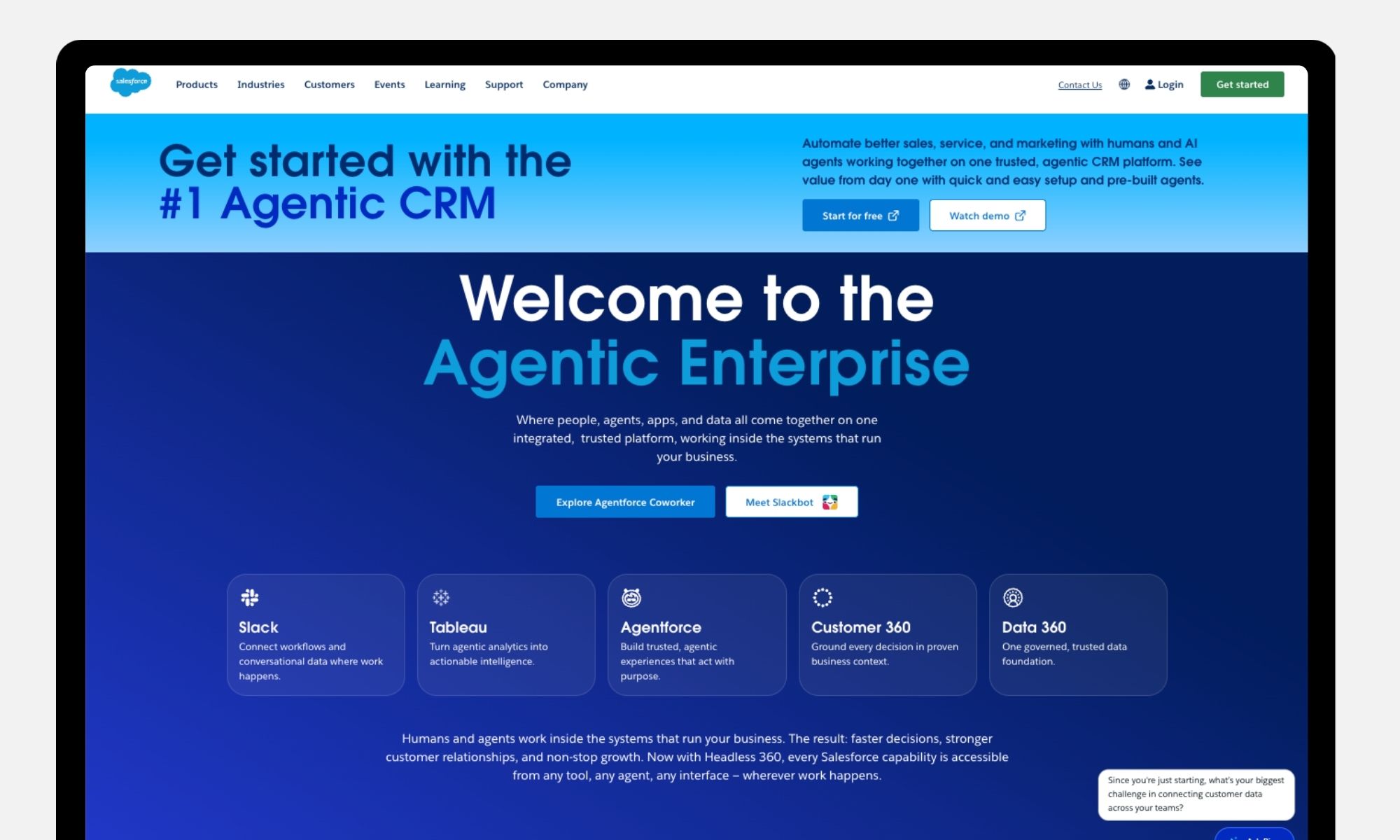
Serves customers, partners, developers, investors, and job candidates from a single domain.
What makes Salesforce enterprise-grade: A design system maintaining component consistency across hundreds of product pages, deep CRM and personalization integration, and performance infrastructure handling a massive content library.
Patagonia
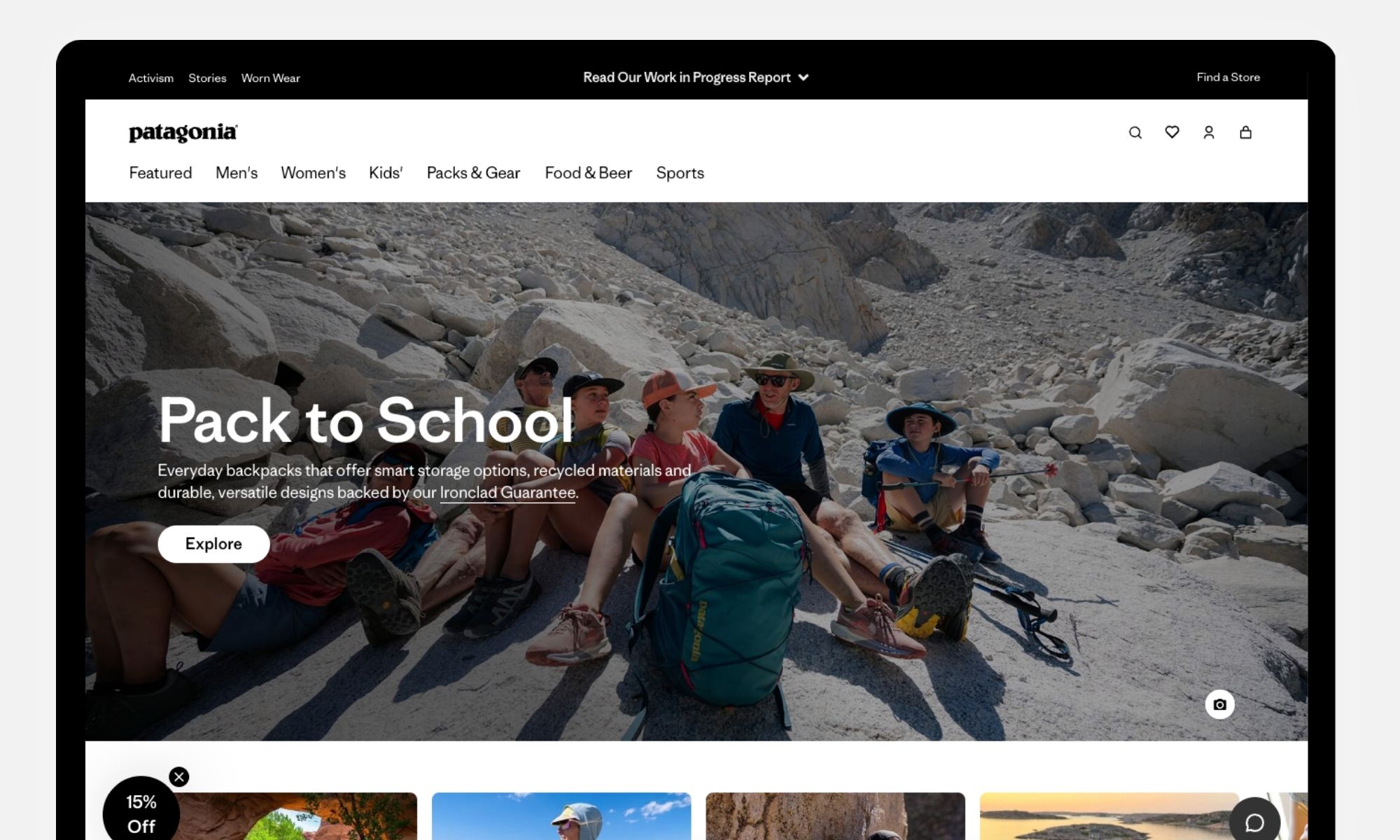
Serves consumers, environmental advocates, retail customers, job candidates, media, and corporate stakeholders through a connected digital ecosystem that combines commerce, brand storytelling, activism, and company information.
What makes Patagonia enterprise-grade: A cohesive brand and content system that integrates e-commerce with environmental advocacy, product education, repair and resale programs, corporate transparency, and editorial storytelling without making these experiences feel disconnected. Patagonia’s purpose is embedded throughout the digital experience rather than confined to a standalone corporate responsibility section.
Service Partners
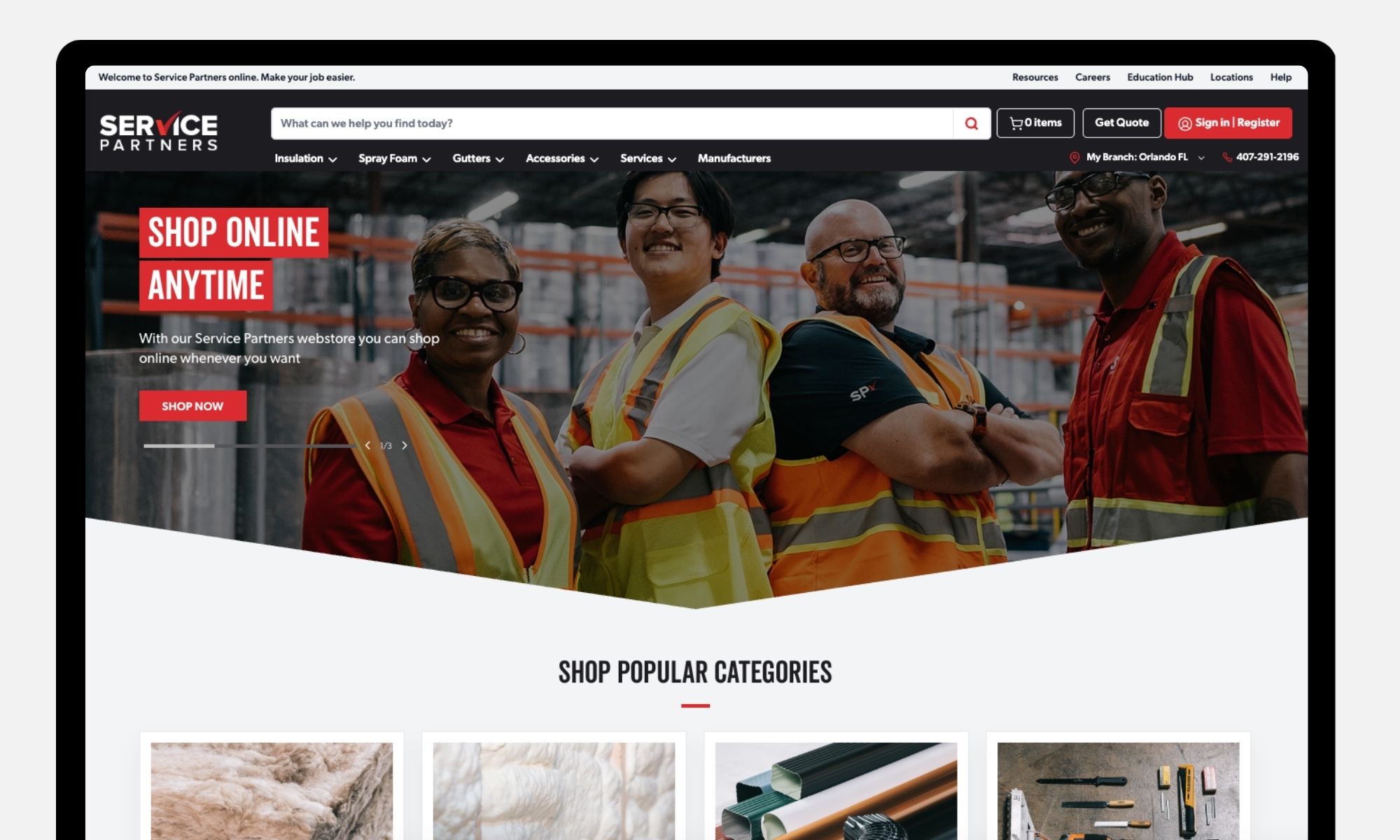
Serves contractors, builders, insulation professionals, suppliers, and commercial customers across a nationwide network of locations.
What makes Service Partners enterprise-grade: A practical combination of corporate marketing, product discovery, location-based content, and B2B commerce. The website supports a large building-materials catalog while helping customers quickly find products, services, and nearby branches. Its connection to a dedicated online ordering platform extends the experience beyond marketing into customer transactions and account support.
Maersk

Serves businesses across industries, regions, cargo types, and levels of supply-chain complexity while also supporting high-frequency customer tasks such as shipment tracking, scheduling, booking, and locating offices.
What makes Maersk enterprise-grade: A task-oriented information architecture that connects a large portfolio of global logistics services with industry-specific solutions, customer tools, local market information, and thought leadership. The experience helps users move between broad supply-chain needs and specific transactional actions.
A Fratzke Case Study
We worked with a B2B entertainment business that had to keep up with global competitors. Fratzke worked on a website redesign that included SEO, GEO, and AEO strategy implementation. As a result, the company saw a 340% increase in AI visibility and a 140% increase in organic keyword growth.
These examples share a clean IA, strong design systems, meaningful integrations, performance infrastructure that handles real load, and governance that keeps the site consistent long after the agency engagement ends.
AI Search and SEO for Enterprise Websites in 2026
Enterprise websites now need to perform across both traditional search and AI-powered search. Google and Bing still matter, but so do ChatGPT, Perplexity, Google AI Overviews, Copilot, Gemini, and other platforms shaping how buyers research and make decisions.
Strong enterprise SEO starts with the foundation: clean site architecture, logical URL structures, crawlability, indexation controls, internal linking, redirect planning, Core Web Vitals, accessibility, and performance under real traffic.
AI search optimization builds on that foundation. To show up in AI-generated answers, enterprise websites need clear content structure, strong authority signals, schema markup, FAQ content, answer-first copy, and pages that help AI systems understand what the brand does, who it serves, and why it can be trusted.
Organizations that build SEO and GEO into the website strategy from day one are better positioned to protect organic visibility, earn AI citations, and turn search into a scalable growth channel.
For a deeper look, explore Fratzke’s SEO services and Generative Engine Optimization services.
Hiring an Enterprise Website Development Agency or Company
The right engagement model depends on your internal capabilities, technical complexity, and long-term ownership needs. For many mid-market and enterprise organizations, the strongest partner is not always the biggest agency in the room. It is the team that brings senior strategy, technical depth, responsive collaboration, and the ability to move with clarity.
Ultimately, the right partner should feel like an extension of your team, and not simply an outside vendor.
Boutique Website Agency: A boutique agency can be a strong fit for organizations that need senior-level strategy, UX, design, development, SEO, GEO, and ongoing optimization without the overhead of a large agency model. The value is access. You work directly with experienced specialists who understand the business goals behind the build, helping create faster alignment, sharper decisions, and a more thoughtful digital experience.
Large Development Company: A large development company may fit highly technical builds involving deep ERP integrations, compliance-heavy environments, or major platform transformations. These engagements often require larger teams, longer timelines, higher budgets, and more internal coordination.
In-House Team: An in-house team can work well when the organization has strong development capabilities and clear ownership. Many teams still benefit from specialist support in strategy, UX, design, SEO, GEO, accessibility, integrations, or launch planning.
Hybrid Model: A hybrid model can create a strong long-term outcome. An agency leads strategy, design, development, and launch while preparing the internal team to manage and optimize the site over time through governance, training, documentation, and handoff.
Red Flags: Limited enterprise experience, vague answers about integrations or security, no SEO and GEO continuity plan, and unclear post-launch ownership.
Questions to ask any prospective enterprise website partner:
- How do you approach integrations and technical discovery?
- How do you address security, accessibility, and compliance?
- How are SEO and GEO incorporated into the build?
- What does post-launch governance and support look like?
- How will you work alongside our internal team?
- Who owns the site, codebase, and documentation after launch?
Read more on How to Hire a Website Design Agency to gain more insight.
Common Enterprise Web Development Challenges
Enterprise website builds are complex by nature. The best way to avoid costly delays is to identify the likely friction points early. When teams understand where enterprise builds most often get complicated, they can plan around those challenges instead of absorbing them mid-project.
- Integration Complexity: Integrations routinely cause scope expansion and delays. Document every requirement in discovery and test connections early.
- Legacy Content Migration: Moving content from legacy CMS platforms is always messier than expected. Audit before the build begins and make cleanup decisions early.
- Stakeholder Alignment: Enterprise builds involve legal, IT, marketing, and executive stakeholders with competing priorities. Establish a single accountable owner at the outset.
- Performance Under Real Load: Sites that perform in testing can struggle at traffic peaks. Load-test against realistic projections.
- SEO Continuity through Migration: Migrations that don't preserve URL structures and redirect chains can erase years of organic rankings. Treat the SEO migration plan as a critical workstream, not an afterthought.
When you follow the enterprise design best practices outlined above, you can avoid a lot of these challenges.
Building an Enterprise Site That Earns Its Keep
An enterprise website is a core business platform that needs to scale, integrate with your technology ecosystem, remain secure and well governed, support the customer journey, and perform across both traditional and AI-powered search.
That means design decisions should be driven by business and operational requirements, and not aesthetics alone.
The most valuable first step is defining those requirements before selecting a platform or engaging a development partner. Organizations that clarify integrations, governance, content workflows, measurement needs, and long-term ownership during discovery are far more likely to avoid costly course corrections later.
At Fratzke, we help enterprise organizations close the gap between digital ambition and execution. We bring strategy, research, experience design, technology, SEO, and GEO together to create websites that are not only built to launch, but built to perform and evolve.
If you are planning an enterprise website redesign or evaluating your visibility in AI-powered search, reach out to start the conversation.
Frequently Asked Questions About Enterprise Website Design
What is an enterprise website?
An enterprise website is a large-scale digital platform built to handle high traffic and content volumes, integrate with core business systems like CRM and ERP, support multiple teams and user roles, and meet strict security and compliance requirements. It functions as an organization's central digital hub rather than a static brochure site. The defining factor is operating requirements, not company size.
What is the difference between a regular website and an enterprise website?
A regular website typically serves a single team, has limited integrations, and operates at manageable traffic volumes. An enterprise website supports multiple teams and regions, integrates with complex systems, requires role-based access governance, and must maintain performance and security under high load. The gap is architectural and organizational, not cosmetic.
What is the difference between enterprise website design and development?
Enterprise website design refers to the user-facing experience like information architecture, visual hierarchy, navigation, content structure, and conversion flows. Enterprise website development refers to the technical infrastructure: the CMS or DXP, integrations, performance architecture, and security configuration. At the enterprise level, the two are deeply interdependent and should be planned together from the start.
What functionality does an enterprise website need?
An enterprise website needs an enterprise CMS with publishing workflows and templating, role-based access control, SSO and multi-factor authentication, CRM and ERP integrations, robust search and information architecture, personalization capabilities, WCAG accessibility compliance, Core Web Vitals performance, and multi-site support. The specific combination depends on the organization's operating model and compliance requirements.
How much does an enterprise website cost?
Enterprise website costs vary based on platform, integration complexity, single-site versus multi-site scope, content migration extent, and compliance requirements. Realistic projects range from mid-five figures for focused single-site builds to seven figures for fully custom, multi-site, compliance-heavy engagements. A discovery phase is the only reliable way to produce an accurate estimate.
How long does it take to build an enterprise website?
Enterprise builds typically take 4 to 18 months. A focused single-site project with minimal integration complexity can deliver in four to six months. A multi-site build with complex integrations, legacy migration, and compliance requirements often runs twelve to eighteen months. Discovery, content migration, and stakeholder alignment are the most common sources of timeline expansion.
What is the best platform for an enterprise website?
There is no single best platform. Traditional DXP platforms like AEM or Sitecore suit complex personalization and compliance needs. Modern visual platforms like Webflow Enterprise suit organizations prioritizing publishing speed and lower overhead. Enterprise WordPress offers editorial flexibility with managed infrastructure. Headless and composable architectures deliver maximum flexibility at higher implementation cost. The right platform depends on integration requirements, governance model, team capabilities, and total cost of ownership.
Does my organization actually need an enterprise website?
Not all businesses need an enterprise website. The investment is justified when your organization has complex integration requirements, multiple publishing teams, high or unpredictable traffic, multi-site needs, or strict compliance requirements. If your site's limitations are mostly cosmetic or content-related rather than architectural, a redesign on a modern platform may deliver better ROI. Be honest about your actual operating requirements before committing to enterprise-scale scope and cost.


.avif)


