

Why AI-Generated Content All Sounds the Same
My biggest AI pet peeve is the sameness of it all.
I recently wrote about ChatGPT launching business profiles, a development that gives brands more influence over how they appear inside the platform.
After publishing the article, I searched to see how other people were covering the news. Within minutes, I found the same phrase repeated across several posts. The wording was nearly identical.
How does that happen?
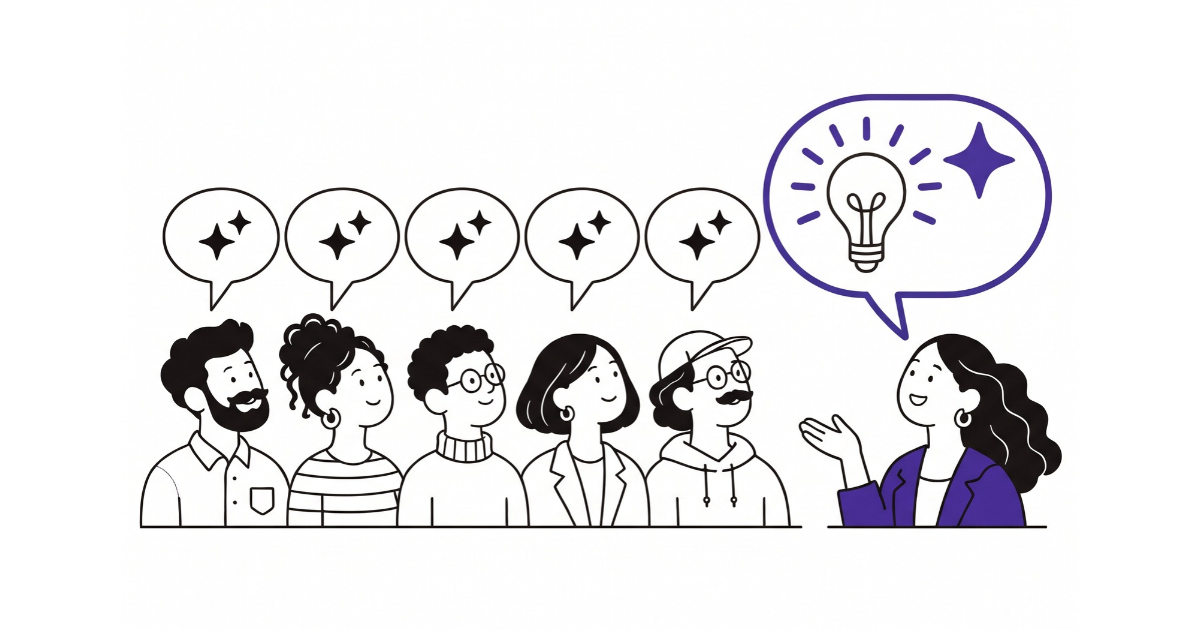
When we ask AI to create content without first giving it our perspective, we effectively ask the technology to supply one for us. Because many people use similar prompts and provide little original context, they receive content built from the same familiar patterns.
The result often sounds polished, competent and completely interchangeable.
AI has writing habits, too
Generative AI learns relationships between words and predicts what should come next based on those patterns. That makes it good at producing fluent language. It also explains why certain phrases, structures and ideas appear again and again. OpenAI describes this process as predicting likely words based on patterns learned from large volumes of text.
The more AI-assisted content you read, the easier it becomes to recognize some of its habits:
- Contrast formulas that pit one idea against another
- Empty adjectives that sound impressive but communicate very little
- A series of short sentences designed to manufacture impact
- Conclusions that neatly summarize every point
- Writing that feels polished but strangely anonymous
None of these choices is automatically wrong. Human writers use them, too. The problem appears when every brand uses the same choices at the same time.
That's when a recognizable writing pattern can quickly become a sea of sameness.
Sameness is a brand problem
Marketing teams are under pressure to create more content across more channels, often with the same resources. AI offers a compelling answer. It can help teams brainstorm ideas, develop outlines, repurpose material and move through early drafts faster.
But speed has limited value when the output could have come from any competitor.
Your audience does not need another perfectly organized article that repeats what everyone already knows. They need a useful perspective shaped by your experience, your customers and the way your organization sees the world.
Your unique perspective is one of the few advantages competitors cannot easily replicate.
When brands hand the entire creative process to AI, they risk removing the very qualities that make their content worth reading:
- A specific belief
- Firsthand experience
- Subject-matter expertise
- Cultural context
- Unexpected connections
- A willingness to take a position
- The small imperfections that make a person sound human
AI can synthesize what has already been said. Your team still has to decide what is worth saying next.
5 tips for writing unique AI-assisted content
Creating distinctive content with AI requires more than an overly involved prompt. It requires active human direction throughout the process.
Here are five ways to ensure you are acting as the creative director your content, protecting your perspective, and creating AI-assisted content that has value.
1. Decide what you believe before you start prompting
Before opening an AI tool, write down the central point you want to make.
What did you notice? Why does it matter? Where do you agree or disagree with the prevailing conversation? What should your audience understand or do differently after reading? A strong point of view gives AI something meaningful to expand on.
2. Give AI the context that shaped your thinking
Share the articles, interviews, customer conversations, research and experiences behind your perspective. Explain which ideas influenced you and where your conclusion differs.
Context helps the tool work with your thinking instead of defaulting to the most common answer.
3. Build voice guidelines from actual examples
Adjectives such as “confident,” “conversational” and “insightful” leave plenty of room for interpretation.
Give AI examples of content that genuinely sounds like your brand. Identify the phrases, sentence structures and habits you want to preserve. Include the patterns you want it to avoid. A useful brand voice guide should act as a linguistic roadmap, with clear examples of turns of phrases to use and avoid entirely.
4. Use AI for defined parts of the process
AI is especially helpful when it has a focused role. Ask it to challenge an argument, organize notes, identify repetition, suggest stronger transitions or adapt an approved idea for another channel. Humans should continue to own the insight, judgment and final editorial decisions.
This reflects Fratzke’s broader approach to AI consulting: technology should amplify human expertise and creativity.
5. Edit for truth, voice and texture
Review the content is the essential and final step of the process. Make sure to ask:
- Does this sound like something I would say?
- More broadly, does this sound like our brand?
- Does it contain an idea that belongs specifically to us?
- Have we supported broad claims with evidence or experience?
- Are any phrases technically correct but emotionally empty or nonsensical?
- Would a competitor be comfortable publishing the same article?
If the answer to the final question is yes, the piece probably needs more of you.
Your perspective matters more as AI improves
As AI-generated content becomes more polished, surface-level quality will become easier for everyone to achieve. Clean writing will no longer be enough to distinguish your brand. Your unique perspective will.
The organizations that stand out will be the ones that use AI to extend the thinking of experienced people, uncover stronger ideas and create more space for meaningful work. You content needs to carry the fingerprints of the people behind it.
We should absolutely use AI to help us work faster and explore what is possible. We should also remember that creativity requires artistic taste, judgment, choice and your unique experience.
AI can help us transform a thought or idea into words, but the point of view still has to come from us.