Private Equity Marketing Due Diligence: From Target Assessment to Growth Roadmap
Learn how early-stage private equity marketing due diligence can uncover risks, reveal growth opportunities, and guide a smarter target-company assessment.
Private equity marketing due diligence is systematic, pre-close evaluation of a target company’s marketing performance, capabilities, and ability to support future growth. It can begin early with an outside-in review of the company’s website, positioning, search visibility, and competitive presence. As a deal progresses, internal data, customer research, and team interviews help validate those observations and clarify the investment required.
This guide walks through three phases of marketing diligence, what to assess at each stage, and how to turn the findings into a practical growth roadmap.
Start diligence early. An outside-in review can reveal marketing strengths, gaps, and growth opportunities before access to internal data.
Look beyond red flags. Underperforming channels can reveal paths to value creation, while stronger channels may offer opportunities to build digital leadership.
Validate as the deal progresses. Use internal data, customer research, and the Fratzke 6 Ps Framework to test assumptions and assess the company’s ability to support growth.
Turn findings into a growth roadmap. Connect priorities to the investment thesis, with clear ownership, budgets, timing, and measures of progress.
What Marketing Due Diligence Helps You Understand
A target company may have strong products and established customer relationships. Marketing due diligence helps investors assess whether its marketing can support the next phase of growth, whether that means entering new markets, introducing products, or integrating acquisitions.
A focused assessment answers five questions:
How clearly does the company communicate its value? Buyers should understand what the business offers, who it serves, and why they should choose it.
Can potential customers find and evaluate the company? Its website, search presence, and content should help buyers research their options and take the next step.
Where are competitors outperforming it? Differences in positioning, visibility, and customer experience can reveal areas that deserve attention.
What could limit the growth plan? Gaps in measurement, capabilities, technology, or customer understanding may affect execution.
Where could marketing contribute to growth? The review should identify opportunities and what it would take to pursue them.
A digital marketing audit provides a foundation by benchmarking current performance and identifying gaps. Marketing due diligence connects that assessment to the acquisition opportunity and the decisions facing the deal team.
At Fratzke, our audits use our Benchmark Method™ to organize the assessment around three perspectives: Performance Intelligence, which examines marketing effectiveness; Customer Intelligence, which explores buyer needs and behavior; and Market Intelligence, which evaluates competitors and market opportunities. Together, they connect marketing activity with the customers and markets the business needs to reach.
Three Phases of Marketing Diligence
Marketing diligence develops as the deal progresses. An early-stage review establishes what is visible from the outside, deeper analysis tests assumptions and capabilities, and a growth roadmap defines the work ahead.
Phase
Focus
Key Activities
Outcome
Early-Stage Due Diligence (Outside-In)
Understand the target's visible strengths, gaps, and potential opportunities.
Review its website, positioning, SEO, AI search visibility, public marketing activity, and competitors.
An initial benchmark and priorities for deeper diligence.
Deal Progression
Validate findings and assess the ability to support growth.
Analyze internal data, conduct customer research, and evaluate marketing capabilities as access expands.
A clearer view of risks, opportunities, and required investment.
Growth Roadmap
Define what to do, when, and with which resources.
Prioritize initiatives, identify dependencies, and establish ownership, budgets, and success measures.
A practical plan for post-close execution and longer-term growth.
Phase 1: Early-Stage Due Diligence with an Outside-In Review
Marketing due diligence can begin while a private equity firm is still getting to know a target company. An outside-in review uses public information and available third-party data to assess how the business presents itself and competes for customer attention.
This early assessment evaluates the company from a prospective customer’s perspective, examining its website, brand positioning, SEO, AI search visibility, and competitive presence.
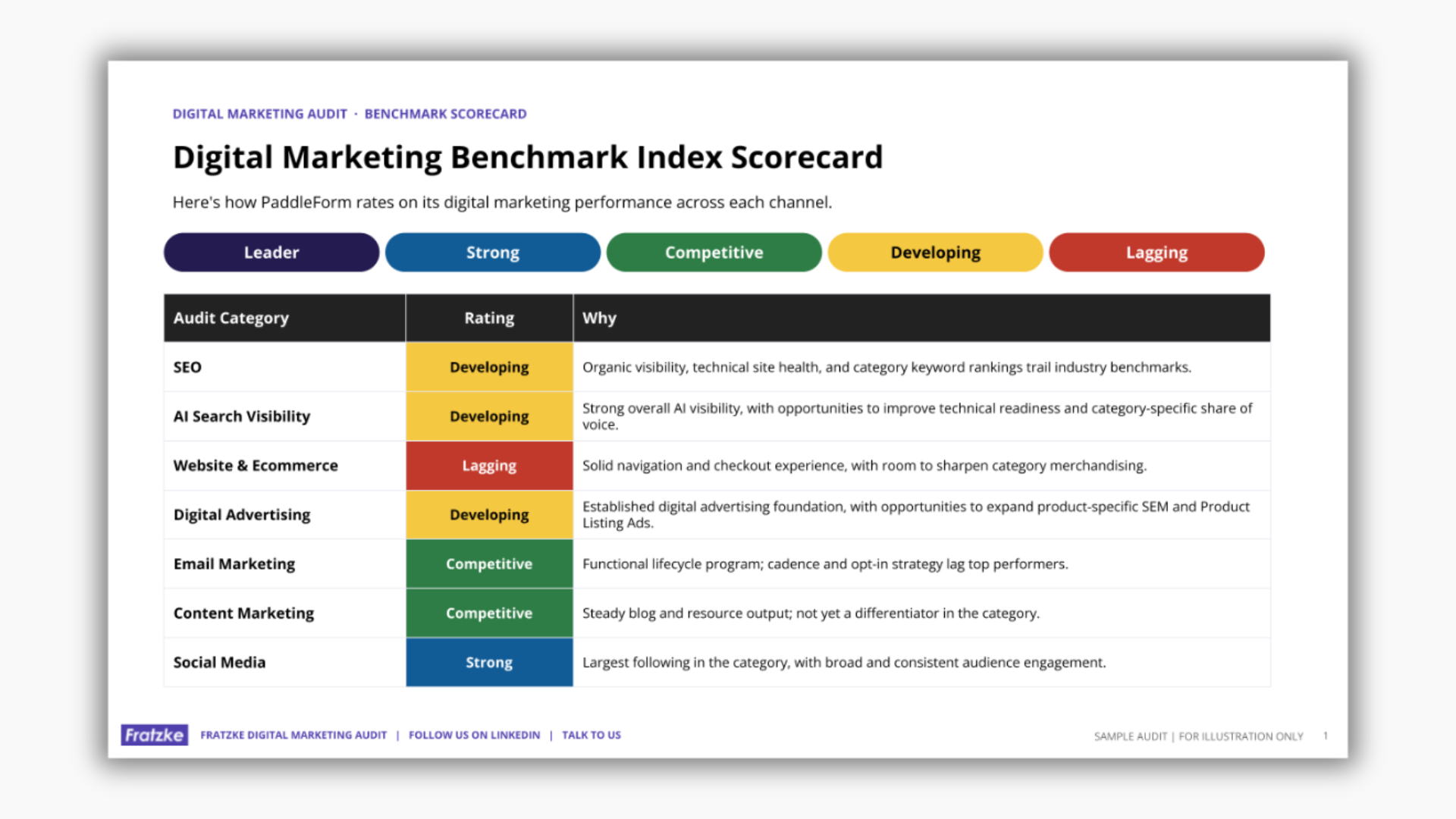
At Fratzke, we use the Fratzke Benchmark Index™ to establish an initial view of digital marketing maturity and identify priorities for deeper diligence. The index uses five maturity ratings, from Lagging to Leader:
Rating
Description
Leader
Sets the benchmark within the industry.
Strong
Performs above average with opportunities to strengthen its advantage.
Competitive
Performs well but has clear opportunities for improvement.
Developing
Foundational capabilities exist but require strategic improvement.
Lagging
Significant gaps are limiting performance and growth.
Channels rated Lagging or Developing put a spotlight on potential red flags, but they can also reveal some of the clearest paths to value creation. The next step is to understand what is limiting performance and what investment would be needed to improve it.
In our assessments, we often see brands score Competitive or Strong, reflecting the strengths that helped attract investor interest in the first place. For private equity firms competing for the investment, identifying a credible path from strong performance to digital leadership can help differentiate their approach. It gives the target company’s leadership a concrete view of how the partnership could accelerate growth. For example:
Turn search strength into AI visibility. A company with competitive SEO may have opportunities to build on its content and credibility to appear more consistently in AI-generated answers.
Make a strong website work harder. A polished website may still leave buyers struggling to compare services, find relevant proof, or make contact. Improving those experiences can help convert more existing interest into qualified inquiries.
Extend success into new markets. A brand with a strong position in its core market may benefit from customer research, tailored messaging, and targeted campaigns to reach new audiences and support expansion.
An example of the Fratzke Benchmark Index™ Scorecard, highlighting marketing strengths, gaps, and opportunities to inform deeper diligence and growth planning.
What an Early Review Should Deliver
The findings should provide a concise picture of:
The company’s visible marketing strengths and gaps.
How its digital presence compares with relevant competitors.
Potential opportunities connected to the growth plan.
Areas that warrant deeper assessment.
Information needed to validate the initial findings.
Public information can reveal useful signals, but it cannot confirm marketing ROI, customer acquisition costs, or conversion performance. Label third-party estimates clearly and treat potential opportunities as hypotheses to test as more information becomes available.
The assessment should reflect how the company wins customers and where it expects to grow. A manufacturer selling through distributors will have different needs from a software company relying on digital acquisition or a service business expanding into new locations.
Five areas provide a practical foundation:
Area
What an Early Review Can Assess
What Deeper Diligence Can Validate
Brand and positioning
How clearly the company explains its offerings, audiences, and differentiation.
Whether the positioning reflects what customers value and supports expansion.
Website and customer experience
How easily buyers can research offerings, find relevant information, and make contact.
Where visitors encounter friction and how website activity translates into qualified inquiries.
SEO and AI search visibility
How the company appears for relevant products, services, and customer questions.
Organic search performance, identifiable AI referrals, and their contribution to business outcomes where measurable.
Marketing channels and measurement
Visible advertising, content, social activity, and publicly accessible email signup experiences.
Campaign spending, audience quality, conversion performance, and measurement reliability.
Customers and marketing capabilities
Public reviews, customer examples, and visible indications of marketing resources.
Buying motivations, customer experience, team capacity, and execution gaps.
SEO and AI search should be assessed as distinct but connected disciplines. SEO analysis examines visibility in traditional search results and, where data is available, organic traffic and conversions. An AI search audit evaluates how the company appears and is represented in AI-generated answers across defined platforms and queries. Both should cover the products, services, and problems buyers research, extending beyond the company’s brand name.
Digital advertising, social media, content, and email deserve attention based on their role in the business. Early reviews can examine visible messaging, engagement indicators, and available third-party advertising data. Internal access allows a closer look at spending, customer acquisition, and retention.
Interpret these channels alongside sales teams, distributors, referrals, and existing customer relationships. The assessment should explain how marketing supports the way the business actually grows.
Phase 2: Go Deeper as the Deal Progresses
As access expands, marketing diligence can validate early findings and assess whether the company has the capabilities to support its growth plan.
A central question is whether the company can repeat and expand its current success. If the growth plan assumes more customers, new markets, or higher marketing spend, assess what must change to deliver those results. Strong performance today provides a starting point, but the assessment should test whether acquisition costs, conversion rates, and team capacity can support the proposed scale.
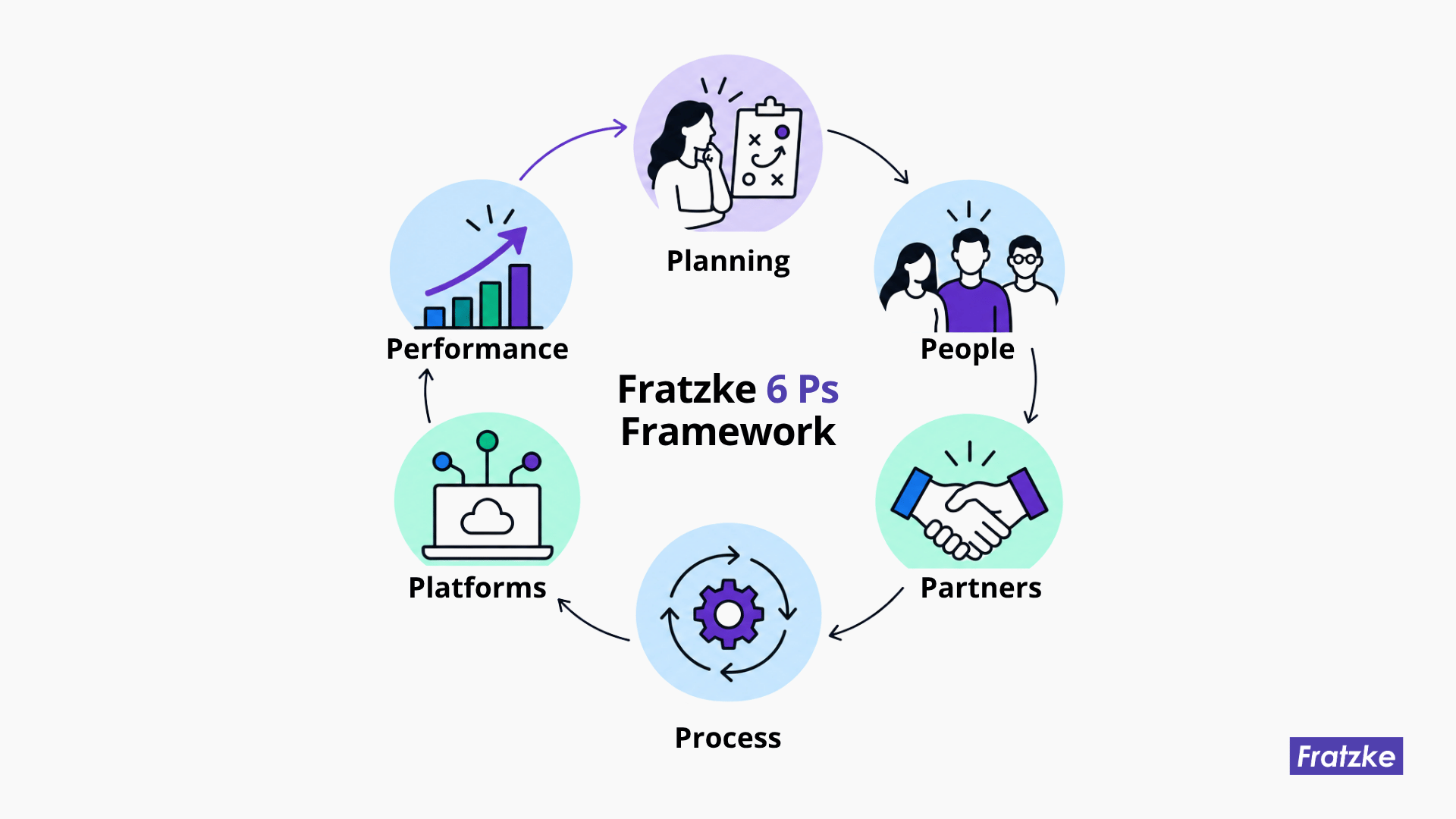
The Fratzke 6 Ps Framework provides a practical structure for this phase by examining six interconnected elements: Planning, People, Partners, Process, Platforms, and Performance. Together, they reveal how marketing operates and whether the company has the capabilities to turn its digital marketing strategy into action.
Element
What to Assess
Planning
Whether the marketing strategy, priorities, and budget support the company's growth objectives and target customers.
People
Whether leadership, skills, roles, and team capacity are sufficient for the work ahead.
Partners
How agencies and vendors contribute, where responsibilities sit, and whether there are gaps or critical dependencies.
Process
How work is planned, approved, executed, and measured, including coordination with sales and follow-up on inquiries.
Platforms
Whether the website, CRM, analytics, and other systems work together and support expansion. Confirm company ownership or appropriate access to domains, advertising accounts, customer data, and content, including dependencies on outside partners.
Performance
What first-party data shows about customer acquisition cost (CAC), conversion rates, retention, and repeat purchases. Where relevant, assess customer lifetime value and acquisition payback, with clear definitions of the costs included and comparisons across channels and customer groups.
The assessment draws on internal performance data, team interviews, and customer insights. Inside-out audits of first-party data can test reported results and identify measurement gaps, such as inconsistent lead definitions or incomplete CRM records.
Customer and prospective-customer research helps explain why buyers choose the company, how they evaluate alternatives, and whether its positioning will resonate in new markets. Select market research methods based on the questions that need answering, and interpret findings in light of the sample and research design.
For example, entering a new market may require stronger customer research, additional team capacity, and better coordination between marketing and sales. Increasing advertising spend alone would leave those needs unresolved. The 6 Ps help make these requirements visible before they become execution problems.
If you are evaluating a target company, talk with Fratzke about an assessment built around your investment priorities, available information, and deal timeline.
Phase 3: Build the Growth Roadmap
The growth roadmap translates diligence findings into decisions about priorities, resources, and timing. It should explain which opportunities are worth pursuing, what needs further validation, and what the company must put in place to execute.
Start by weighing each initiative against five considerations:
Relevance: How directly does it support the investment thesis?
Evidence: What supports the opportunity, and which assumptions still need testing?
Benefit and cost: What improvement could it deliver, and what investment would it require?
Capacity and dependencies: Can the team execute it, and what must happen first?
Accountability: Who owns the work, when should it happen, and how will progress be measured?
These considerations help establish a realistic sequence. For example, fixing inquiry tracking and sales follow-up may need to happen before increasing advertising spend. Customer research may need to precede a positioning change or website rebuild.
The roadmap should distinguish between questions that need answers before the investment decision and initiatives that can move into post-close planning. During the first 100 days, priorities may include establishing reliable measurement, addressing urgent website issues, validating customer assumptions, and confirming who will lead execution. Larger initiatives, such as brand integration or a website rebuild, may extend beyond that period.
Each priority should include:
The business objective and supporting evidence.
A defined action and accountable owner.
Required budget, expertise, and technology.
Dependencies and a realistic timeline.
A baseline and measures of progress.
The final diligence report brings this roadmap together with an executive summary, the current-state benchmark, material risks and opportunities, and unresolved questions. This gives the deal team a clear record of what is known and the operating team a practical starting point.
Each finding should connect to a potential risk, growth opportunity, or investment requirement. An outdated website may create little immediate concern for a business with stable contractual relationships. The same website could become a significant limitation if the growth plan depends on reaching new buyers who research suppliers online.
An Example: Strong Business, Underdeveloped Digital Presence
Consider an established B2B company with strong customer relationships and a broad range of capabilities. Its website explains only part of what it offers, and competitors are more visible for relevant searches.
The assessment identifies potential opportunities, then distinguishes those observations from the evidence needed to support action:
Finding
Potential Business Implication
What to Validate
Important services are difficult to find on the website.
Prospective and existing customers may overlook relevant capabilities.
Customer awareness, buying behavior, and demand for those services.
Competitors are more visible in relevant searches.
The company may be missing opportunities to reach buyers during research.
Search demand, competitor relevance, and current acquisition sources.
Management may have limited visibility into marketing's contribution.
Inquiry quality, sales follow-up, and conversion into customers.
Team interviews reveal limited capacity for additional work.
Capturing the opportunity may require additional investment.
Staffing, partner support, technology, costs, and implementation time.
A large share of new customers comes through one channel, referral partner, or founder relationship.
Growth may be vulnerable if that source becomes more expensive, less effective, or unavailable after the acquisition.
The share of customers and revenue tied to the source, the durability of those relationships, and realistic alternatives.
This illustrative example shows how outside-in observations and deeper diligence work together. Customer research and internal data help determine whether an opportunity is meaningful and what it would take to pursue it.
Evaluate the Effort Behind the Opportunity
Some improvements may be straightforward, such as clarifying service descriptions or fixing an inquiry form. Others may depend on new positioning, better customer data, a different CMS, or additional team capacity.
A useful recommendation explains both the potential benefit and the work required. That gives investors a more realistic view of the opportunity and helps management set achievable priorities.
Fratzke’s Experience with Portfolio-Company Benchmarking
At Fratzke, we work with private equity firms to assess marketing strengths and growth opportunities. For example, CVC Capital Partners engaged Fratzke to assess a global technology portfolio company within a key product category. The outside-in audit reviewed the website and conversion journey, SEO, AI visibility, content, paid media, and social presence, with competitive benchmarking to put the findings in context.
The engagement gave leadership a clearer view of strengths, gaps, and opportunities, along with recommendations to help prioritize future marketing investment.
What Is the Difference Between Marketing Due Diligence and a Marketing Audit?
A digital marketing audit benchmarks performance and identifies areas for improvement. Marketing due diligence applies that assessment to an acquisition decision, focusing on the growth assumptions, risks, and investment requirements relevant to the deal.
How Does Marketing Due Diligence Support a Post-Close Growth Strategy?
It establishes a baseline and identifies opportunities, capability gaps, and resource needs. Those findings inform a digital marketing strategy with clear priorities, owners, budgets, and measures of progress.
Can a Private Equity Firm Assess Marketing Before Receiving Internal Data?
Yes. An outside-in review can evaluate the company’s website, positioning, search visibility, competitive presence, and public reputation. Fratzke’s Private Equity Digital Marketing Audit can be scoped around available information, with deeper analysis added as access expands.
How Does Marketing Due Diligence Fit Within Commercial Due Diligence?
Commercial due diligence examines the broader market and business opportunity. Marketing due diligence contributes a focused assessment of positioning, customer acquisition, channels, and capabilities. Customer insights research can support both by testing buyer needs, preferences, and perceptions.
How Long Does Marketing Due Diligence Take?
Timing depends on the scope, deal schedule, available data, and research requirements. An early outside-in review can be more focused than an assessment involving internal analytics, customer surveys, and team interviews. Define the decisions the work needs to support before setting the timeline.
Does Marketing Due Diligence Apply to Add-On Acquisitions?
Yes. For an add-on, the assessment may focus on customer overlap, geographic coverage, brand relationships, cross-selling opportunities, and the work required to integrate websites or marketing systems. The scope should reflect how the acquisition is expected to contribute to the platform’s growth.
Can the Same Approach Be Used for Existing Portfolio Companies?
Yes. Fratzke’s Digital Marketing Audit Services help assess a portfolio company’s marketing performance, identify gaps, and prioritize growth opportunities during ownership. The findings can guide investment decisions, inform a growth roadmap, and establish a baseline for measuring progress.
Fratzke helps private equity firms understand how a target company’s marketing supports its business today and where improvements could contribute to future growth. An early outside-in review establishes the starting point, with deeper analysis and research available as the deal progresses.
About The Contributors
James Fratzke is a Partner and Executive Strategist at Fratzke with more than a decade of experience helping mid-market and enterprise organizations improve their digital marketing strategies, customer experiences, and marketing operations. He helps private equity firms assess target companies through marketing due diligence and identify opportunities to create value across their portfolio companies. His work spans digital marketing audits, competitive benchmarking, performance measurement, strategic growth planning, and leading enterprise website design and development initiatives for brands including Disney, Dollar Tree, Patagonia, Advance Auto Parts, Ferguson, Jelly Belly, Pentair, and Crocs. James has contributed to or been featured in publications including Forbes and the Orange County Register, has spoken at industry events, and serves on the CSUF College of Business and Economics Executive Council. View Full Profile.
Fratzke is a top-rated strategic agency that helps mid-market and enterprise brands spark growth through customer insights, brand strategy, marketing, and creating digital experiences. Since our founding in 2017, we've worked with leading brands across industries including Razer, TopBuild, REI, DTS, and TiVo, partnering from research and strategy through implementation. We combine data, technology, and human-centered storytelling to help brands better understand their customers, strengthen their market position, and create consistent growth over time. Learn More.
Ready to unlock growth across your portfolio?
Accelerate value creation and digital transformation across your portfolio with Fratzke's Digital Marketing Audit services.




.avif)